


What is a liquidity pool?
A liquidity pool is a smart contract containing a reserve of two or more cryptocurrency tokens in a decentralized exchange (DEX). Liquidity pools encourage investors to earn passive income from cryptocurrencies that would otherwise be idle.
The exact procedure for joining a liquidity pool may vary by platform. Typically, however, the process involves setting up an account on a decentralized finance (DeFi) platform, connecting an Ethereum wallet to the account, and escrowing two different types of the platform’s token pool to form a trading pair. (Most liquidity pools require depositing cryptocurrencies in pairs of equal value.)
What Liquidity Pools Do
Liquidity pools allow cryptocurrency buyers and sellers to trade tokens on a DEX without the need for a centralized order book or traditional market maker. Instead, all trading activity is handled by the smart contract that controls the pool.
Automated Market Maker (AMM) algorithms in the contract determine the price of each token and adjust prices in real-time based on supply and demand. This ensures that the supply of each token in a pool is always in proportion to the other tokens in the pool.
Investors who add their tokens to the pool receive a share of the exchange’s trading fees or some other investment incentive. The value of the incentive achieved is proportional to the amount of liquidity provided by the investor.
History of Liquidity Pools
In the early stages of DeFi, decentralized exchanges used traditional bank order books to match buyers and sellers. This approach was problematic for several reasons:
- The order books required a significant amount of computing power to match buyers and sellers, and the process was slow.
- High gas fees made it difficult for smaller traders to enter the market.
- Traditional order books are prone to front-running. Users with faster connections could see and execute trades before users with slower connections.
In 2017, the co-founders of Bancor Network found a way to counteract these issues by executing trades against the liquidity of a pool of crowdsourced assets. This single change is credited with being responsible for DeFi’s rapid growth.
The importance of liquidity pools
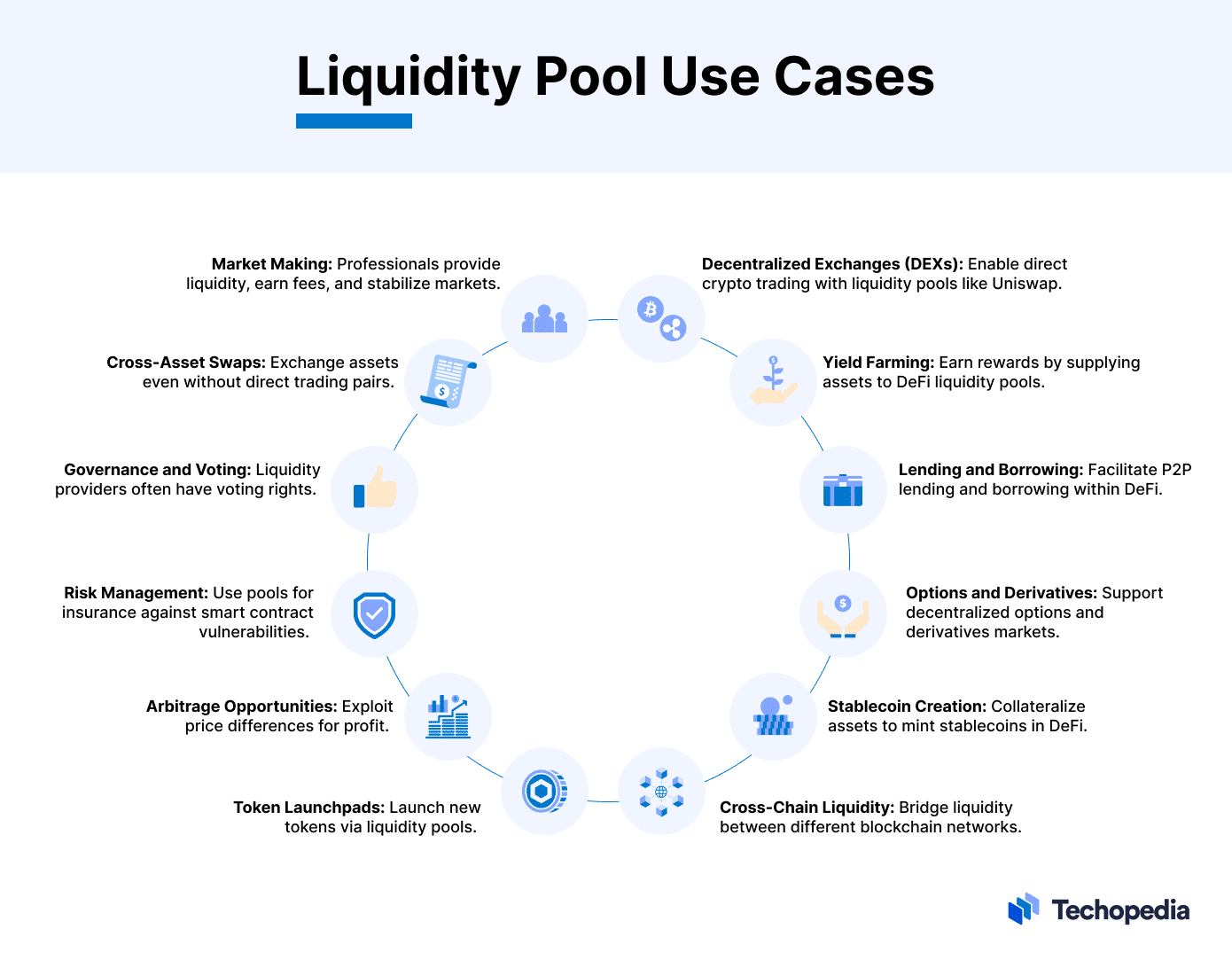
Liquidity pools play an important role in blockchain borrow-lending protocols, yield farming, on-chain insurance, and gaming protocols.
In traditional finance (TradFi), a buyer must be matched with a seller before a transaction can be completed. In contrast, DeFi platforms can automatically execute a trade against the liquidity in the platform’s pool.
This is important as it means that DeFi platforms do not need to match the expected price of a transaction to the executed price. If the executed price of the trade is higher than the expected price, the buyer simply gets fewer tokens than expected and the seller gets more tokens. This is called slip.
To offset potential losses caused by slippage, the pool charges a small fee for each transaction and splits the fee between the liquidity providers in a ratio proportional to their share of the pool.
total locked
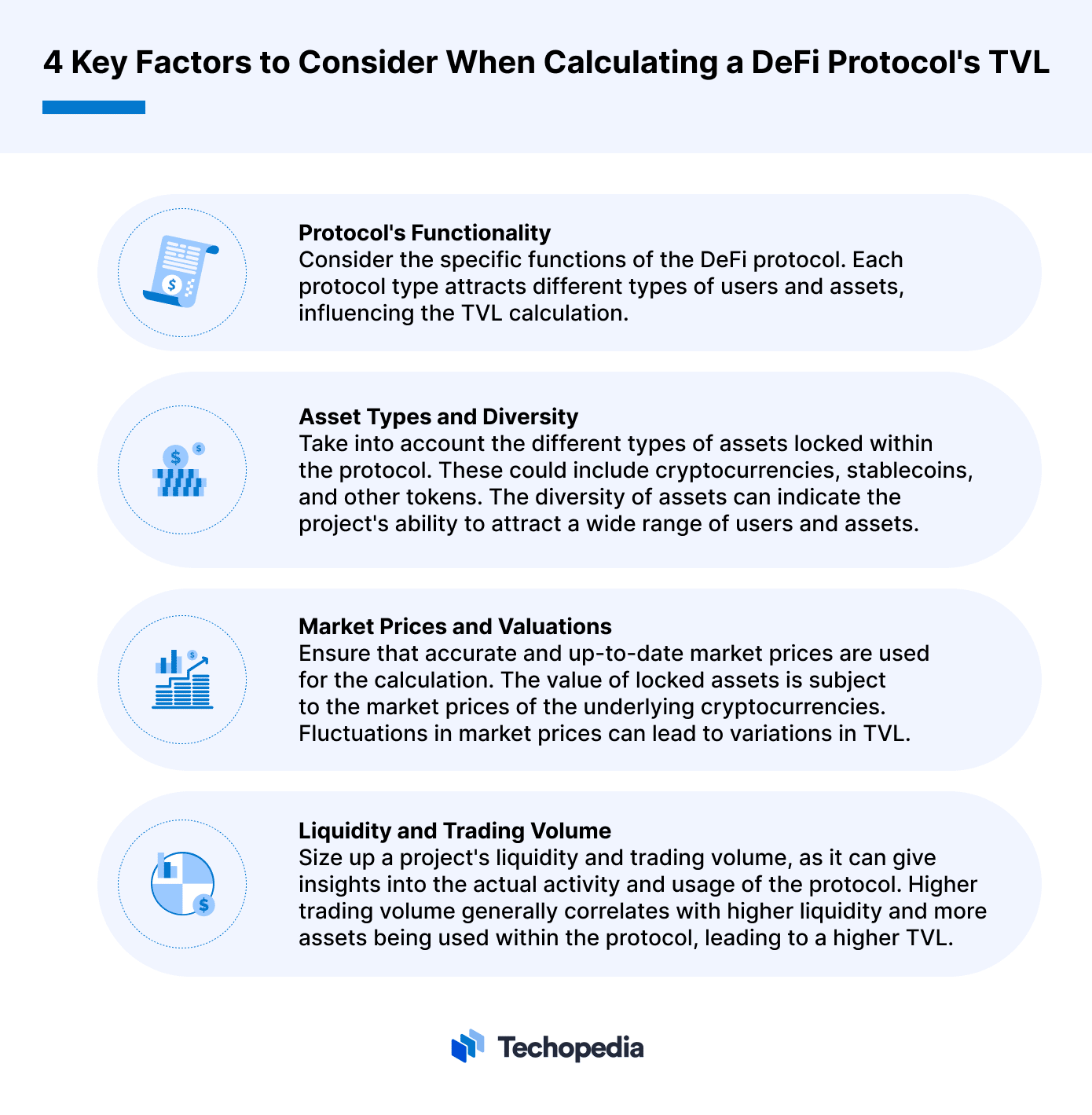
DeFi liquidity is typically expressed as Total Value Locked (TVL). TVL represents the total value of assets locked in a given DeFi platform. Typically, this includes the amount of cryptocurrency locked in smart contracts, as well as any other assets that the platform has tokenized.
TVL is an important metric for DeFi protocols as it gives investors an indication of a platform’s overall liquidity.
Higher TVL platforms are generally viewed as having greater growth potential than lower TVL platforms.
risks
Although liquid asset pools offer users the opportunity to earn an income from cryptocurrencies that would otherwise go unused, there are risks involved in using these pools to build passive income.
- Once assets are added to a liquidity pool, they are controlled by a smart contract. If a malicious actor gains access to a smart contract that controls a pool of liquidity, they can potentially steal all of the funds in the pool.
- When smart contract developers give themselves permission to change the rules for the pool, there is always a risk that the developer will manipulate the contract for their own benefit by changing the pool’s fee structure, token ratio or other key parameters .
- If the ratio of tokens in a liquidity pool becomes uneven due to significant price changes, the liquidity provider (LP) could face a permanent and temporary loss of its invested assets.
It is important for investors to be aware of the risks and take appropriate measures to protect their investments. This includes conducting due diligence before investing in a pool.
Recommended course of action
Before investing in a pool, liquidity providers should do thorough research on the platform and the pool itself.
Best practices for ensuring that a pool’s liquidity rules are fair and predictable and that the interests of liquidity providers are protected include:
- Looking for pools with a high trading volume and significant liquidity;
- Verify that the Liquid asset pool is supported by a strong developer community and has an active user base;
- verification of platform team credentials;
- Reading the team’s whitepapers and website content;
- find reviews from other users;
- Ensuring that the liquidity pool has a transparent governance structure and decision-making processes;
- Look for evidence that the pool has undergone independent security reviews.
Popular liquidity pools
Today, many decentralized platforms use liquid asset pools to trade digital assets automatically and without permission. Popular platforms that focus their activities on liquidity pools include:
Uniswap: Uniswap is a decentralized exchange that operates on the Ethereum blockchain and allows users to trade any ERC-20 token. Uniswap has multiple liquidity pools. Some of their most popular pools support ETH/USDT, ETH/DAI, and ETH/USDC exchanges.
Curve: Curve is a decentralized exchange specializing in stablecoins, offering low-slippage trading for assets of similar value. Curve has multiple liquidity pools. Some of their most popular pools support BTC/renBTC/wBTC/sBTC and USDT/USDC/DAI.
balancers: Balancer is a decentralized exchange that allows users to create custom liquidity pools of up to eight tokens. Popular balancer pools include ETH/USDC/DAI/WBTC, WBTC/renBTC/sBTC, and LINK/ETH.
SushiSwap: SushiSwap is a decentralized exchange that offers liquidity pools with high-yield farming incentives for liquidity providers. The most popular SushiSwap pools include ETH/USDC, ETH/USDT, and ETH/WBTC.
Learn Crypto Trading, Yield Farms, Income strategies and more at CrytoAnswers
https://nov.link/cryptoanswers
Comments are closed.