


Stablecoins have become an integral part of the modern crypto scene: everyone needs them, from newbie traders and holders with diamond hands to experienced DeFi fans (“Degens”) and GameFi enthusiasts. As a censorship-resistant and easy-to-use alternative to fiat money, they have already established themselves as a medium of exchange and store of value.
However, the largest stablecoins (USDT, USDT, BUSD) are not aligned with a decentralization ethos and are vulnerable to the same threats as fiat banking systems. Therefore, fully decentralized stablecoins will replace them. What have we achieved so far?
What are stablecoins?
Stablecoins are cryptocurrency assets whose prices are linked to fiat currencies or precious metals. As such, they are issued, stored and transferred on blockchains (decentralized registers) between accounts (wallets). Stablecoins are mostly pegged to the world’s major currencies: US dollar, euro, Chinese yuan and gold (XAU).
The first (and now defunct) stablecoin, BitUSD, launched on the BitShares (BTS) blockchain in 2014. Its design was suggested by IOG founder Charles Hoskinson and Daniel Larimer of Block.one. According to the statistics of the largest crypto asset tracker CoinMarketCap, there are 75 stablecoins in the crypto scene at the beginning of the second quarter of 2022.
To sue
What are centralized stablecoins?
All of the largest stablecoins are centralized: their reserves are guaranteed by this or that financial institution, e.g. B. when a company issues $1 pegged stablecoin on a blockchain, it guarantees that it is backed with $1 in value from its reserves.
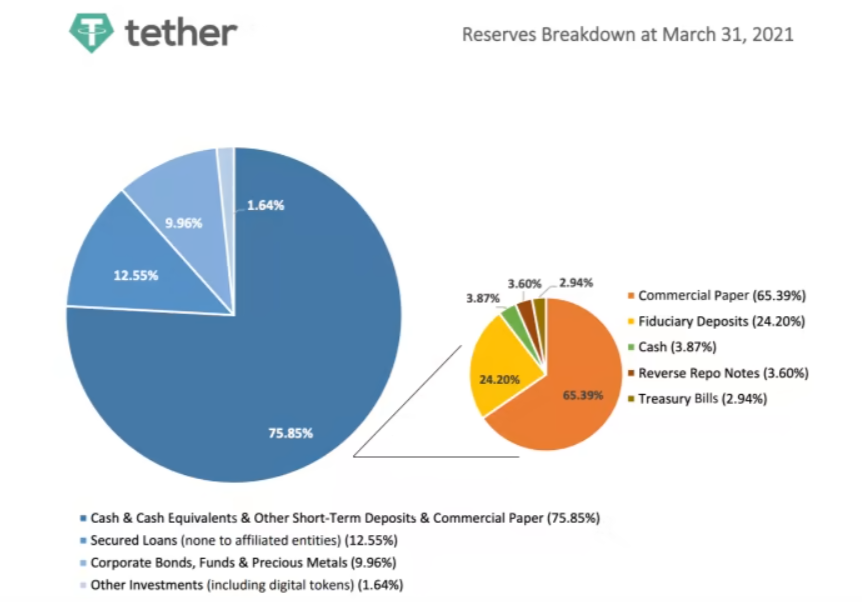 Structure of Tether reserves // Image by Tether Limited
The issuer of the stablecoin, in turn, can store its reserves in fiat money (cash), stocks, treasury bills, corporate bonds, precious metals, and so on.
The stablecoin segment is dominated by the three largest centralized stablecoins, namely USD Tether (USDT) from Tether Limited, USD Coin (USDC) from Circle Inc. and Binance USD (BUSD) from the world’s leading centralized crypto ecosystem, Binance.
 Logo of Tether, an issuer of USDT
Together, they are responsible for $151 billion of the $182 billion capitalization of the entire stablecoin segment, or 82.9%.
What are decentralized stablecoins?
Decentralized stablecoins, by definition, are not issued by centralized banking institutions. Its peg to the underlying currency is guaranteed by a hierarchy of smart contracts as well as by a reserve pool of collateral.
Decentralized stablecoins implemented sophisticated strategies to ensure the sustainability of their balance. The Elastic Supply and Collateralized Debt Position (CDP) strategies are the two most popular in this space.
“Elastic supply” stablecoins like Nu will be supported with an increased APY if held when the price falls below $1. Their monetary design reduces supply when interest in the token increases, restricting supply.
In collateral-based systems, users can get a certain amount of stablecoins by locking the collateral in smart contracts. Some stablecoin ecosystems are over-collateralised while others are under-collateralised: this depends on the credit/collateral ratio.
Pros and cons of decentralized stablecoins
Decentralized stablecoins are far more censorship-resistant: for example, Tether and Circle can “freeze” USDT and USDC in geo-restricted jurisdictions or at the request of a government agency.
Also, mainstream media often publish reports about a lack of transparency in the reserve systems of large centralized stablecoins. We do not know whether they actually have sufficient wealth reserves. The binding of decentralized stablecoins is guaranteed by algorithms, so they cannot be controlled by teams or third parties.
At the same time, during periods of extreme market volatility or as a result of FUD, the prices of decentralized stablecoins can become unpegged: their algorithms simply cannot cope with a surge or collapse in demand.
For example, on Black Thursday in Crypto, the DAI fell to $0.89 in 2020 while the Neutrino Dollar (USDN) fluctuated below $0.69 and $1.20 in the recent clash between Waves and Alameda Research.
The Best Decentralized Stablecoins in 2022
To address the most dangerous shortcomings of centralized stablecoins, leading DeFi teams have proposed their unique designs for decentralized USD-pegged assets.
Dai (DAI)
Surname: Dai (DAI)
Blockchain: ether
Team: Manufacturer
Market Cap: $6.4 billion
Dai (DAI) is a pioneering decentralized stablecoin from Ethereum veteran Maker. Its design accepts MKR crypto as collateral. The average maker loan is overcollateralized with a collateral-to-debt ratio of 150%.
DAI has long been the dominant stablecoin of the Ethereum-based DeFi ecosystem.
Magic Internet Money (MIM)
Surname: Magic Internet Money (MIM)
Blockchain: Ethereum, Avalanche, Arbitrum, BNB Chain, Polygon
Team: Abracadabra Money
Market Cap: $223 million
Magic Internet Money (MIM) is developed and maintained by the Abracadabra Money team. It can be obtained by collateralizing vYFI, yvUSDT, yvUSDC, xSUSHI and other interest-bearing assets.
Among all decentralized stablecoins, MIM offers the widest range of blockchains for its operation.
Frax (FRAX)
Surname: Frax (FRAX)
Blockchain: ether
team: Frax Finance
Market Cap: $1.5 billion
Frax (FRAX) advertises itself as the world’s first fractional-algorithmic stablecoin: it is backed partly by collateral and partly by algorithms. FXS is used as the main security value for the FRAX ecosystem. At press time, the lion’s share of its reserves are backed by Liquidity on Curve (CRV).
USD (USD)
Surname: USD (USD)
Blockchain: Tron
team: TronDAO
Market Cap: $724 million
Tron’s ecosystem’s USDD is a DAO-managed overcollateralized stablecoin pegged to the US dollar. HE Justin Sun, a founder of Tron (TRX) and CEO of Bittorrent (BTT), introduced USDD in April 2022. Tron DAO drew liquidity into the USDD ecosystem with a staggering 30-40% APY on Tron’s DeFis for USDD-based pairs.
Disappointing decentralized stablecoins of 2022
Typically, managing a decentralized stablecoin (its 1:1 pegging to the underlying asset, the health of the collateral portfolio, the balance between supply and demand, etc.) is not an easy task. Because of this, these assets can easily collapse during periods of heightened volatility.
TerraUSD (UST)
Surname: TerraUSD (UST)
Blockchain: Terra
team: Terraform Labs
collapsed: May 2022; Anchor Protocol (ANC) imbalance caused by unsustainable APYs on UST-based yield farming.
FEI (FEI)
Surname: FEI (FEI)
Blockchain: ether
team: Free Labs
shut down: Aug 2022; Rari protocol hacking, regulatory scrutiny, irrelevant product design.
bottom line
Decentralized stablecoins should be viewed as a type of stablecoin whose peg to the underlying asset is guaranteed either by an algorithm or by collateral structures. This area is growing rapidly; Although there are some stability issues, it remains the most transparent and DeFi-native type of stablecoin.
Learn Crypto Trading, Yield Farms, Income strategies and more at CrytoAnswers
https://nov.link/cryptoanswers
Comments are closed.