


Emerging markets are pushing Tron to become the top blockchain for USDT and other fiat-backed stablecoin transfers.
Matias’ online store, which he runs in Buenos Aires, is an example of crypto entering the mainstream. Most buyers on Ditel use stablecoins to purchase electronic devices.
But they don’t use the blockchain that most crypto insiders would probably suspect (or hope). Argentinians do not pay for iPhones via the Bitcoin network. They don’t use Ethereum either.
You pay with Tron.
Matias, who requested that The Defiant use only his first name to protect his privacy, estimated that about 95% of his customers chose USDT as a payment method on Tron. The store owner said he believes Tron’s low fees and fast transactions have contributed to the network’s popularity.
Not just Argentina
This Argentinian shop reflects a broader trend that shows emerging markets are gravitating towards Tron.
Global searches on Google for “USDT Tron” have increased during the bear market, with the most interest coming from Nigeria, Ivory Coast and Pakistan, in that order.
 Worldwide searches on Google for “USDT Tron”
Conversely, searches for “USDT Ethereum,” where the stablecoin is also the largest dollar-pegged asset, have been declining since early 2022. At this point, it is a mystery which blockchain is being searched with “USDT,” even though Ethereum’s market cap dwarfs Tron’s by a multiple of over 26.
 Search for “USDT Ethereum” (red) vs. “USDT Tron” (blue)
The activity in emerging markets puts Tron at the forefront of stablecoin activity.
DeFi AlphaPremium contentLooking for Alpha? Become a premium member of The Defiant and join our DeFi Alpha community.
- DeFi Daily | weekdays
- DeFi Alpha Letter | Weekly
- Defiant Podcast Transcript | Weekly
- Inbox dump | Saturday
- Weekly Summary | Sunday
Start for free
A recent stablecoin article from a major hedge fund caused quite a stir thanks to a chart that showed the Tron blockchain as the clear frontrunner for fiat-backed stablecoin transactions.
The paper, written by employees of Brevan Howard, a hedge fund with $23.4 billion in assets under management and a burgeoning interest in cryptocurrencies, showed that Tron has over 2.4 million weekly active addresses interacting with stablecoins.
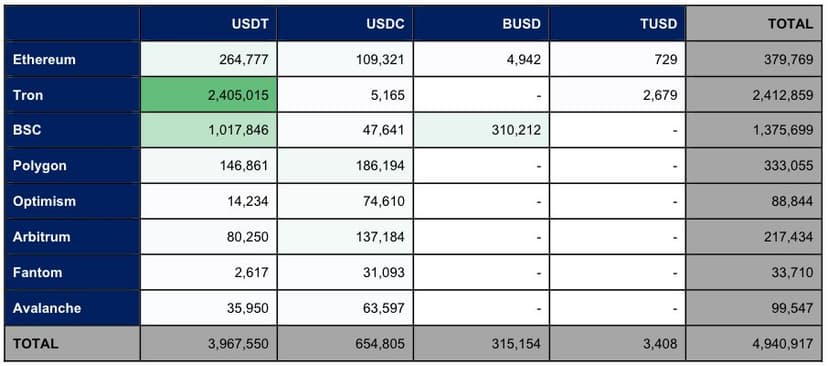 Stablecoin activity by chain
The number surpassed those of Ethereum as well as Ethereum-based Layer 2s such as Optimism and Arbitrum.
Payment network
Key signs point to Tron being used extensively as a network for easy remittance payments.
Data from Allium, a data provider that worked with the Brevan Howard team to develop the stablecoin report, showed that the average USDT transaction on Tron has fluctuated between $100 and $300 over the past three years. USDT is the largest stablecoin in the crypto space with a market cap of $84.2 billion.
There was also an even distribution of amounts above and below this range, suggesting that a fairly wide range of parties are using Tron to send USDT. In contrast, Allium’s data showed that stablecoin volume on Ethereum consisted primarily of large transactions valued at over $100,000.
Cheaper transactions
Tron has a decisive advantage over Ethereum: it is cheaper to use. According to Etherscan, sending USDT to Ethereum costs around $3.50 at the time of writing.
Data on transaction fees on Tron is not readily available, but based on The Defiant’s own test transaction across the network, sending USDT cost around 13.7 TRX. TRX is Tron’s native token. At current prices of $0.095, this means the transfer will cost around $1.30.
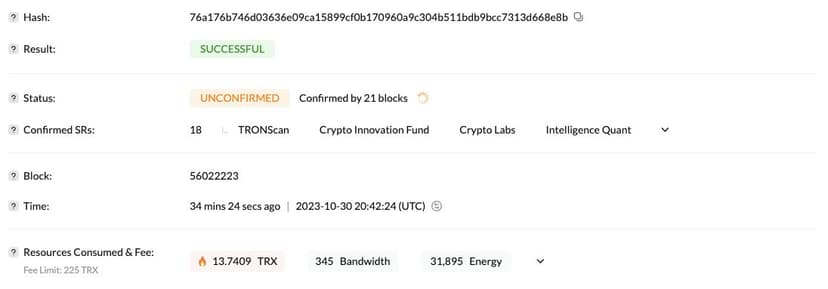 A successful Tron transaction
Matias said he believes Tron’s low fees and fast transactions have contributed to the network’s popularity.
Diego Diaz, who works in payments at an Argentine bank, agreed.
“The Tron network is popular because it is fast and affordable,” he said. “It is also commonly used in markets that are not regulated by the government.”
Diaz added that every fintech company in Argentina that uses cryptocurrencies offers USDT on Tron. Regarding Layer 2, which is touted as a cheaper way to transact while maintaining the security of Ethereum, Diaz said the solutions are less well known
In terms of price, Tron doesn’t beat Layer 2 – USDT transfers to leading solutions like Arbitrum and Optimism were about an order of magnitude cheaper than Tron at $0.11.
Why stablecoins
Transferring stablecoins over cheap and fast networks is one of the most popular use cases in emerging markets, where users often struggle with local currency devaluation and capital controls.
Fernando Volpe, who runs a peer-to-peer exchange called Calypso and is also Argentinian, said Argentina’s strict controls on official dollar purchases have driven people to turn to cryptocurrencies. The South American country has different exchange rates depending on how the dollars are used, and there are limits on how much foreign currency individuals can purchase.
Stablecoins also help people avoid the Argentine peso, a currency that has suffered over 100% year-on-year inflation for most of 2023. “As the peso continues to devalue, people are finding refuge in stablecoins and the dollar,” Volpe said.
Diaz said that many people pay their salaries in USDT to avoid inflation and then convert the stablecoin into pesos for daily expenses. The platforms on which people receive their salaries also contribute to privacy, Diaz said. The bank official declined to name specific companies because he has a business relationship with them, he said.
“These platforms offer them a way to protect their cryptocurrencies from government control and easily save money,” Diaz added.
Everyone else uses it
Using stablecoins helps people avoid capital controls and inflation. And since they are concerned about preserving their savings and not yield farming or selling NFTs, they choose the option with the cheapest fees and highest volume.
Matias, who runs the e-commerce store, says he uses USDT on Tron because everyone else uses it and he wants to accept currencies that people own.
Volpe’s peer-to-peer exchange runs on messaging Telegram and facilitates trading between pesos and dollar-pegged stablecoins. He says he facilitates selling USDT on Tron every day.
Lack of decentralization
Certainly Tron does not have a reputation for upholding the value of cryptocurrency decentralization. The blockchain is based on a system of “super representatives,” 27 parties that must be elected to validate transactions. This is in contrast to Ethereum’s proof-of-stake system, which has almost a million validators, according to Beaconscan.
Tron founder Justin Sun has also repeatedly caused controversy – the white paper describing Tron’s design was accused of plagiarism by leading figures in the crypto space such as Vitalik Buterin.
Sun controversially canceled a charity dinner with Warren Buffet before finally rescheduling the date six months later. And in March, the Securities and Exchange Commission accused Sun of selling unregistered securities and paying celebrities for secret endorsements.
When discussing Tron’s reputation, Volpe hinted that people had other priorities.
“When they see that the network is working for them, they don’t pay attention to security,” he said.
Regardless, Tron’s success as a stablecoin transfer network is an important development for the crypto space, whose proponents have often emphasized the technology’s ability to “transfer the unbanked.”
It looks like the success of this mission is thanks to an unlikely competitor in Tron.
Learn Crypto Trading, Yield Farms, Income strategies and more at CrytoAnswers
https://nov.link/cryptoanswers
Comments are closed.