


Trader Joe, the largest decentralized exchange (DEX) on the Avalanche network with a Total Value Locked (TVL) of 191 million, launched its v2 iteration today.
The Joe v2 protocol introduces a “liquidity book” design to improve capital efficiency through concentrated liquidity, as well as a variable fee that adjusts based on market volatility to offset risks for liquidity providers.
“Concentrated liquidity allows liquidity providers to earn more fees with significantly less liquidity,” Trader Joe told The Defiant. “Instead of a pool of unbound price ranges, Liquidity Book has multiple separate bins with different prices that can be used as building blocks for a liquidity position.”
Trader Joe's has facilitated over $88 billion in transactions since launching its v1 iteration in July 2021, while also generating $265 million in revenue for liquidity providers and token holders. However, Trader Joe notes that its v1 design is hampered by capital inefficiency and divergent loss risks (also known as impermanent losses) for liquidity providers.
AMM model
Market leader Uniswap popularized the automated market maker DEX model and its v2 platform was the first decentralized exchange to attract ten-digit liquidity in the heady days of DeFi summer 2020. Simple AMMs allow users to trade against passive asset pools consisting of two assets provided by liquidity providers, with LPs earning fees for each trade.
But Uniswap faced increasing competition from rivals exploiting the protocol's General Use License to leverage the same AMM design throughout 2020 and early 2021. SushiSwap famously gained significant market share by offering token incentives to users who migrated their assets from Uniswap in late 2020. while a variety of AMMs have been launched on low-cost Layer 1s and offer cheaper transaction fees compared to the Ethereum mainnet.
Concentrated liquidity
Uniswap responded by launching its v3 iteration in May 2021. The platform offers improved capital efficiency compared to AMMs that leverage concentrated liquidity – meaning liquidity providers could target specific price ranges at which their assets would be mobilized for trades, creating new Opportunities for advanced LP opens up strategies.
The strategy appears to have paid off for Uniswap, as its v3 platform accounts for more than $1 billion in trading value in 24 hours, or 44% of total DEX trading volume, according to CoinGecko. Curve is in second place with a market share of 8.4%, followed by Dodo with 6.3% and PancakeSwap with 6.2%.
While Trader Joe is currently ranked 22nd with $16.4 million or just 0.7% of the sector total, its team believes that the launch of Joe v2 could significantly improve the protocol's position.
Liquidity book
Joe v2's Liquidity Book design divides liquidity pools into “price bins”. While a traditional AMM aggregates all assets committed to a specific token pair into a single pool, Trader Joe aggregates different pools of bins with pairs separated by price into a larger market.
Trader Joe claims that the design minimizes traders' slippage, meaning they get better prices when trading, and also enables advanced and novel strategies for liquidity providers. Trader Joe's describes its pricing tiers as a “discretized concentrated liquidity” mechanism, invoking a term introduced by Izumi Finance's iZiSwap AMM design.
While most AMMs host liquidity pools consisting of two separate assets, with Joe v2 only the bin corresponding to the current market price includes both assets in a pair.
A single asset is deployed to bins above the current price, while the second asset is deployed to bins below the market price. Once a particular bin is exhausted – meaning that the entire asset has been removed from the pool by traders and only a single asset remains in the bin – the exchange shifts trading to the next bin, also adjusting the price of the asset in the process .
“Concentrated liquidity already offers huge improvements over the traditional AMM model because it is very capital efficient,” said Trader Joe. “Because users can choose at what prices they want to provide liquidity, far fewer tokens remain idle and contribute nothing to swaps.”
Increased temporary loss
However, the team told The Defiant that liquidity providers should ensure they understand the risks associated with using concentrated liquidity-based strategies and may consider hedging through other products such as derivatives.
“There is additional divergence risk (also known as temporary loss) if positions are not well managed to remain in market range,” the team said. “For less sophisticated users, we also plan to offer an automated vault that will help users manage their liquidity positions automatically.”
The liquidity book design means that Joe v2 does not rely on external oracles like Chainlink for its prices. The Trader Joe team told The Defiant that fair market value is maintained by arbitrageurs who will intervene to exploit price differences between assets traded on Joe v2 and other exchanges.
Volatility accumulator
Joe v2 also introduces an internal “volatility accumulator” mechanism designed to measure market volatility and inform the platform’s variable fee without using external data feeds.
Liquidity providers earn higher fees during times of increased volatility and lower fees during calm markets.
The volatility accumulator measures how many bins a trade is executed over and how much time has passed since the last exchange of a particular asset pairing.
Variable fees
Swap fees are split into a base fee and a variable fee, with the variable fee theoretically capped at a maximum of 10%. However, Trader Joe told The Defiant that the variable fees will not reach the maximum threshold due to a cap on the volatility accumulator caps.
Trader Joe said that the variable fee feature is aimed at mitigating the varying losses experienced by liquidity providers during periods of significant price fluctuations. The team added that while retail users are unlikely to notice a significant change in fee prices, whales and arbitrage bots “will have to pay their fair share.”
The team emphasized that liquidity positions are represented by fungible tokens, which closely resemble the ERC-20 token standard, unlike the non-fungible LP tokens issued to Uniswap v3 liquidity providers. This enables composability and product integrations with third-party projects.
Limit orders
Trader Joe also told The Defiant that he plans to introduce limit order functionality to Joe v2 in the near future.
Transactions executed on Trader Joe's will be routed between platforms v1 and v2 to provide traders with the best prices available moving forward.
Trader Joe's isn't the only DEX throwing its hat into the concentrated liquidity ring: Orca offered its own solution on Solana in March and QuickSwap partnered with Algebra on Polygon last month.
According to DeFi Llama, Trader Joe's is currently the 15th DEX with a total value of $190.7 million. Its JOE token is currently trading at $0.27 and has a market cap of $86 million.
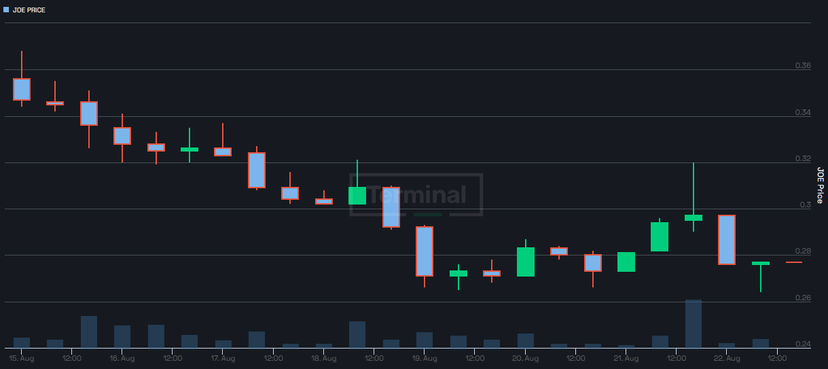
JOE price. Source: The Defiant Terminal
Learn Crypto Trading, Yield Farms, Income strategies and more at CrytoAnswers
https://nov.link/cryptoanswers
Comments are closed.