


Summary: Stablecoins have become the foundation for much of the crypto economy thanks to their low volatility and investor confidence. By using DeFi protocols, it is possible not only to hold these stable digital assets, but also to use them to generate income, or yield. Investors could do this by providing liquidity to the crypto markets or collecting interest when lending their stablecoins. Here you can find them Top Stablecoin Yield Farming Strategies for crypto investors.
What is stablecoin yield farming?
stablecoins are digital assets tied to real-world assets such as fiat currencies, bonds, or gold.
yield farming is a method to earn rewards for your crypto by using it in DeFi applications.
The combination of the two Stablecoin yield farming stakes your stablecoins in DeFi protocols to earn interest on them.
Stablecoin yield farming typically offers higher returns than traditional financial services (e.g., earning interest on a traditional savings account or CD).
While traditional interest-bearing products give you more security in the form of bank insurance and FDIC protection, stablecoin yield farming can give you more returns. (Higher risk often translates into higher rewards.)

On the other hand, stablecoins can be a way to reduce risk by using other crypto assets to generate income.
For example, let’s say Robin deposits wETH into a lending protocol like Aave in hopes of earning interest on her holdings. However, due to the volatility of the asset, the price of ETH falls, causing Robin to suffer a loss.
If Robin uses a stable asset like USDC or USDT instead, they remain unaffected by crypto’s volatility storms, and so the value of their assets remains safe.
While stablecoins are generally considered safer alternatives to other digital assets, they are not entirely risk-free. With this in mind, the two popular ways to generate income from stablecoins are as follows:
- Providing liquidity for DEXs: Help create a market by pooling your wealth with other investors to facilitate trading for a share of trading fees.
- Lending Assets on Lending Records: Assistance in facilitating credit for borrowers, receiving a share of the interest on the loan.
These strategies can be enhanced by various protocols that can offer users even more yields.
The Best Stablecoin Yield Farming Strategies
Strategy #1: Providing liquidity
Below are some of the most popular protocols and platforms that can be used to provide market liquidity while still earning a return in the form of a share of trading fees.
![curve financing]() Curve
Curve
 Curve
CurveCurve is a popular DEX that takes a different approach than your typical Automated Market Maker (AMM). The protocol is primarily designed for exchanges between tokens with identical pegs, such as stablecoins. This means low fees, low slippage and less risk of temporary loss.
Curve’s swap fees are fixed at 0.04%, and every time someone makes a trade, that fee is split between the liquidity providers.
Traders can become liquidity providers by depositing their tokens in pools to receive LP tokens that can be staked to receive the protocol’s CRV tokens. This is the main incentive for a liquidity provider as they have the opportunity to increase the rewards for their provided liquidity by 2.5x by voice locking CRV to get veCRV which boosts CRV earnings and additional offers voting rights.
![apy.finance]() APY.Finance
APY.Finance
 APY.Finance
At its core, APY.Finance automates the process of yield farming. It creates a bridge between you and complex farming strategies by providing a single interface for depositing your funds. After adding to the liquidity pool, the protocol will present you with LP tokens representing your pool share. In the background, APY.Finance routes your funds across multiple DeFi platforms.
As of this writing, APY.Finance allows DAI, USDC and USDT deposits and offers APY up to 1.8%. The protocol also allows you to increase your rewards by up to 2.5x by locking the governance token APY for a set period of time.
![mstable]() mStable
mStable
 mStable
mStable is a protocol designed to unify and strengthen stablecoins. It tries to achieve this by creating a basket of assets that accept USDC, DAI, USDT, and TUSD stablecoins. These stablecoins are individually referred to as “Basset”, and whenever a Basset is deposited into mStable, the protocol mints mUSD tokens. Their argument is that mUSD is much safer than other stablecoins since it is backed by multiple stablecoins.
In addition to providing liquidity to earn a share of trading fees, the protocol has a product called Save that allows you to deposit mUSD tokens and earn returns on the underlying assets through protocols like Compound and Aave.
![ellipse]() Ellipse.Finance
Ellipse.Finance
 Ellipse.Finance
Ellipsis Finance is a hard fork of Curve, so it is similarly facilitating stablecoin swaps with low slippage and low fees. The protocol allows you to deposit assets into liquidity pools to earn a share of the 0.04% fee on trades via LP tokens. These tokens can be used for the protocol’s native token EPX, which can be further locked down to give liquidity providers a reward boost of up to 2.5x.
Strategy #2: Lending
While centralized lending platforms have come under fire lately, their decentralized counterparts have avoided these problems thanks to their transparency and over-collateralization of the loans they offer.
![AAVE logo]() Spirit
Spirit
 Spirit
Aave is a protocol that allows users to lend and borrow cryptocurrencies peer-to-peer. These loans are funded by lenders, but borrowers are required to post overcollateralization (i.e., more than they borrow as a down payment) to allow the protocol to liquidate the collateral when it falls below a certain quick repayment threshold.
Aave allows you to lend various assets including stablecoins like BUSD, USDC, DAI and USDP. The credit protocol has over 20 markets and offers up to 3% APY on some stablecoins.
![Connection]() Connection
Connection
 Connection
Compound is another protocol that allows you to borrow and lend crypto. If you deposit an ERC-20 token – say USDC – you will receive a corresponding amount of cUSDC tokens. These tokens are profitable because when you redeem them you get your original tokens plus the interest paid.
Currently, Compound supports stablecoins like DAI, USDC, and USDT. Additionally, the protocol’s native token, COMP, is distributed to lenders and borrowers every day.
Compound has over 15 markets and offers up to 2% APR on some stablecoins like USDC.
Which stablecoin is best for yield farming?
Circle’s USDC is currently one of the best stablecoins for yield farming. The stablecoin had a meteoric rise in 2021, mostly driven by DeFi. Many investors used the stablecoin as an alternative to USDT. In fact, just last year USDC surpassed USDT to become the largest supply stablecoin in Ethereum. This means that many investors trust USDC to meet their stablecoin yield breeding needs in Defi.
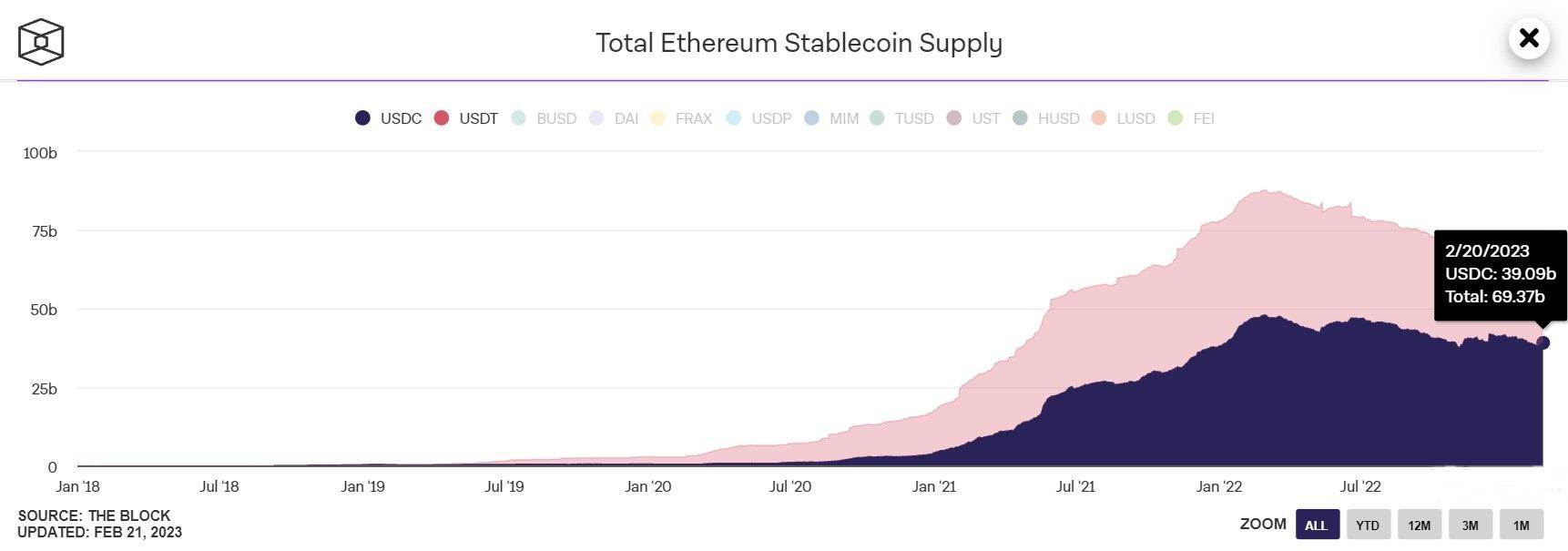 USDC (purple) is now more popular than USDT (pink). picture above The block
Circle has worked hard to build investor confidence and has issued monthly attestation reports confirming that USDC is fully backed by cash and equivalents. However, all stablecoins carry some risk, including the risk of government shutdown.
Investor Takeaway
Decentralized finance is one of the strongest use cases for stablecoins right now.
While the bear market has been tough for DeFi firms, it has forced them to focus on inciting users with “real log yield”, i.e. real projects making real money.
(This compares to the unsustainable “token issuance model” of the past, which paid out unrealistically high APY rewards to attract users.)
While stablecoins’ long-term goal is to serve as everyday currency for the average user, they have since proven to be well-suited for crypto investors looking to earn more from their holdings.
Learn Crypto Trading, Yield Farms, Income strategies and more at CrytoAnswers
https://nov.link/cryptoanswers
Comments are closed.