


2023 begins with precarious global markets. Last year the Federal Reserve hiked rates faster and higher, than at any point in recent history. And by all accounts they are not ready yet.
How much longer can they hold out before markets collapse under the strain? What other big moves should investors be watching for in 2023? And where do we think gold and silver prices will go in the coming year? We address these questions and more, but first, a look back at last year’s price calls.
Last year we said that markets are at a crossroads, awaiting a political (therefore unpredictable) decision: whether or not the Fed will hike rates as promised.
Well, they hiked.
This is what we said in the migration scenario:
“If asset prices go over the cliff like they did in 2008, gold prices will fall less. And stay down for just a moment.”
Well, asset prices fell, if not off a cliff. And they have more to fall, most likely in residential real estate.
 But what has gold done?
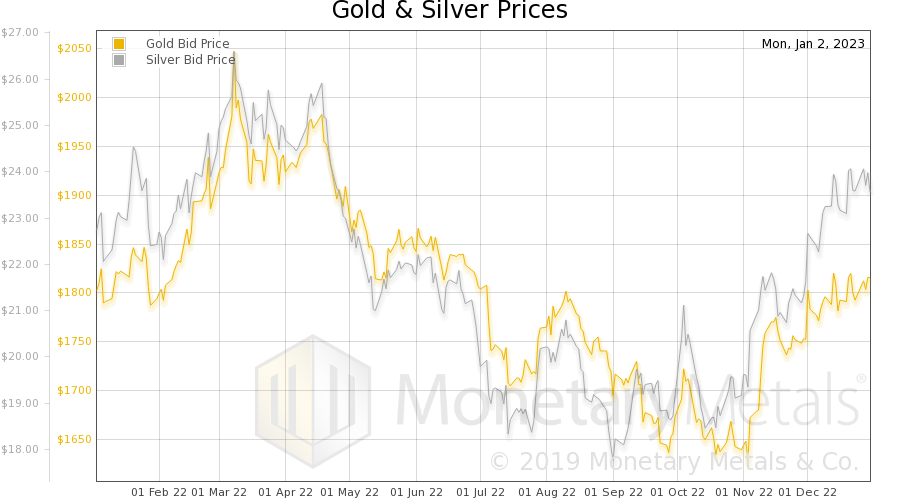
The price went from $1,803 to $1,816. That is, it has essentially not changed. At least until the end. It initially surged well above $2,000 before beginning a long decline to just above $1,600. And finally a strong rise back to equalization.
The gold price in dollars is just a reflection of the reality that the dollar has a value in gold (and when this value goes to zerothe dollar is done, like a steak kept under the grill for three hours).
In other words, the dollar spun wildly but held its value (because there are so many debtors who owe so many dollars, who are desperately bidding on dollars to service their debt). The other currencies fared worse.
Anyway, back to our prediction a year ago. The price of gold held. Gold isn’t just disloved by the mainstream, or even much of the alternative asset community. But we’ve had a year desperately looking for dollar liquidity. And yet something extraordinary happened.
The sale of gold by people desperate for cash to avoid defaulting on declining liquidity contrasted with the buying by people seeking refuge from declining credit quality.
We didn’t have the epic bull run that many in the gold community predicted. Also no crash. We had some volatility but the price of gold held up in the end.
Regarding silver we said:
“If the crisis metastasizes, there could be a major drop in silver prices. And a big jump in the gold to silver ratio. 120 is out of the question.”
Well, the crisis has not metastasized. So far, the Fed has managed at least one so-called “soft landing” that has caused bond prices, and thus other asset prices, to fall without a 2008-style crisis.
And the price of silver not only held up, but rose about a dollar an ounce.
We also said two interesting and controversial things. First, many people see gold as a hedge against inflation – rising consumer prices.
“It’s not necessarily true that the dollar price of gold is keeping pace with consumer prices.”
As we’ve written (here, here, and here), there are many non-monetary forces driving prices higher. To name a few: regulations, lockdown and whiplash, green energy restrictions, trade war and tariffs, and war in Ukraine. These do not necessarily involve gold.
And there is empirical evidence for this. At the time of writing, the CPI for December has not yet been released, but prices have risen by over 7% since November (we do not expect December to change that much). If gold had risen 7%, it would have ended the year around $1,930.
Our second comment was:
“There is no direct correlation between the interest rate and the price of gold.”
This is a link to a previous forecast report showing the fact that gold prices rose with interest rates through the 1980s, then plummeted during the falling interest rates of the 1980’s and 1990’s, then skyrocketed during the falling interest rates of the 2000’s and then fell at the falling rates of the 2010s.
Some gold perma bulls want to convince you that rising interest rates are good for gold, and of course perma bears portray this as bad for gold. And both are wrong. There are hardly any correlations over the long term.
And yes, we also looked at the so-called real interest rates. Ironically, the actual interest rate at which actual lenders actually lend to actual borrowers is lightly dismissed as the nominal interest rate. And a theoretically calculated interest rate – based on a consumer price index that even proponents dispute – is called a real interest rate. Economics is a damn science! In what other area would such a methodology be used? Even the so-called real prices do not correlate with the price of gold.
Each year we discuss macroeconomic conditions and how they are likely to affect global markets and what conditions, if any, will drive precious metals prices.
Last year we started our economic evaluation with this gem:
“One of the fundamental fallacies of socialism is that it does not allow the production to be conditional. In order for you to be able to buy goods or get paid for a job, many things must first happen. An inventor must invent the product. An entrepreneur needs to start a business. Then the company has to raise capital from investors and later from lenders. It needs to hire people (maybe you). It must produce the goods. Then hand them out. And finally sell the goods to you.”
How is an entrepreneur supposed to organize and plan a business—let alone raise capital—when the central credit planner, also known as the central bank, is busily trying to distort the value of the monetary unit? Much less if it eagerly drives up the cost of doing business, by the rising cost of capital?
Well, the answer is often that he can’t. Now we see many startups laying off recently hired employees. Some close their doors forever. Their capital costs have skyrocketed – if they can afford any at all. Even large, established companies like Macy’s have recently announced store closures. They may be able to raise capital, or they may have cash on their balance sheet (Macy’s had over $7 billion in October). But why put it in a low-yield business like marginal retail when you could put it in T-Bills at nearly 5% risk-free and without a headache?
 In 2022, it wasn’t just central banks whose politicized decisions wrecked economic planning. For many years, Europe has banned the use of viable energy sources such as oil, coal and nuclear power. Instead, they pursue unreliable energy sources like wind and solar (solar is particularly questionable for extreme latitudes (Berlin is on the 52nd parallel).
Europe has become dependent on natural gas by default. And because of geopolitics, that natural gas came from Russia. What they can’t buy now. So energy prices shot up. And the prices of all things made from energy (if energy is even rationed to those producers – a very different politicized decision-making process by other central planners).
If you look at it this way, you can see why such price movements do not exert upward force on gold prices. The root is not monetary. It’s a group of regulators who speak the wheels of those who would produce. Goods are becoming scarcer and society is becoming impoverished in general.
The Fed has now been in a rate-hike purge for ten months, following a zero-rate binge that has lasted well over a decade. They, like their apologists and critics, believe that the result will be lower prices because less money is available.
Does it work like this? Maybe there are short term lower prices. But what about longer term? What are the economic consequences of the Fed’s rate-hike purge?
For the rest of our 2023 macroeconomic analysis, download the full forecast report
What Gold Outlook Report would be complete without a word about so-called “digital gold”?
We will not repeat our previous discussions of Bitcoin’s economic, social, and technical issues. Interested readers can Click here to visit our collection of articles over the years.
We will only mention one new thing. Keith has been saying since 2012 that nobody can borrow bitcoin. This increases the value of one’s own debt by a factor of a thousand (proponents are no doubt propagating even higher price targets). Imagine your monthly home mortgage payment goes from $1,500 to $1,500,000. you would be ruined
Then the so-called “yield farming” came onto the market. Smug Bitcoin advocates said, “See! See!” What they missed is now apparent. These programs did not derive their returns (or purported returns) from funding productive businesses. They were self-fulfilling, self-referential schemes that basically amounted to borrowing to do more To buy crypto When the price of crypto coins dropped, these schemes blew up.
A get-rich-quick mentality has permeated the crypto space. But while the retail speculators – and some prominent institutions – were betting they would get rich, they were ignoring something. The companies that were formed to exploit the demand for all things crypto shared the same ethos as well.
When a financial institution is formed for the purpose of get-rich-quick, all too often it is looks like FTX. This company had no internal systems, let alone controls. Who cares about such things when you become a billionaire overnight?
We certainly wouldn’t bet there wouldn’t be another (or more) price increase. But it’s safe to say that the gloss is different from crypto as an asset class.
It’s all over except for the crying.
Last year we had great uncertainty as to whether the Fed would keep its insane promises to raise interest rates. We got clarification on that (they did). Now we face slightly less uncertainty about when they will stop hiking and then return to zero interest rate policy and beyond.
Let’s first take a look at the current fundamentals to see if we can derive a likely direction before looking at the longer-term macro drivers.
Download the full forecast report (free) for our full analysis of gold and silver in 2023
© 2023 Monetary Metals & Co. All rights reserved.
Learn Crypto Trading, Yield Farms, Income strategies and more at CrytoAnswers
https://nov.link/cryptoanswers
Comments are closed.