


Olemedia
The Securities and Exchange Commission (SEC)’s long delay in making a formal decision on several spot Bitcoin ETF (BTC-USD) proposals, including filings from applicants such as BlackRock (BLK) and Invesco (IVZ), is disappointing news for investors who want to gain access to the flagship cryptocurrency through these proposed ETF products. For investors familiar with MicroStrategy Inc. (NASDAQ:MSTR) and its (so far) successful Bitcoin strategy, the SEC’s long delays in approving a spot Bitcoin ETF only increase the appeal of MSTR, which in my opinion is currently one of the most convenient ways to gain exposure to Bitcoin with a stock brokerage account.
Thanks to a business strategy adopted in August 2020 that has led the company to aggressively accumulate Bitcoin, MSTR is one of the largest publicly traded corporate holders of Bitcoin in the world Time with excess cash and proceeds from debt and equity raising.
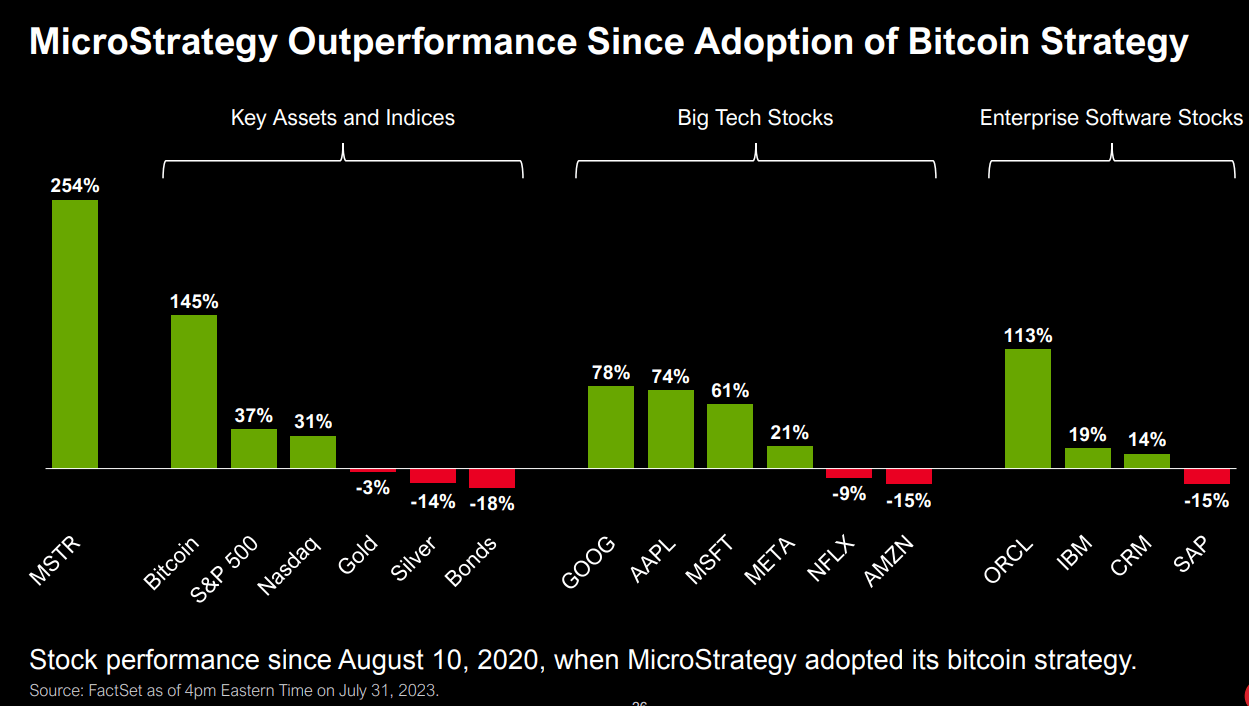
According to its Q2 2023 earnings presentation, MSTR had 152,800 acquired Bitcoins as of July 31, at a total price of $4.53 billion, or $29,672 per Bitcoin. Of the total holdings, 15,731 Bitcoins are held by parent company MicroStrategy and pledged as collateral for the company’s 2028 secured notes. The remaining 137,069 Bitcoins, around 90% of the total Bitcoin holdings, are completely unpledged and unencumbered. This buy-and-hold approach has defined MSTR’s Bitcoin strategy since its launch three years ago and explains the strong correlation between Bitcoin’s price return and MSTR’s return over this period. As the chart below shows, Bitcoin has returned 149% over the last three years, while MSTR returned 117%.

I’m looking for alpha
MSTR isn’t the only play for investors who might want to profit from Bitcoin’s price action. Stocks like Grayscale Bitcoin Trust (OTC:GBTC), Bitcoin miners like Marathon Digital Holdings (MARA) and Riot Platforms (RIOT), and crypto exchanges like Coinbase (COIN) have historically moved in tandem with Bitcoin’s price. However, unlike these stocks, MSTR has a core business whose financial performance is not affected by short-term Bitcoin price fluctuations. This is a strong competitive advantage.
A stable core business limits the downside risk
MSTR is an enterprise software company that has been providing business intelligence products and services for decades. MSTR employs around 2,000 people, including engineering teams working on its core product. It has a solid customer base that includes brands like Hilton Hotels and Sony Interactive Entertainment and generates fairly predictable annual revenues, with revenues of $499.3 million in 2022, $510.8 million in 2021, 480 .7 million in 2020 and $486.3 million in 2019. Analysts expect it to earn $500.7 million this year.
A key strategic initiative currently underway in MSTR’s core business is the transition of its business intelligence customers to the cloud. This involves a shift from generating revenue from product licenses to generating revenue from subscriptions. So far, the subscription model has proven successful with high renewal rates. “Customer renewal rates were 93% in the quarter and remained above 90% for the sixth consecutive quarter, continuing to demonstrate the resilience of our customer base even in a challenging macroeconomic environment,” noted Andrew Kang, senior executive vice president and chief financial officer Q2 earnings call.
In line with technological trends, MSTR’s core business intelligence platform also integrates with AI, particularly generative AI and deep learning. In the second quarter, MSTR expanded its relationship with Microsoft (MSFT), announcing a multi-year partnership that integrates MSTR’s analytics capabilities with the Azure OpenAI service and Microsoft 365. The partnership also makes MSTR’s products and services available on the Azure Marketplace.
MSTR is also pursuing new innovations through MicroStrategy Lightning, which aims to leverage the Bitcoin network to enable new e-commerce use cases and address cybersecurity challenges.
While I am not convinced that these innovations and strategic initiatives will result in explosive revenue growth, I do believe they are a credible sign that MSTR’s core business is healthy and likely to continue to have stable and sufficient cash to cover operating expenses will provide. This limits the downside risk to the stock price, implying a valuation that is roughly in line with the valuation of the entire software industry. MSTR has a price-to-sales (P/S) ratio of 7.1, which is in line with the average P/S of 7.14 for the software (systems and applications) industry, according to industry data compiled by NYU Stern professor Aswath Damodaran became.
From a P/S perspective, MSTR is fairly valued at the current share price compared to other software companies. The only thing is that MSTR is not just any software company. In addition to its software business, it owns more than 137,000 unencumbered Bitcoins (and counting). This explains why the stock has outperformed a broad range of assets in recent years. Since launching its Bitcoin strategy three years ago, MSTR has outperformed not only Bitcoin itself, but also major assets and indices, including some of the leading Big Tech and enterprise software stocks.
Microstrategy
Access to low-cost capital is a huge advantage
Another important reason why MSTR is a compelling choice for investors looking to gain exposure to Bitcoin is the fact that MSTR can raise capital on attractive terms. The $2.2 billion of outstanding debt and convertible notes carry a weighted average interest rate of approximately 1.6%, according to the company. This compares to the blended weighted average interest rate of 2.1% at the end of 2022, representing a decline in annual interest expense of over $15 million.
The ability to use low-interest debt to accumulate Bitcoin is a smart move in my opinion, as the value of Bitcoin will likely exceed the cost of debt and interest payments as crypto market conditions improve over the next few quarters due to factors such as Possible improvements include ETF approvals from the SEC, the Bitcoin halving in the second quarter of 2024 and the potential for lower interest rates as inflation falls.
Issuing new shares to raise capital is another important financing opportunity for MSTR. Since the third quarter of 2021, MSTR has raised a total of $1.7 billion in gross proceeds through at-the-market (ATM) offerings, with the average price of all offerings being approximately $424 per share, according to the company’s CFO fraud. ATM revenue was primarily used to purchase additional Bitcoins.

Microstrategy
What makes MSTR’s ATM program unique is that it has a very low number of shares outstanding compared to other players in the Bitcoin space such as MARA and RIOT, who regularly use regular stock offerings for funding.
MSTR’s total shares outstanding increased from 11.3 million in 2021 to 14.1 million in the most recent quarter. In comparison, MARA’s number of shares outstanding increased from 102.7 million in 2021 to 174.2 million last quarter, while RIOT’s number rose from 117.3 million in 2021 to 185.3 million last quarter has increased. A lower share count means MSTR has more scope to raise additional equity financing in the future. Significantly, on September 24, MSTR sold a total of 403,362 of its shares for net proceeds of approximately $147.3 million, allowing it to make Bitcoin purchases for the same amount. Investors should expect more of the same as the company uses its equity to acquire more Bitcoin.
Finally, a word about the risk factors
Before we conclude, it is necessary to say a word about some of the risks associated with purchasing MSTR. The first risk I foresee is that any possible decision by MSTR to divest some or all of its Bitcoins for any reason in the future could result in a disproportionately negative reaction from investors. The company must therefore continue to raise debt and dilute investors to maintain the Bitcoin strategy. There is also no guarantee that the company will be able to continue to raise capital on attractive terms, especially if the price of Bitcoin continues to trend sideways or, worse, falls sharply, as it has in recent months. It is instructive to note that during the last crypto bear market in 2022, many crypto firms went under due to excessive leverage.
Another factor that makes MSTR a potentially risky investment is the difficulty of valuing the company. Although investors can use the P/E ratio to get an idea of the company’s valuation as a software company, this is only half the story as MSTR is also a Bitcoin holding company. Additionally, the Company’s Bitcoin holdings often result in impairment due to GAAP accounting principles, which require the Company to recognize impairment losses on a quarterly basis when the fair value of its Bitcoin holdings changes. This makes it difficult to compare annual data due to the volatility of Bitcoin’s price over a period of time. For example, MSTR recorded $24 million in Bitcoin impairment in the second quarter of 2023, compared to $918 million in the second quarter of last year. These wide fluctuations in impairment charges make comparing MSTR’s net income across different periods impractical, adding complexity to the already laborious business valuation process.
Regardless of these risks, I am optimistic about MSTR. For investors looking to gain exposure to Bitcoin, MSTR may be a better option than waiting for a spot Bitcoin ETF to come to market, as I suspect the price of Bitcoin will have already increased significantly by the time the SEC officially approved the pending ETF applications. MSTR can allow investors to lock in these potential Bitcoin price increases early. The arguments presented in this article – such as MSTR’s core business limiting the stock’s downside risk and the company’s ability to raise capital on attractive terms to buy more Bitcoin – are also compelling reasons to consider the stock over spot Bitcoin -ETF is preferable.
Learn Crypto Trading, Yield Farms, Income strategies and more at CrytoAnswers
https://nov.link/cryptoanswers
Comments are closed.