


Managing Liquidity Pools in Uniswap V3 – Cryptum’s brief introduction
Uniswap V3 – Liquidity Pool
In the spirit of curiosity and educating the public about DeFi, our Tech Lead Vitor Rezende Costa, wanted to share some insights from his experience working with LP on Uniswap V3. This journey includes a touch of economics, a pinch of strategy and lots of Uniswap V3.
Discover how worthwhile it is to swap your crypto assets on Uniswap in this article.
Comparison of our liquidity provision with other strategies
When providing liquidity, you can configure a number of parameters and apply strategies. Our adventure began by evaluating four different strategies: 1- implementation of our own approach (blue); 2 – hold 100% of WETH (green); 3 – Holding a balanced 50/50 portfolio of WETH and USDC (grey); 4 – Hold 100% of USDC. The chart below provides a comparative analysis of these strategies over a period of approximately 10 days:
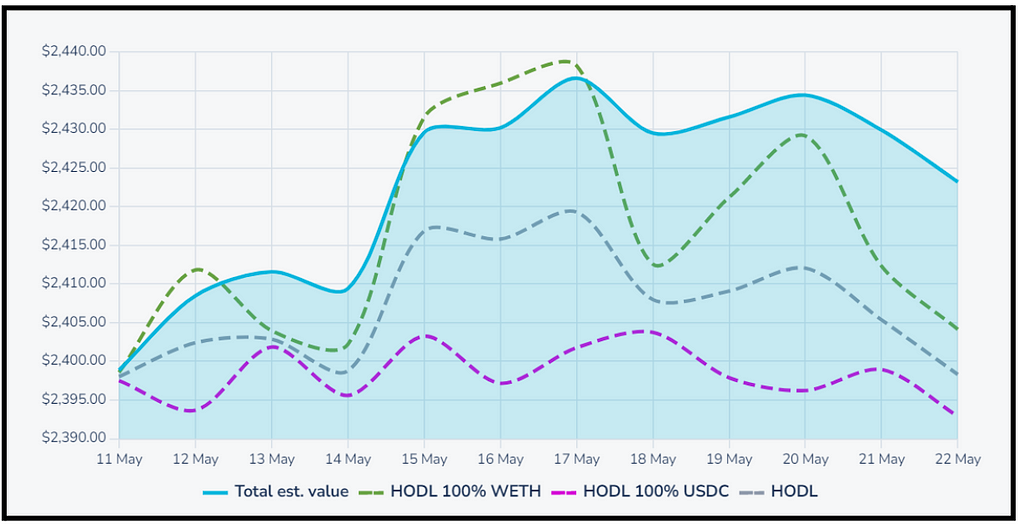
The final results after 10 days were:
1 – Our strategy: $2,422.32 (⬆️1.31%)
2 – WETH Hold: $2,404.14 (⬆️0.56%)
3 – 50/50 hold: $2,398.30 (⬆️0.32%)
4 – Hold USDC: $2,392 (⬆️0.1%)
Earnings Breakdown – Asset Appreciation vs. Liquidity Provisioning Fee
It provided $2,391.98 in initial capital and spent $0.89 on transaction fees, which means we made exactly $31.23 in profit. As expected, our approach significantly outperformed the others, and this can be clearly explained by taking a look at where the gains came from:
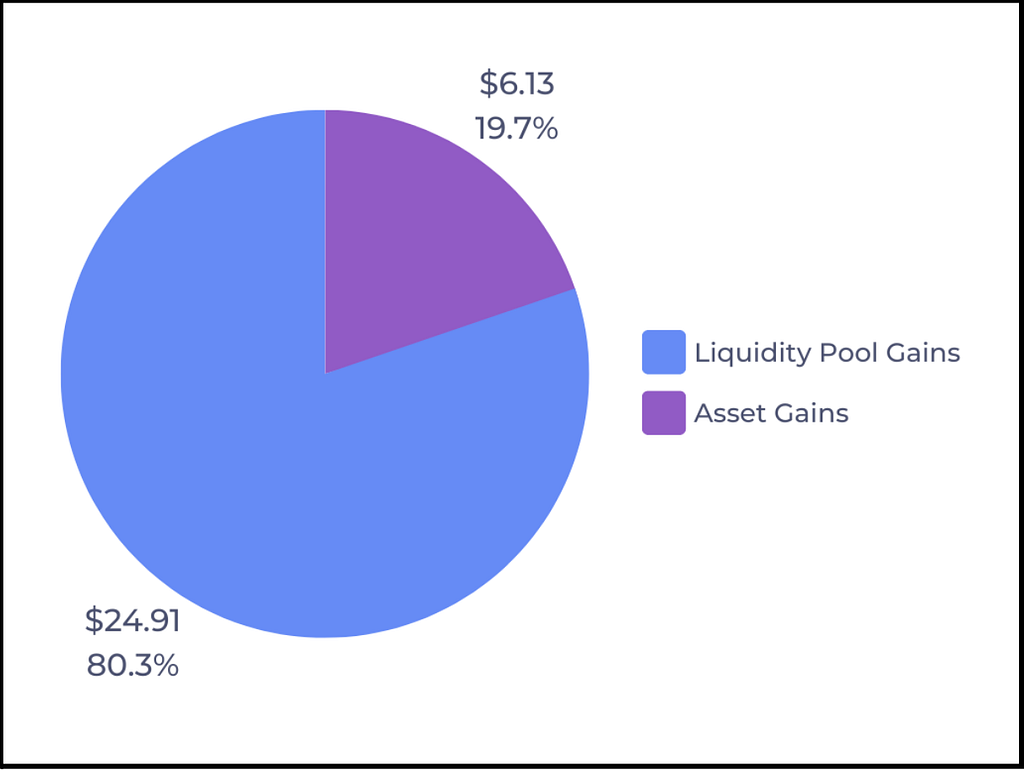
The fees incurred by providing liquidity are almost four times higher than natural asset appreciation. This serves as a reminder that while wealth growth is important, the role of liquidity provision should not be underestimated. The true core of DeFi’s profitability often lies in its multiple revenue streams.
What about the loss of impermanence?
Losing impermanence is an inherent risk in the DeFi world. However, by utilizing Uniswap V3’s concentrated liquidity feature, we have managed to significantly reduce the expiration loss.
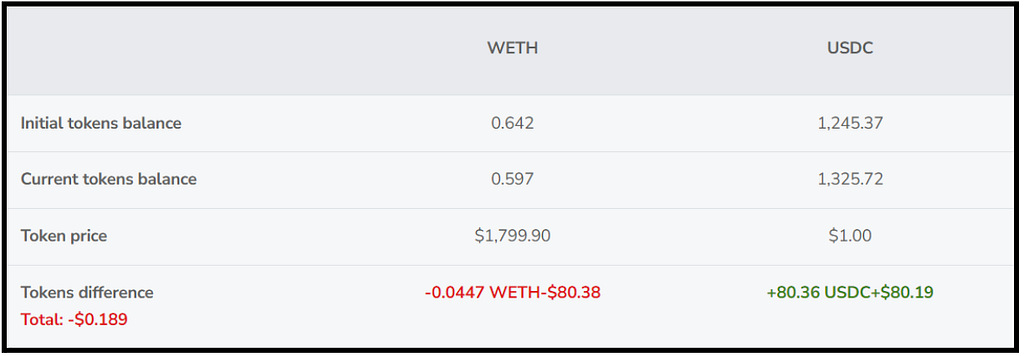
The loss of impermanence is easier to understand than you might think: if you provide liquidity, you may end up with a different token ratio than when you got in. For mathematical reasons, the initial token ratio appreciation would always have been higher than the current asset gains. The difference between this hypothetical appreciation if you maintained the original relationship and the appreciation you actually experienced is called impermanence loss.
In the image above you can see that the ratio has shifted: we “gained” more USDC than when we started and “lost” some WETH in the process. Exactly $80.38 less at WETH and $80.19 more at USDC. This difference in value is the total impermanence loss: $0.189. This concept can be scary because it is literally impossible to escape from this phenomenon, but it can be greatly mitigated – after all, we have a ⬆️1.04% profit from liquidity provision fees and a whopping ⬇️0.01 decay loss % achieved from the provision of liquidity.
Note:
This was a brief study only, not financial advice. Investing in DeFi should only be made with a thorough understanding of the protocols.
Stay connected with us on our social networks to delve deeper into the DeFi ecosystem and its applications!
Learn Crypto Trading, Yield Farms, Income strategies and more at CrytoAnswers
https://nov.link/cryptoanswers
Comments are closed.