


With the explosive popularity of decentralized finance (DeFi) in the crypto space, investors interacting with DeFi protocols have encountered a whole host of innovative financial products. A fundamental product created as a result of DeFi is liquidity pools (LPs) and their associated liquidity pool tokens (LP tokens). Liquidity pools form the backbone of many DeFi protocols, enabling token swaps, lending and lending protocols, yield farming and aggregators, on-chain liquidity insurance, and many other products.
What is a liquidity pool?
A liquidity pool is essentially a group of tokens or assets locked into a smart contract to enable decentralized token swaps, lending, borrowing and other activities, all on-chain. Each liquidity pool has a specific composition of assets (typically 2-3 specific tokens) where the amount of token A + token B = “LP AB” and liquidity providers must deposit equal shares (in market value) of each token in order to participate the pool. Liquidity pools form the backbone of decentralized exchanges (DEXes) such as Uniswap, Pancakeswap, and Raydium.
Unlike a centralized exchange, DEXs do not use an order book to create the market price. When you place a buy order on a central exchange, you choose the price at which you want to buy the asset and when that order is filled, there is a seller on the other side who has placed an order and is happy to sell you the asset has at the same price your order will be executed. Instead, automated market makers (AMMs) manage the liquidity pools in DeFi and algorithmically balance the pools to determine the price.
Example:
Let’s take a theoretical liquidity pool on Uniswap consisting of 100,000 ETH and 10,000 WBTC. This would be an ETH-WBTC Liquidity Pool (LP). This gives an initial price ratio of 1 ETH : 0.1 WBTC. Let’s assume that the price of ETH on some major exchanges like Binance and Coinbase starts falling below this ratio, down to 1 ETH : 0.09 WBTC. There is now an arbitrage opportunity between the centralized exchanges and Uniswap’s crypto liquidity pool.
ETH would be bought from the centralized exchanges and sold to the pool for an instant profit. This sale would rebalance the liquidity pool, adding ETH and removing WBTC until an equilibrium is reached between the centralized exchange price and the decentralized liquidity pool price, meaning arbitrage would no longer be profitable. In practice, this happens all the time, which is why, in general, the price of assets is very similar to prices on major exchanges.
The problem that constant rebalancing creates for crypto liquidity pools and liquidity providers is a concept called Impermanent Loss (IL). IL occurs when one of the assets in the pool appreciates in value relative to the other. In the example above where WBTC has appreciated against ETH, the liquidity providers of that pool have essentially lost some WBTC exposure as the arbitragers have removed WBTC from the pool and added ETH.
The loss is “volatile” as it can revert to the same allocation of assets if price returns in the same proportion as when the liquidity provider entered the liquidity pool. In order to compensate liquidity providers for taking IL risk, traders transacting trades through the liquidity pool must pay a trading fee allocated to liquidity providers. The more trades are made, the higher the return % for liquidity providers.
The process of providing liquidity
If you have decided to participate in this innovative new financial product and risk a temporary loss in exchange for a chance to earn trading fee income, you must go through the process of providing liquidity.
The first step is to decide which pool you want to join. This will mainly depend on what tokens you own and are willing to give liquidity pool tokens for a return. Examples of popular liquidity pools are: ETH/USDC, ETH/WBTC, ETH/DAI, etc.
The second step is to decide which platform you want to entrust your tokens to. Certain platforms are more battle-hardened than others and may have their code checked for bugs or bugs. Some liquidity pools may have incentive schemes in place to entice you to join the liquidity pool, especially if the pool is new. It is important to note that your money is only as safe as the contract you deposit it into.
Note: Brand new protocols are generally more risky than bigger, well-known and tested ones! However, there is a risk with any DeFi protocol. So think carefully before you decide to join an LP.
The third step is to provide the liquidity through your Web3 wallet like Metamask. The pool requires you to deposit fixed proportions of each token at the time of deposit, e.g. B. 1 ETH : 5000 USDC for the ETH/USDC Uniswap liquidity pool. In return, you receive a proportional amount of LP tokens allocated to this liquidity pool. These tokens represent your share of the pool.
The final step is when you want to redeem your LP token and withdraw your funds from the pool. Upon redemption, you are essentially swapping the LP token back into the liquidity pool for your stake (plus your share of the fees generated during that period). If no temporary loss has occurred, each token will give you the same amount that you deposited. If there was some IL, you may get different shares of the tokens you deposited first.
Categorization of liquidity provision on CryptoTaxCalculator
The process of providing liquidity and the resulting LP tokens and their properties are a gray area in most tax jurisdictions. It is important that you discuss these transactions fully with your personal tax adviser so that they can consider your personal situation and how these transactions may affect your tax obligations.
When you deposit your tokens into the pool, you are effectively “disposing of” the tokens (giving up control of them) and in return you receive a Liquidity Pool (LP) token with significantly different properties. From the guidelines we received, our platform categorizes this initial deposit into the liquidity pool tokens as “Add Liquidity”. Receiving the Liquidity Pool (LP) Token is categorized as a Receive LP Token. This creates a taxable event on our platform where you can realize capital gains from the “liquidity addition” of the deposited tokens as some taxing jurisdictions treat this as a capital disposal event. This can be seen in the example below, where digital assets from pxGMX and ETH have been deposited into a liquidity pool on Arbitrum’s Camelot DEX:
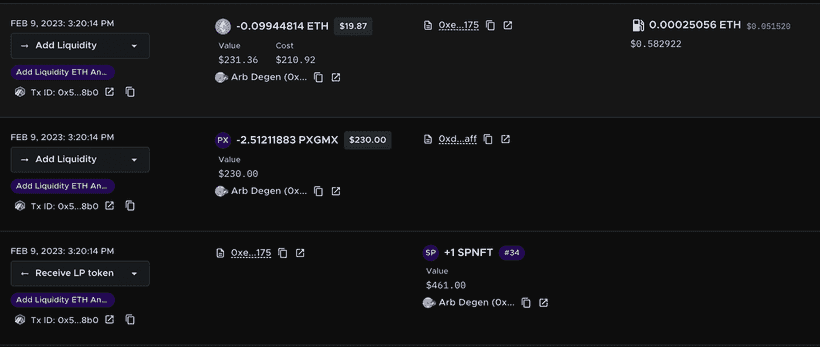
Liquidity pool CTC example 1
You can see each asset’s deposit, pxGMX and ETH, digital assets have been categorized as “Add Liquidity” and have an associated capital gain/loss. This is followed immediately by the receipt of the Camelot LP token, which is assigned a value equal to the value of the two deposited tokens. Since there is a fee for this transaction, there is a small capital loss involved on the right.
The redemption of the LP token works in the reverse process, with the LP token being categorized as “Send LP Token” and the deposited tokens (plus generated fees/return) being categorized as “Remove Liquidity”. If the value of the LP position has changed between the initial deposit and the final withdrawal, this will be classified as a chargeable event depending on your tax jurisdiction. This can be seen again in the example where pxGMX and ETH were withdrawn from the same liquidity pool on Arbitrum’s Camelot DEX:
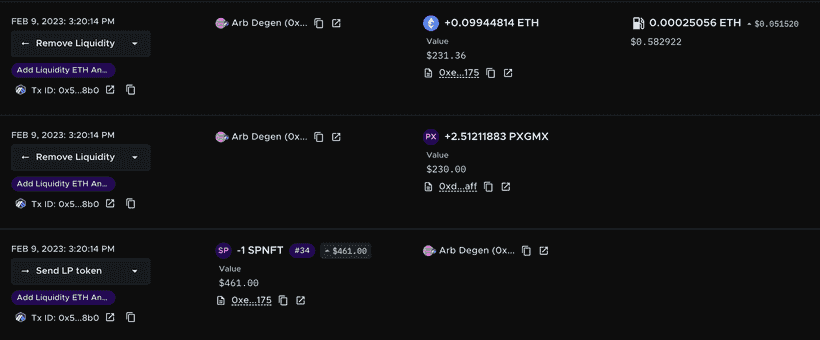
Liquidity pool CTC example 2
You can see the Camelot LP token being sent, which is assigned a value that corresponds to the value of the two stored tokens. This is then immediately followed by the payout of each crypto asset, pxGMX and ETH. The CryptoTaxCalculator platform has automatically categorized these as “Remove Liquidity” and has an associated capital gain/loss.
As mentioned earlier, crypto liquidity deposits are a gray area in most tax jurisdictions. CryptoTaxCalculator uses the method outlined above, where each step of providing liquidity is a taxable event. This ensures our users are best prepared for the future clarification of these complex transactions. If this is to be clarified in the future as a chain of taxable events (as the platform envisages), users will be properly positioned for tax purposes. If we took the position that this is not a chain of chargeable events, and future clarifications contradicted that assumption, many of our users would be affected and have unmet tax obligations.
Again, it is very important that you discuss this process of events with your tax adviser to ensure your taxable obligations are met in your particular personal circumstances.
LP token value
Because there are millions of different liquidity pools, each associated with its own unique LP token and associated with its own unique pool characteristics, it is not always possible for us to assign a market value to your LP token at this time. Each LP token changes its value each time a trade is executed in the liquidity pool or when liquidity is added or removed, and therefore the portion of the pool that the LP token represents is constantly changing.
This explains why it is currently difficult to assign a correct market value to your LP token. The LP token is assigned the value of the deposited tokens at the time of deposit and only receives a new value at the time of payout, which corresponds to the value of the tokens withdrawn at that time. This is how capital gains and losses are accounted for, but this can result in an incorrect “stock value” on the dashboard as long as you hold this LP token.
Learn Crypto Trading, Yield Farms, Income strategies and more at CrytoAnswers
https://nov.link/cryptoanswers
Comments are closed.