


Crypto liquidity pools are an essential part of the DeFi ecosystem. These pools are a collection of tokens or digital assets stored in a smart contract. Among other things, these pools help to facilitate decentralized trading and reduce the risk of a washout.

The core technology behind the current DeFi ecosystem is liquidity pools. They form a fundamental part of yield farming, lending borrow protocols, Automated Market Makers (AMM), technical resources, on-chain protection, blockchain gaming and so on.
Let’s dig deeper into the concept of crypto liquidity pools.
Understand the importance of liquidity pools
Liquidity pools are stored crypto assets to facilitate trading on major exchanges on DEX (decentralized exchanges).
- Liquidity pools are token reserves secured in smart contracts.
- They provide liquidity in the DEX and try to mitigate the problems caused by the illiquidity of such systems.
- The convergence of orders and the creation of price quotes (if reached) will determine whether the asset continues to rise or fall. They are also referred to as liquidity pools.
- The same DEX that uses crypto liquidity pools uses the AMM (Automated Market Maker) approach. Such exchange platforms function to replace traditional order books with pre-funded on-chain liquidity pools for both assets of the trading pair.
- Bancor was one of the first protocols to use liquidity pools, but the concept gained traction after Uniswap became popular.
- SushiSwap, Balancer, and Curve are among the popular Ethereum exchanges that use liquidity pools. The liquidity pools of these venues contain ERC20 tokens.
- BakerySwap, PancakeSwap and BurgerSwap are Binance Smart Chain (BSC) analogues with pools containing BEP20 tokens.
Mechanism of crypto liquidity pools
The ease with which you can convert your cryptocurrency into fiat currency or any other asset without affecting the price is known as liquidity in cryptocurrencies. This means you can instantly convert your bitcoins or other crypto assets into a reasonable cash value.
Let’s understand how this works:
- Two tokens or cryptocurrencies form a liquidity pool. For a pair of tokens, pools generate multiple markets.
- The creator of the pool determines the starting price of each asset. However, if the pool’s pricing does not match that of the global crypto market, the liquidity provider risks losing money.
- As more providers add funds to the pool, it is important to keep the tokens in line with market prices.
- The pricing algorithm is responsible for adjusting the asset price as the liquidity pool supports token swaps. The value could be calculated by each liquidity pool using its own methodology.
- Regardless of the size of the trade, the algorithm ensures that the pool is always liquid and is known as Automated Market Makers (AMMs).
- The token ratio determines the pricing of the pool. For example, if someone buys DAI from the DAI/ETH pool, ETH volume will increase, causing the price of DAI to increase and the price of ETH to decrease at the same time.
- The total price adjustment depends on how much the person has spent and how much the pool has been altered.
- Because changes require large transactions and purchases, larger pools experience less volatility.
- The transaction fees that others pay for buying and selling from the pool are paid by the liquidity providers. These transaction fees are reinvested into the liquidity pool, helping to increase the value of your tokens and expand the pool.
Around $1 million can be invested in established liquidity pools, making them relatively stable for novice crypto traders. Smaller pools are more susceptible to market fluctuations, which can cause your tokens to fall in value. Still, if you choose the right pool, you can enjoy good value retention while earning transaction fees that add to your initial investment.
Regulation of Liquidity Pools
For the mutual fund manager, a license to set up a pool is essential. Additionally, wherever the pool is actively sold or promoted to clients, regardless of jurisdiction, a mutual fund license is required.
Some cryptocurrency liquidity pools circumvent the issue by issuing governance tokens and masquerading as community property. Regulators will not be able to pursue owners in court as the entire community owns the property. However, participation in such pools carries a significant risk.
Some examples of the best liquidity pools
Liquidity pools large enough to limit risk and large changes, stocks with a long history, high daily volume and large reserves are best suited. DAI/USDC/USDT, BTC/USDT, renBTC/WBTC, renBTC/WBTC/sBTC, USDC/WETH, HBTC/WBTC, WETH/USDT are some of the best liquidity pools.
Advantages of Liquidity Pools
Liquidity pools offer their users the following advantages:
You exchange instead of trading:
- The main advantage of LPs is that you don’t have to worry about finding a partner who appreciates crypto as much as you do.
- If you’ve ever tried trading cryptocurrencies, you’ve surely come across investors who want to sell them at inflated prices or buy them at low prices. To win, you need outstanding negotiation skills and a strong character. Unfortunately, these are not available to everyone.
- Liquidity pools, on the other hand, change the value of cryptocurrencies depending on the exchange rate of the platform.
Minimal market impact:
- Transactions are much smoother now that there are no sellers asking double the market price and no buyers willing to discount below average.
- A liquidity pool is a collection of assets locked in a smart contract whose values are automatically updated based on exchange rates.
Use cases of liquidity pools
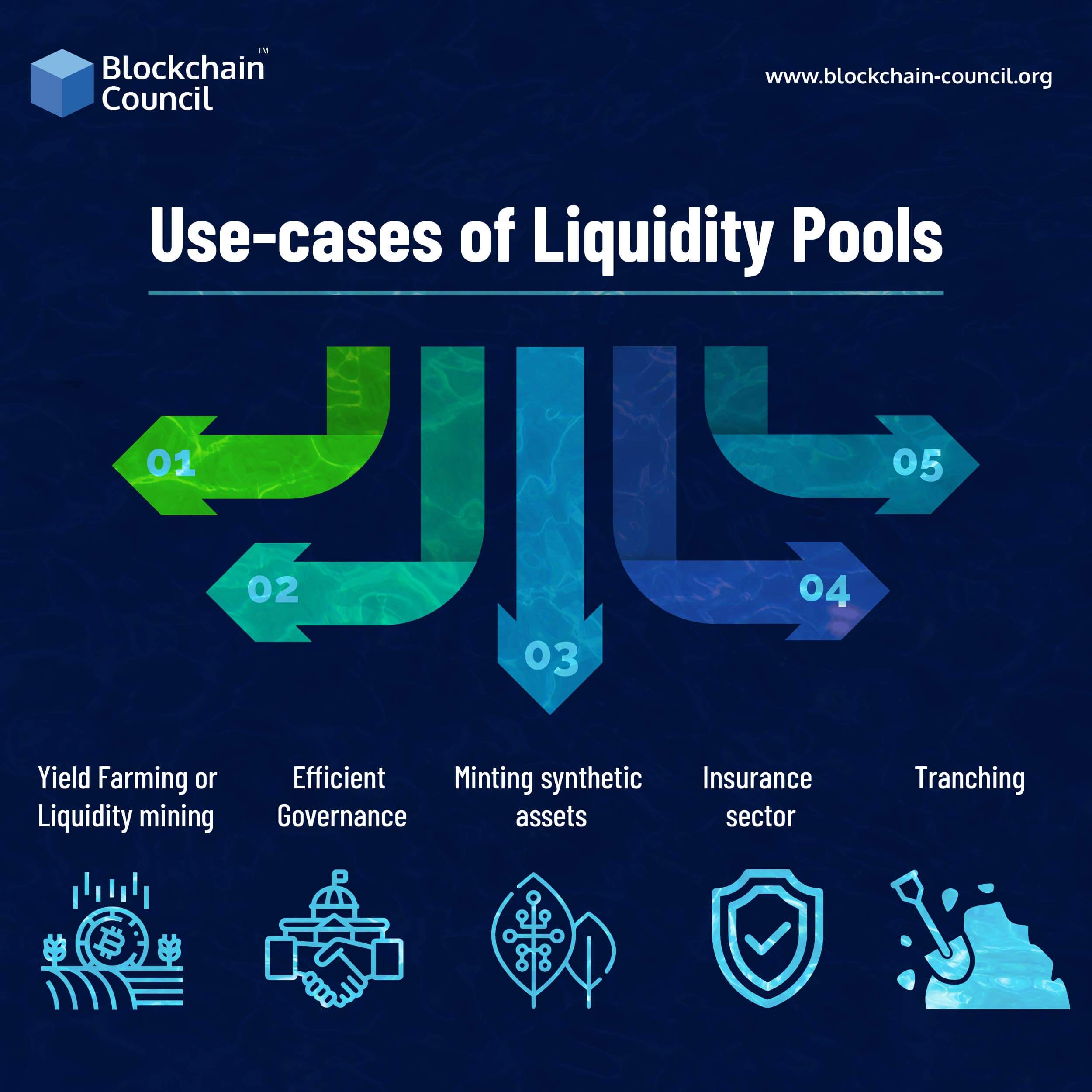
There are numerous ways to benefit from the features of liquidity pools. Some of the best use cases of liquidity pools are:
yield farming or liquidity mining
- Users contribute funds to liquidity pools which are then used to generate revenue on automated revenue generation platforms like As Yearn.
- Getting more tokens into the hands of the right people is a big problem for crypto projects. Liquidity mining has proven to be an extremely profitable strategy.
- In short: customers who deposit their tokens into a liquidity pool receive tokens according to an algorithm. After that, the newly generated tokens are assigned.
- Keep in mind that these can be pool tokens, i.e. tokens from other liquidity pools. Assuming you donate liquidity to Uniswap or lend assets to Compound, you will receive tokens covering your share of the pool. You may have an opportunity to store these tokens in another pool and earn a return. These chains can get quite complicated as protocols include pool tokens from other protocols in their offerings.
Efficient governance
Another use case that comes to mind is governance. In certain circumstances, a substantial majority of the token votes may be required to present a formal governance proposal. However, participants can unite around a common cause that they believe is critical to the protocol if resources are pooled instead.
Minting Synthetic Assets
Liquidity pools are also used in the creation of synthetic assets on the blockchain. You can create a synthetic token by placing collateral in a liquidity pool and connecting it to a trusted oracle.
insurance sector
Another potential DeFi market is risk insurance for smart contracts. Many applications in the DeFi sector are supported by liquidity pools.
tranches
Tranching is another, even more innovative use of liquidity pools. It is a traditional financial concept that categorizes financial assets based on their risks and rewards. As expected, these products allow LPs to create their own risk and return profiles.
Liquidity Pool Risks
Liquidity pools undoubtedly offer many benefits and best use cases, but they also come with some risks. Associated liquidity pool risks include:
Smart Contract Based Risks:
Ignoring smart contract-based risks could lead to unmanageable losses. When you deposit funds into a liquidity pool, you own the pool. Although there are no intermediaries to manage your assets, the contract itself could act as a custodian. Therefore, in the event of a system failure, for example, on a short-term loan, you can lose money forever.
Risk of Temporary Loss:
When you provide liquidity to an AMM, there is a risk of temporary loss. Such a loss results in a dollar loss in value compared to HODling. It can sometimes be small and sometimes large. If you plan to invest in double-sided liquidity pools, make sure you do advanced research.
access risks:
Watch out for projects where the creators have the authority to change the pool rules. Developers may have an admin key or other privileged access within the smart contract code. This could allow them to do something malicious, such as take control of the pool’s funds.
Final Thoughts
Liquidity pools are one of the significant technologies in the current DeFi technology stack. Among other things, they enable decentralized trading, lending and yield production. Smart contracts are currently driving virtually every aspect of DeFi and will most likely continue to do so in the future. To better understand DeFi and its applications, you can start learning about DeFi.
Liquidity pools are a great way to passively make money from cryptocurrencies. The first step is to choose a solid platform and the best pools to ensure a stable and secure income.
In case of forgetting, you can always seek professional advice. However, if you want expertise in this area, you can probably check out some cryptocurrency courses. You can even opt for some blockchain certification courses and become an expert in the crypto market.
Learn Crypto Trading, Yield Farms, Income strategies and more at CrytoAnswers
https://nov.link/cryptoanswers
Comments are closed.