


Liquid mining can be a big moneymaker. In fact, providing liquidity is the backbone of decentralized finance protocols, and rewards are expensive these days. But if you’re a miner yourself, it’s important to understand the tax rules before you go. Use this guide to avoid nasty tax surprises on your cash-reduction income.
What is Cryptocurrency Liquidity Mining?
Decentralized exchanges need liquidity to enable trading. Liquidity mining is a mechanism by which people provide their crypto assets to a liquidity pool on a decentralized exchange in exchange for fees and additional governance token rewards.
For example, Aaron holds 1 ETH and 2,000 USDT in his wallet. He provided his wealth as liquidity on the USDT/ETH pair on the Uniswap exchange. Uniswap charges 0.3% fees on each swap. Aaron receives this amount as fees when a user swaps assets on Uniswap’s USDT/ETH pair.
How is liquidity mining taxed?
The IRS currently treats cryptocurrencies as property. As a result, the disposition (sale, issuance or exchange) of a crypto-asset triggers a tax event. The IRS has provided general guidance on taxing crypto transactions. However, there are no specific guidance on taxing decentralized finance (DeFi) transactions, including liquidity mining.
As a result, we have to derive interpretations from existing tax regulations and determine the taxes accordingly.
Liquid mining can consist of different transactions. Let’s break down each type of transaction and identify the potential tax implications.
1. You put funds into a liquidity pool
When a user deposits crypto assets into a liquidity pool, they receive a Liquidity Provider (LP) token, which represents the user’s share of the pool’s assets.
There are two possible control positions:
A. Conservative: taxable capital gain
The process of providing liquidity in a pool can be treated as a taxable event as it results in the receipt of another crypto asset. This is similar to a crypto-to-crypto trade and results in the disposal of an asset, resulting in a tax event.
In addition, there is also the possibility that the assets taken out of a pool may not be in the same proportion as when they were deposited. Therefore, this stance would be the most appropriate from a tax point of view.
For example: Aaron deployed 100 USDT & 10 BNB in Uniswap’s USDT/BNB pool and received USDT-BNB-LP tokens. In this case, Aaron records a sale of 100 USDT and 10 BNB and accordingly pays tax on the profits made, if any.
Selling value of USDT and BNB tokens will now be the cost basis for USDT-BNB-LP tokens as it is treated as a crypto-crypto trade.
B. Aggressive: Not taxable
The provision of liquidity does not result in the user losing control of his assets, nor does it amount to a sale. Merely receiving an LP token representing ownership of assets is not disposition.
This transaction is similar to setting up a fixed deposit (FD) at a bank and receiving an FD receipt. In the present case, the LP tokens are similar to FD revenues and are therefore not subject to any tax liability.
2. You have been rewarded with a token representing your funds in the liquidity pool
As mentioned, the benefit of providing liquidity in a liquidity pool is revenue in the form of fees and rewards.
These rewards are taxed as income based on the market value of the asset on the date of receipt.
Example: Aaron received 1 BNB as a fee for providing liquidity on April 1st. The fair value of 1 BNB on this date is $350. Therefore, Aaron will disclose income of $350 on his tax return Form 1040 Schedule I Other Income
3. You removed funds from a liquidity pool
Removing funds from a liquidity pool would mean divesting LP tokens and acquiring the two tokens originally provided.
There are two possible control positions:
A. Conservative: taxable capital gain
The process of removing liquidity from a pool can be treated as a taxable event as it results in the disposal of crypto assets i.e. the LP token. This is similar to a crypto-to-crypto trade and results in a tax event.
Calculation of capital gains on LP tokens:
The cost of LP tokens is the income recognized on disposal of assets in Transaction 1 “You place funds in a liquidity pool”
The sale value of LP tokens is the time value of the two tokens removed from the pool.
Profits = Sales Value – Purchase Value
B. Aggressive: Not taxable
In providing liquidity in the pool, we did not treat the transaction as a sale and consequently did not recognize any gains. As a result, we will not realize any income from the withdrawal of liquidity.
Are liquidity pools like stock lending tax free?
In stock lending, the lender loses ownership of the asset and no longer receives the associated benefits (dividends, voting rights, etc.) for the duration of the loan, and the borrower of the stock acquires ownership and enjoys the benefits.
This transaction, while appearing like a sale transaction, is not taxable under a specific Section 1058 of the US tax code.
Although liquidity mining transactions are similar to stock lending, they fall outside the scope of Section 1058 as it only covers securities and not crypto assets. Therefore, liquidity mining is treated as taxable under the conservative approach and not taxable under the aggressive approach.
Summary of the tax treatment of liquidity mining
To summarize the main points:
- Liquidity mining offers benefits in the form of fee income and additional rewards in the form of governance tokens.
- Providing liquidity in a pool can be treated as a disposal and taxed under the conservative approach.
- Fees and rewards generated by providing liquidity in a pool are treated as other income and taxed at market value.
- The withdrawal of liquidity can be treated as a disposal under the conservative approach and taxes would be due.
- The US tax code 1058 benefit available for lending and borrowing of securities is not available in the case of crypto transactions.
Easily manage your liquidity mining taxes with Bitwave
Deposit into a liquidity pool
Here is an example of a transaction on SushiSwap where WBTC and WETH (the ERC-20 version of BTC and ETH) were deposited into a liquidity pool, in this case earning liquidity mining incentives in the form of fees and reward tokens $ SUSHI.

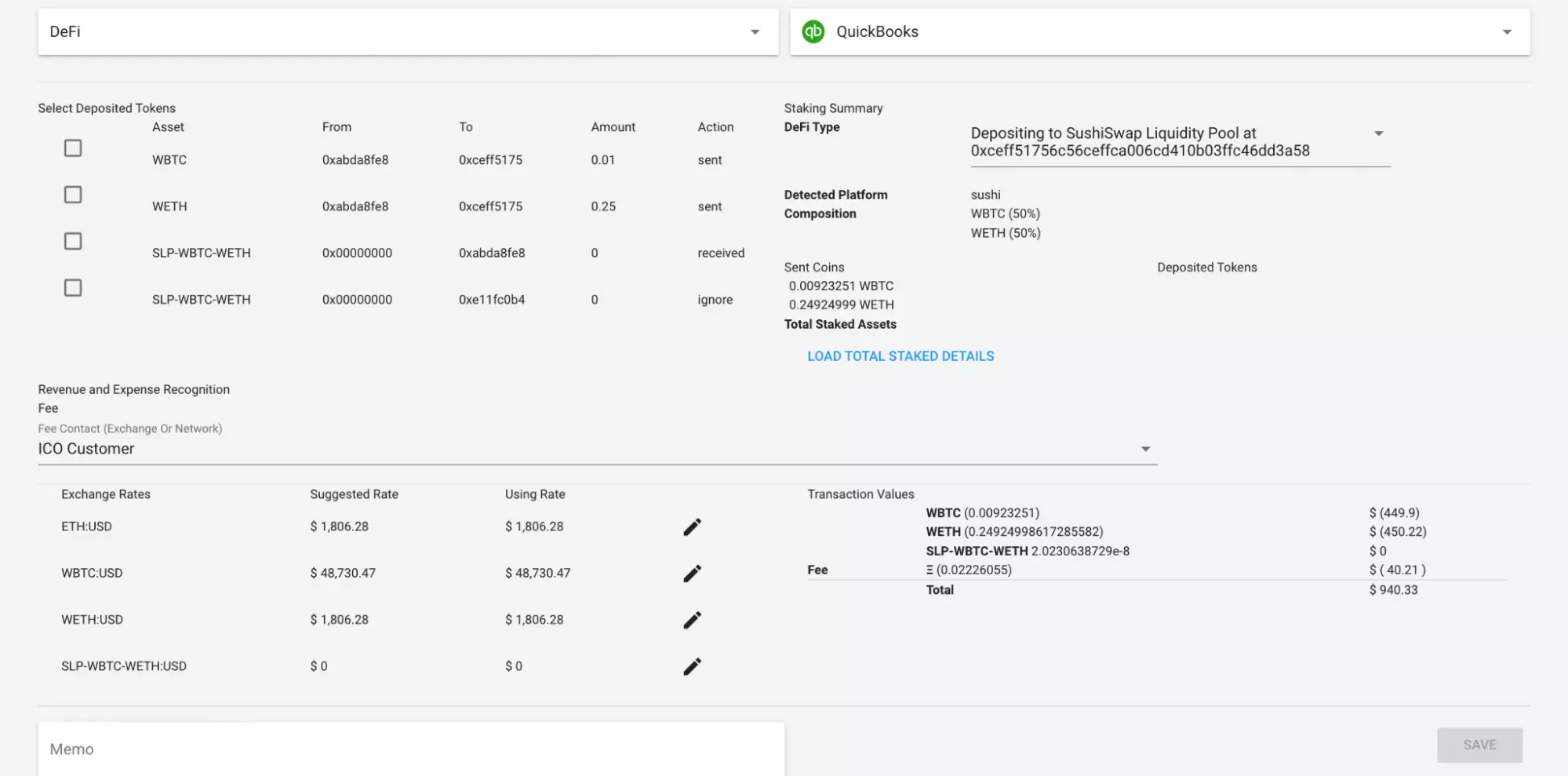
Since this transaction has many components, let’s look at how Bitwave handles it.
- First, Bitwave will automatically record this transaction as a Defi transaction.
- Next we have the two tokens that we deposit into the liquidity pool, the LP tokens that we receive as a receipt for our deposit and that we have.
- Once we open the transaction to categorize it in Bitwave, we can see that there are many details. Bitwave actually uses the wallet address and transaction hash to index the smart contract for information about that wallet’s specific deposit into the smart contract. Smart contract information is detailed on the right under ‘Defi Type’ in the drop down menu allowing the user to select which method to call from the smart contract, in this case we are ‘Deposit Liquidity’.
- Finally we can choose to change the rate at which the tokens are valued depending on the context of the transaction, the fee will be sent to a fee specific account and there is a tick at the bottom of the entry here showing the relevant components of the transaction indicates .
After earning LP tokens, you are usually automatically eligible for rewards in the form of trading fees, as these fees are linked to your LP tokens to collect additional tokens, typically governance tokens, which you often turn your LP into need to deposit another smart contract. This transaction is a simple deposit that includes outgoing LP tokens and a gas fee (see below).

Withdrawal from a liquidity pool
Claiming your LP tokens from the above contract results in revenue in the form of $SUHI tokens and includes some components, incoming LP tokens, incoming $SUSHI tokens and outgoing gas. The key takeaway here is that we can see that the $SUSHI token can be categorized as income once claimed.


Now that you have received the LP tokens and wish to convert back into your original deposit tokens, WBTC & WETH, you will initiate this transaction which is essentially the reverse flow of the original deposit. Note here the change in the ratio of WBTC and WETH that was received. There was an increase in WBTC received and a decrease in WETH received.
Bitwave has a GainLoss report and a DeFi ROI report so you can see how the outcome of this trade affects your P&L in the form of profit on WBTC and loss on WETH.


Learn Crypto Trading, Yield Farms, Income strategies and more at CrytoAnswers
https://nov.link/cryptoanswers
Comments are closed.