


The demand for creating crypto projects on the Ethereum network has increased sharply in recent years. As a result, Ethereum faces many network congestion issues that slow down transaction speeds and increase network gas prices. Layer 2 scaling solutions address these issues Ethereum faces.
Arbitrum is one of the most widely used Layer 2 scaling solutions based on the Ethereum network. The Arbitrum Network and its “Arbitrum Bridge” help solve the traditional Ethereum problems.
First, let’s learn about Arbitrum.
About Arbitrum
Ethereum is the most popular blockchain network for building decentralized applications (DApps). Crypto projects largely rely on Ethereum to deploy their smart contacts.
Aside from DApps, programmers use these smart contracts to develop NFTs, lending protocols, and decentralized exchanges. However, Ethereum’s network congestion leads to slow speeds and high gas fees. In this case, Arbitrum comes to save Ethereum.
Arbitrum is a large scale Layer 2 scaling solution built for the Ethereum blockchain. This scaling solution aims to achieve faster throughput at a reduced gas fee.
Arbitrum can create a maximum of 40,000 transactions per second (TPS). This impressive speed will help in massive scaling of projects based on Ethereum smart contracts.
Arbitrum uses optimistic roll-up technology for its scaling process. These rollups allow transactions to be executed on the Arbitrum network. In addition, the output data is recorded on the Ethereum mainnet. This process is crucial to reduce network congestion on the Ethereum network.
Using Arbitrum also helps reduce transaction fees significantly. For example, sending 1 ETH over the Ethereum network costs $0.53, while Arbitrum costs just $0.05. This enormous difference in fees is also visible in token exchanges.
It is important to understand the components of this network.
Important decision components
Four main components are essential to the functioning of an Arbitrum ecosystem. These are as follows:
button
Key is a protocol member responsible for handling and settling currency holdings. The user can consider the hash of the public key as an identification feature. In addition, if you are interested, you can propose a transaction. To do this, you need to sign with the private key transactions.
Virtual machine
Arbitrum Virtual Machines (VM) are an important element in the protocol participation process. This VM behaves like a virtual CPU to run the provided smart contracts. Using blockchain technology, Arbitrum VM can borrow memory, memory and CPU from different nodes.
Manager
Here manager refers to someone who manages the virtual machine mentioned above. This person is solely responsible for tracking and recording progress in a VM. Also, the manager should verify the proper functioning of the VM according to the instructions.
tester
As the name suggests, the verifier is responsible for evaluating the validity of blockchain transactions. In Arbitrum, the validator can consist of a distributed protocol or a universal body.
Steps to bypass Arbitrum
Arbitrum Bridging transfers ETH or ERC-20 tokens from the Ethereum mainnet to the Arbitrum network. With this method, for example, tokens are transferred from layer 1 (L1) to layer 2 (L2).
As mentioned earlier, Arbitrum aims to increase Ethereum’s scalability. So, follow the steps below to transfer ETH tokens from L1 to L2.
Step 1: Select the Arbitrum One network.
- Visit the WardenSwap website.
- Then select Arbitrum as the preferred network. You can find the network selection option on the “Chain logo”. You can find this logo in the top right corner of the WardenSwap website.
- Next, connect your crypto wallet to the WardenSwap platform. Wallets supported by this platform include MetaMask, Trust Wallet, WalletConnect, and Coinbase Wallet.
- Finally, approve the selected network in your connected wallet.
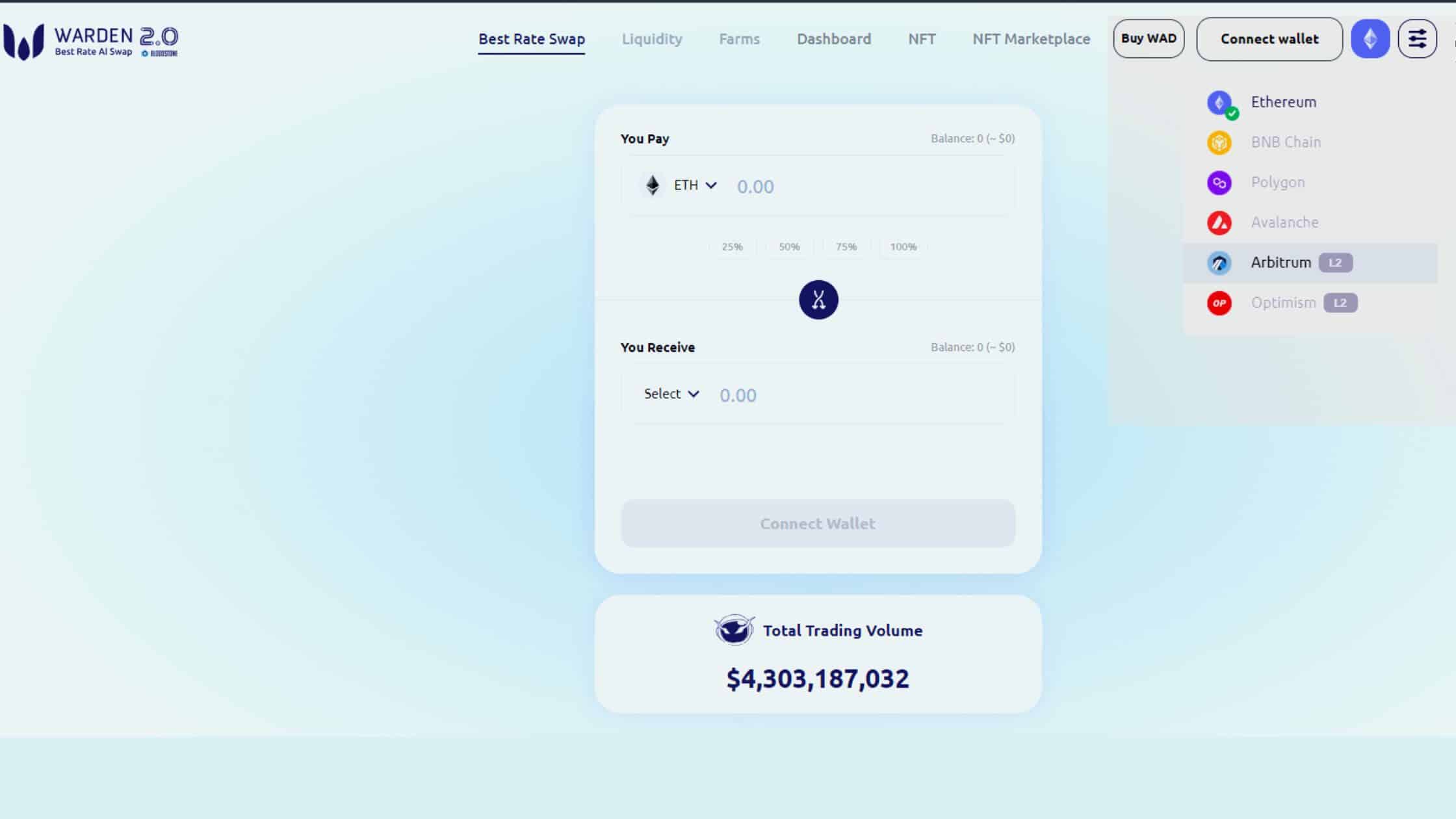
After these steps, your wallet will show “Arbitrum” as your connected network. Now follow the second step to bridge ETH tokens.
Step 2: Bridge ETH (L1 to L2)
- Visit bridge.arbitrum.io.
- Connect your wallet. Load your wallet with enough ETH tokens needed to bridge.
- Select the ETH/ERC-20 tokens that you need to bridge. You can either select from the dropdown menu or paste the smart contract address of that particular token.
- Now select the amount of tokens that you want to bridge in the “L1” input field. Then click on “Deposit”.
Once you complete all these steps, your connected wallet will receive the funds. The time required for this transaction varies depending on network congestion.
Steps to withdraw ETH/ERC-20 tokens
You can also withdraw your converted L2 tokens into ETH/ERC-20 tokens. To do this, follow the steps below
- Go to the WardenSwap website.
- Select Arbitrum One as the network.
- Connect your wallet to the WardenSwap platform.
- Load your wallet with minimal ETH tokens. You can use these tokens to pay for the transitions.
- Select the token you want to convert to L1 from the drop down menu.
- Next, select the amount of L1 tokens you want to bridge.
- Click Withdraw.
- Finally, click on “Claim”.
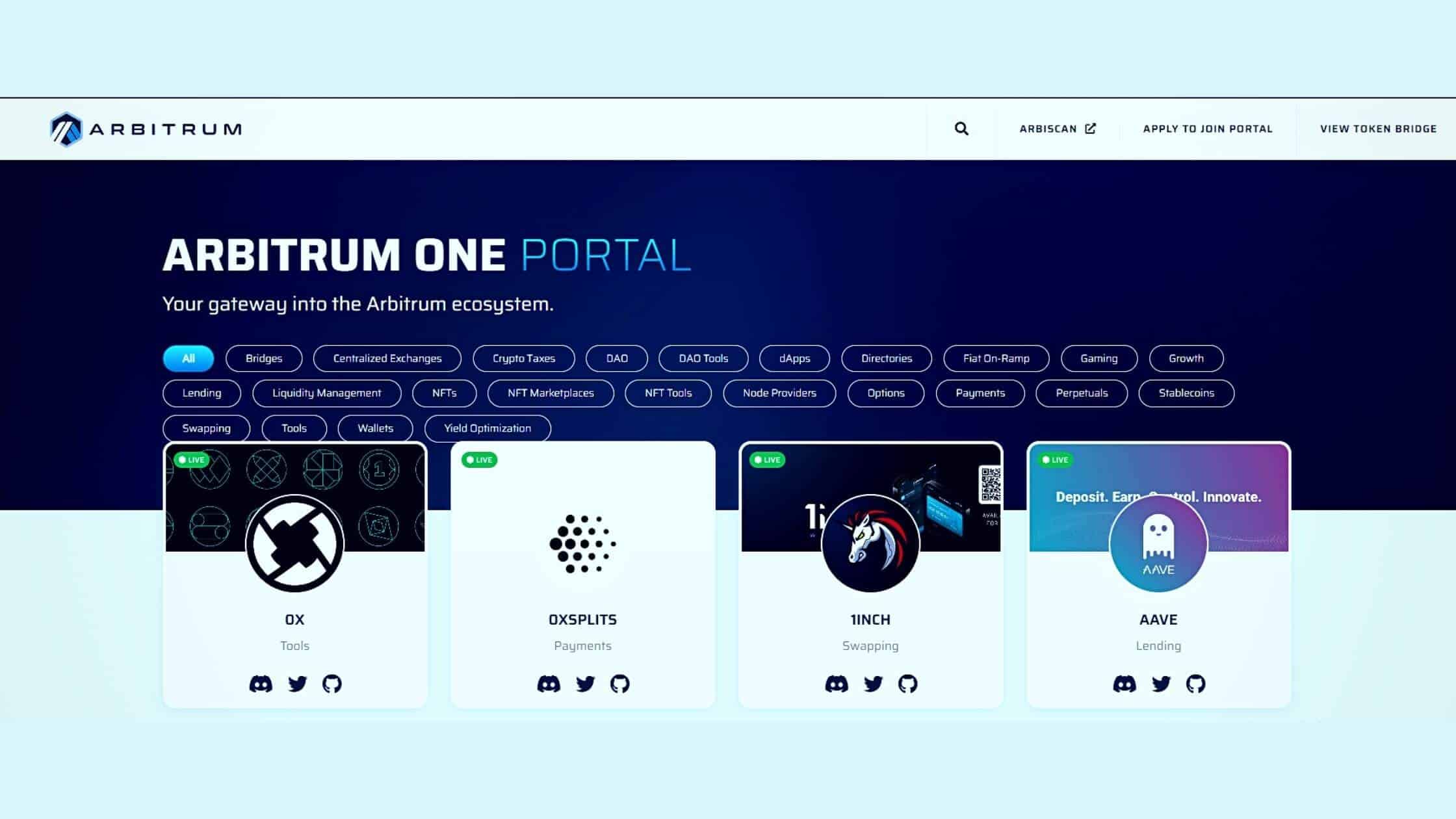
Once you complete all these steps, your connected wallet will receive the L1 tokens. You can repeat this transfer process if necessary.
Popular election projects
Arbitrum’s benefits have led to the creation of numerous crypto projects on the Arbitrum network. The most popular projects are:
sushi exchange
This popular decentralized exchange allows users to swap, lend and stake their tokens. You need to visit the Sushiswap platform, connect your wallet and exchange your tokens. The fee charged is also low compared to centralized exchanges.
Aside from Arbitrum, Sushiswap also supports networks like Polygon, Avalanche, and Fantom to name a few.
Spirit
Aave is a prominent credit and lending marketplace on the Arbitrum network. Here, users can use different liquidity pools to earn interest on their assets.
Aave considers your crypto asset as collateral and lends it to a borrower. Finally, you get the interest.
Conclusion
Layer 2 scaling solutions offer a unique solution to the network problem faced by the Ethereum mainnet or Layer 1. Arbitrum Bridge is a convenient method that you can follow to convert your ETH or ERC-20 tokens into L2 tokens.
The token bridging feature helps you take advantage of both layers. In addition, you only have to spend little on gas fees.
Learn Crypto Trading, Yield Farms, Income strategies and more at CrytoAnswers
https://nov.link/cryptoanswers
Comments are closed.