


The New Zealand diet is particularly bad for the planet because it takes a lot of land to produce food, says environmental activist and author George Monbiot.
George Monbiot
Photo: Guy Reece
There’s a lot of talk about agriculture’s damage to our environment, but what are the alternatives?
In his latest book, Regenesis: How to Feed the World Without Devouring the Planet, Monbiot explores the possibilities.
As an author, Guardian columnist and environmental activist, Monbiot has recently argued that grass-fed, organic beef and lamb are the world’s most harmful agricultural products.
The need, argues Monbiot, is urgent: Half of the world’s habitable land has already been used to produce food, and population growth requires that we at least double food production by 2050.
Monbiot spoke to Kim Hill about why the average New Zealander’s diet is particularly bad for the planet.
“For me, land use is the most important of all environmental indicators,” says Monbiot.
“Because every hectare of land that we use for our extractive industry is an hectare of land that cannot be used for wild ecosystems like forests or wetlands or savannas or natural grasslands that the vast majority of the world’s species depend on.”
While much emphasis has been placed on the impact of increasing urban sprawl, Monbiot says we should be more concerned about the amount of land needed for agriculture.
“The total urban area occupied by humanity makes up 1 percent of the planet’s land area,” he says.
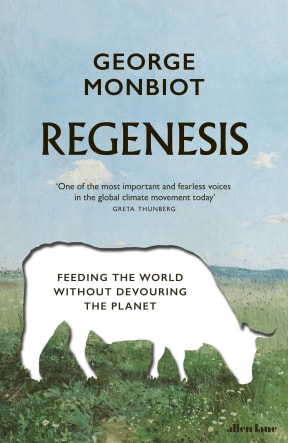
Photo: delivered
“Agriculture, on the other hand, occupies about 38 percent of the land area of the planet, and of that, 12 percent is crops, and of that almost half produces crops for animals, the rest produces crops for humans.
“And what about the rest? A good 26 percent of the planet’s land area, by far the largest land use ever caused by humans on the planet, is used for the production of pasture meat.
“Yet we only get 1 percent of our protein from pasture feeding alone, from animals raised entirely on pasture.
Monbiot says our total land use could be reduced by about three quarters if we switched to a plant-based diet. He points to metrics showing that soy crops require just two square meters of land per 100 grams of protein — compared to 163 square meters for beef and 185 square meters for lamb.
“It’s because of them [metrics] that the nation with the greatest need for land in the world is New Zealand,” he says.
Switching to high-yielding crops like soy could help us see a brighter future, Monbiot says, but when he explored the options in his book, he found examples were few. And although New Zealand has a very productive agriculture, this is offset by our “extraordinary level of agricultural sprawl”.
And it seems our love of free-range beef and lamb could be devastating to the planet.
“If everyone ate the average New Zealand diet, we would need another planet almost the size of Earth to feed us. And that’s because of the very high proportion of free-range lamb and beef in the diet of New Zealanders.
“Because we don’t have an extra planet, we can’t claim the right to eat this diet. It’s just wrong to do it, it’s unethical to eat this diet.”
Learn Crypto Trading, Yield Farms, Income strategies and more at CrytoAnswers
https://nov.link/cryptoanswers
Comments are closed.