


(Kitco News) – Gold's recent rise to new all-time highs has delighted long-time precious metals owners as their confidence in the asset class has been reaffirmed, but has been somewhat overshadowed by the rise of Bitcoin (BTC) and new record highs for the S&P 500, Dow and Nasdaq.
As younger investors expect their wealth profile to increase, it will become increasingly important for them to understand the reasons why gold is a strategic asset, particularly the role it plays as a safe haven during times of economic uncertainty.
“Gold is a highly liquid, unaccountable, credit-free and scarce asset with a history of maintaining its value over time,” the World Gold Council (WGC) said in a report on gold as a strategic asset . “It also benefits from multiple sources of demand: as an investment, as a reserve asset, gold jewelry and as a technology component.”
“These characteristics mean that gold can enhance a portfolio in three important ways: producing long-term returns; improving diversification; and providing liquidity,” the report said. “Taken together, these characteristics make gold a clear complement to stocks and bonds and a welcome addition to broad-based portfolios.”
With environmental, social and governance (ESG) concerns becoming increasingly important among younger people, the WGC said the yellow metal could play a role in supporting these goals as it is “an asset that is responsibly produced and delivered through a supply chain “will comply with high ESG standards.”
“Gold can also play a potential role in reducing investors’ exposure to climate-related risks,” they said. And it's not just climate-related risks that gold can protect against, as history shows it has reliably helped preserve prosperity amid economic upheaval.
“Looking back over half a century, the price of gold in U.S. dollar terms has risen nearly 8% per year since 1971, when the U.S. gold standard collapsed,” WGC said. “Over this period, gold’s long-term return is comparable to stocks and higher than bonds. Gold has also outperformed many other major asset classes over the last 3, 5, 10 and 20 years.”
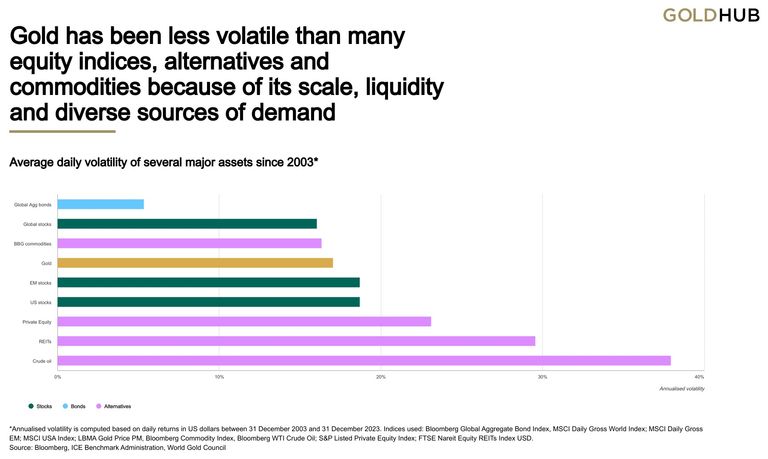
“In addition, the diversity of its sources of demand contributes to gold being a less volatile asset than some stock indices, other commodities or alternatives,” they added.
With inflation continuing well above the Federal Reserve's 2 percent target, the report said, “Gold has long been considered a hedge against inflation, and the data bears this out: It has outperformed U.S. and global consumer price indices since 1971 (CPI). Gold also protects investors from high inflation. In years when inflation was between 2% and 5%, the price of gold increased by an average of 8% per year.”
The average price increase was even higher at higher inflation levels: “So in the long run, gold not only preserved capital, but also contributed to its growth,” the report says.
WGC research also shows that “gold should perform well during periods of deflation.” Such periods are characterized by low interest rates, reduced consumption and investment, and financial stress, all of which tend to boost gold demand.”
Since the abolition of the gold standard to back the U.S. dollar, “gold has significantly outperformed all major currencies and commodities as a medium of exchange,” they said. “And although this outperformance was particularly pronounced immediately after the end of the gold standard, gold has significantly outperformed most major currencies in the recent past.”
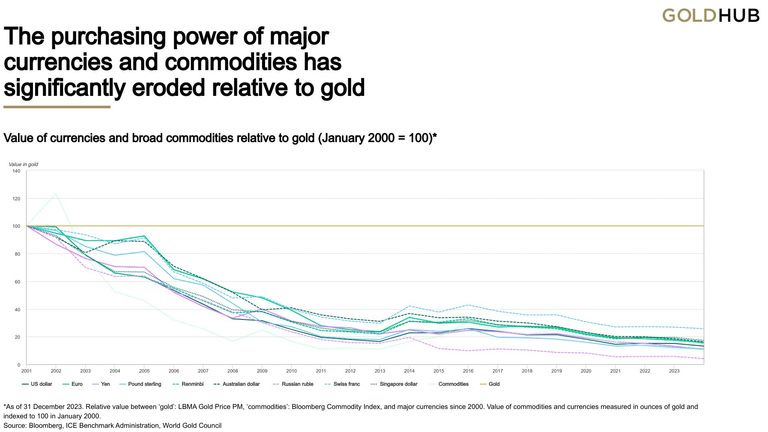
“A key factor in this robust performance is that gold mine production has grown slowly over time – at about 1.7% per year over the past 20 years,” they said. “In contrast, fiat money can be printed in unlimited quantities to support monetary policy, as demonstrated by quantitative easing measures following the global financial crisis (GFC) and the COVID-19 pandemic.” During these crises, many investors turned to gold to protect themselves against currency devaluations and to preserve their purchasing power in the long term.”
The precious metal is a great diversification tool because its “negative correlation to stocks and other risk assets increases when these assets sell off.” This was evident during the global financial crisis, when “gold held its own and rose in price, gaining 21% in US dollar terms from December 2007 to February 2009,” while stocks, other risk assets, hedge funds, real estate and most commodities lost value .
And if market conditions improve, the yellow metal “can also provide positive correlation with stocks and other risk assets, making gold a comprehensive, efficient hedge,” they said. “This advantage arises from the dual nature of gold: as an investment and consumer good at the same time. Therefore, gold’s long-term performance is supported by income growth.”
Another advantage of investing in gold is sufficient liquidity. WGC estimates “the physical gold holdings of investors and central banks are worth approximately $5.1 trillion, with another $1.0 trillion in open interest through derivatives traded on exchanges or over-the-counter (OTC) markets .”
“The size and depth of the market means it can comfortably accommodate large buy-and-hold institutional investors,” the report said. “In stark contrast to many other financial markets, gold’s liquidity does not dry up, even in times of financial stress. Importantly, gold also allows investors to pay off liabilities when less liquid assets in their portfolio are difficult to sell or are mispriced.”
From a risk-return perspective, WGC analysis of investment performance over the last 3, 5, 10 and 20 years shows “that an average USD portfolio at 2.5%, 5%, 7.5” has higher risk-adjusted returns and lower Drawdowns would have been achieved % or 10% was allocated to gold.”
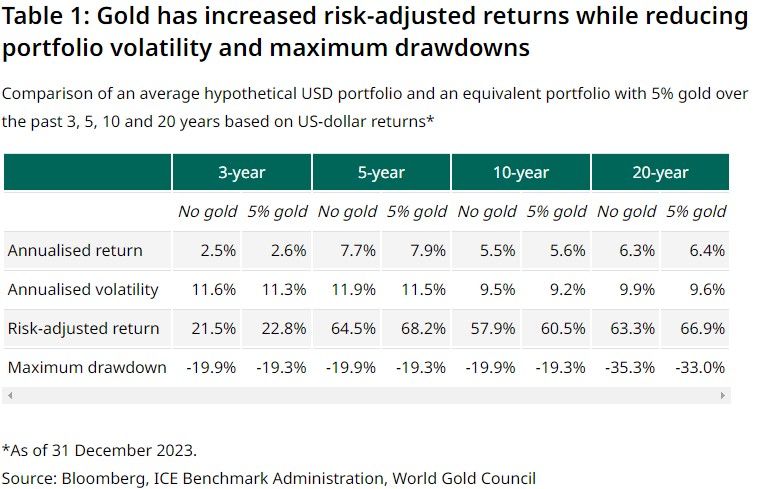
“The 'optimal' amount of gold varies depending on individual asset allocation decisions,” they said. “Broadly speaking, the analysis suggests that the higher the risk in the portfolio – be it in terms of volatility or concentration of assets – the greater the allocation to gold required within the considered range to offset that risk.”
Amid increasing concerns about the global climate, the WGC said its analysis suggests that gold has the potential to perform better than many mainstream asset classes under various long-term climate scenarios, particularly if climate impacts lead to or increase market volatility “We are experiencing such a disruptive transition to a carbon-neutral economy.”
“In addition, gold’s value is less likely to be negatively impacted by a rising carbon price, which also provides investors with some protection from the likely policy responses required to accelerate the transition to a decarbonized economy,” they added.
The main risks associated with investing in gold are that it does not directly correspond to the most common valuation methodologies for stocks or bonds; does not provide cash flows; and there may be significant price fluctuations at certain times, the report said.
“Gold’s unique characteristics as a scarce, highly liquid and uncorrelated asset allow it to act as a diversifier over the long term,” WGC said. “Gold’s status as an investment and luxury asset has enabled it to generate an annual return of nearly 8% since 1971, comparable to stocks and higher than bonds and commodities.”
“Gold’s traditional role as a safe haven means it comes into its own during times of high risk. But due to its dual appeal as an investment and consumer good, it can generate positive returns even in good times. This dynamic is likely to continue and reflects ongoing political and economic uncertainty as well as economic concerns surrounding equity and bond markets,” the report concludes.
Disclaimer: The views expressed in this article are those of the author and may not reflect those of Kitco Metals Inc. The author has made every effort to ensure the accuracy of the information provided; However, neither Kitco Metals Inc. nor the author can guarantee this accuracy. This article is for informational purposes only. It is not a request to exchange goods, securities or other financial instruments. Kitco Metals Inc. and the author of this article accept no liability for any loss and/or damage arising from the use of this publication.
Learn Crypto Trading, Yield Farms, Income strategies and more at CrytoAnswers
https://nov.link/cryptoanswers
Comments are closed.