
DeFi in trade finance: Increasing inclusivity in global supply chains | by Kelroy James | Aug 2022


Tokenization of real-world assets can close the $1.7 trillion trade finance gap.
Source: Techplanet.today (2022)
TCurrent bottlenecks in the supply chain have raised awareness of the importance of global trade. It is understood that development depends on trade, but the need for efficient processes and adequate funding is crucial. Trade Finance represents the financial tools and products that businesses use to facilitate international trade and commerce, including the Letter of Credit and the Bill of Laden. It provides the exporter with receivables or payments based on the agreement that the importer could get extended credit for the trade order. According to the WTO, up to 80 percent of trade is financed by credit or credit insurance, but coverage is not uniform.
This system has not changed significantly in over three hundred years. In fact, despite decades of digitization efforts, cross-border trade is still a notoriously complex process and still heavily reliant on paper documents. In fact, a cross-border transaction requires numerous processes and involves the exchange of 36 documents and 240 copies on average, with less than one percent of commercial documents being fully digitised.
Small and medium-sized enterprises (SMEs) in the supply chain
A lack of trade finance is a significant non-tariff barrier to trade, particularly (but not exclusively) in developing countries.
- 33 percent of SMEs in large developed economies face the greatest challenges in securing affordable trade finance. SMEs account for 20 percent of US exports and 40 percent of EU exports.
- Globally, 50 percent of SME trade finance applications are rejected, compared to just 7 percent for multinationals. This gives the largest institutions and their customers better access to global liquidity.
- In developing countries, SMEs face greater difficulties accessing trade finance, with unmet demand in Africa being US$120 billion (33 percent of the market) and US$700 billion in Asia.
 Source: Envoydefi (2022)
This persistent gap between supply and demand in the trade finance market has resulted in a lack of finance for SMEs, affecting global trade and creating inefficiencies and bottlenecks. Bridging these supply gaps would unlock the commerce potential of many thousands of individuals and small businesses around the world. One solution is to use distributed ledger technology, specifically DeFi, to expand the supply of credit and to digitize and standardize some of the processes associated with trade finance.
Institutional lending and access to liquidity
The main problem is that banks are unable to provide all the necessary corporate financing as banking regulations make corporate lending expensive for them. On the other hand, institutional investors are interested in returns above comparable benchmarks. Trade finance is considered a good asset class as it regularly pays in excess of reasonable returns as it is based on the flow of physical goods and services, making it less vulnerable to financial market volatility. Default rates for trade finance products are lower and recovery times in the event of default tend to be faster than other credit products.
SMEs also face difficulties in borrowing due to domestic liquidity constraints, alongside the mismatch between domestic and cross-border trade liquidity pools, which are mainly denominated in a few foreign currencies. In addition, cross-border financing for SMEs requires consideration of financial exchange movements, payment controls and dependence on financial institutions in some international markets.
DeFi and the tokenization of real world assets
The DeFi ecosystem has the potential to disrupt traditional financial structures and provide an alternative supply for rising credit demand. The tokenization of real assets (RWA) in DeFi is relatively unknown, but it can become a stable investment option for financial institutions looking to expand their portfolios.
Tokenization is a capability that uses blockchain technology to securitise both traded and non-traded assets. Key benefits of tokenization include increased liquidity, faster settlement, lower costs, and improved risk management.
According to the OECD, tokenization could improve inclusion in markets previously reserved for larger or institutional investors and improve access to finance for SMEs by allowing any type of investor, including retail investors, to finance SME projects indirectly or directly .
DeFi’s inherent properties make it the ideal ecosystem to make this possible, as it can expand the supply of credit and enable access to financial services via blockchains like Ethereum. The distributed, coordinated nature of the DeFi network is efficient and secure, which can reduce the many limitations on SMEs’ ability to trade and allow anyone worldwide to participate in financial services.
WThese are real assets in DeFi
Essentially, any asset that exists in the real world can be tokenized on-chain using blockchain technology. Examples include stocks, real estate, bills, inventory, and more. Through tokenization, the RWA can then be verified, evaluated and used as collateral.
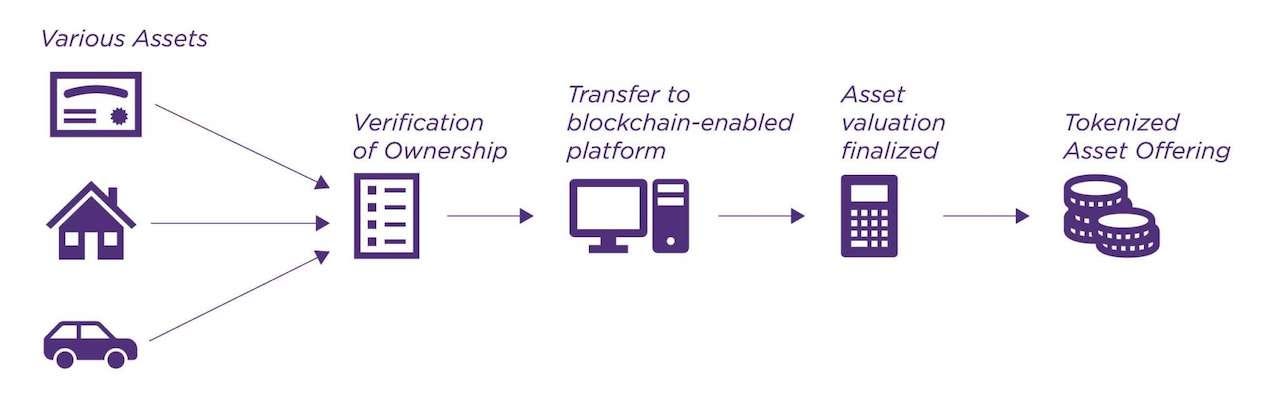 Source: https://fortisauxilium.com/services/IT/asset-tokenization.php
How do they deliver a return
Capital is invested in pools hosted on the Liquidity Providers (LP) blockchain backed by tokenized RWAs. Companies that have submitted assets to the pool are then verified and can use the capital to conduct business operations. After a predetermined period of time, they can then pay back the money with interest. Investors thus have a stable return secured by RWAs and companies have access to a line of credit.
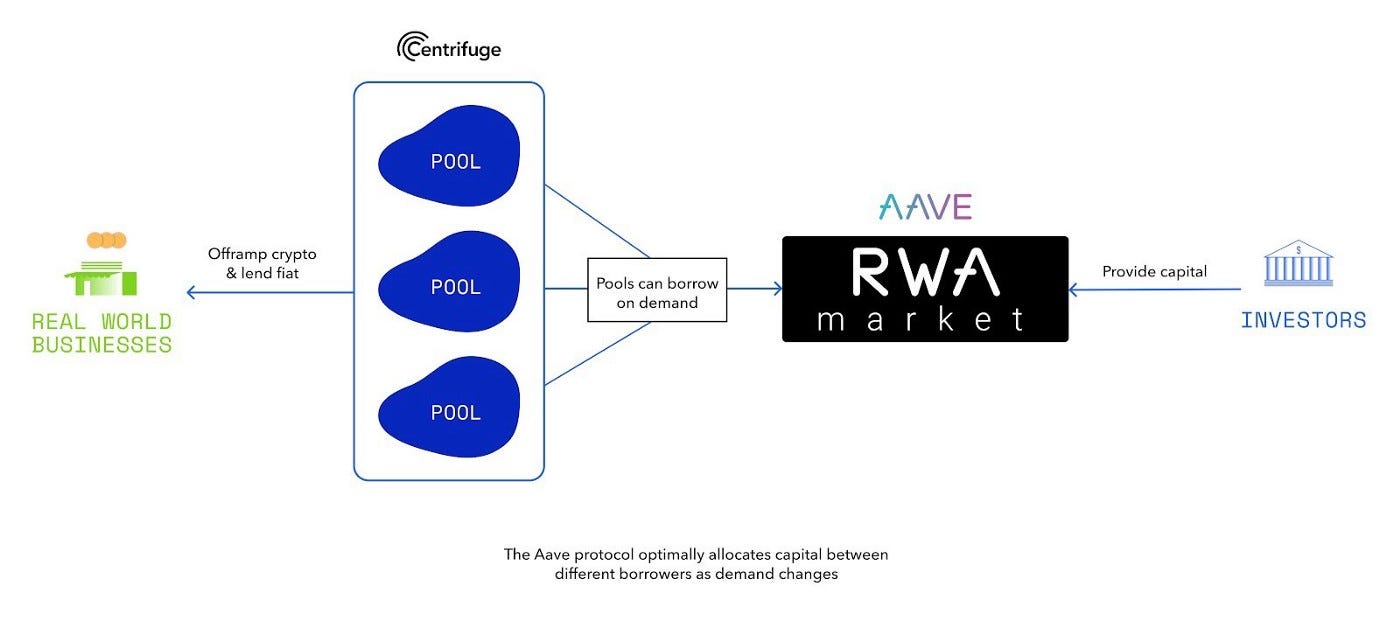 Source: (Centrifuge.io)
The combined value of all real assets on Earth – every bar of gold, every barrel of oil, every property – is estimated at $256 trillion. Once asset owners are able to record that ownership in a distributed ledger on the blockchain, they could potentially use that wealth to unlock endless growth opportunities.
Use cases and innovation projects
Current projects aiming to bring RWAs to DeFi to enhance trade finance include MakerDAO, Aavesome, and enVoy. Two specific use cases are:
Centrifuge is a DeFi lending protocol that aims to make lending more accessible for individuals and SMEs by allowing them to obtain lending by tokenizing their physical assets. By bridging assets like bills, real estate, and royalties with DeFi, Centrifuge enables borrowers to fund their real-world assets without banks or other intermediaries. Anyone can provide liquidity and investors can receive a return. Likewise, investors who grant this loan can earn a stable rate of return through the interest they receive on repaying these loans.
Centrifuge uses a platform called Tinlake, essentially a marketplace for NFT-based RWAs. Assets are verified by Tinlake and represented on the blockchain, which are then used as collateral by their owners to obtain funding through the marketplace, drawing on pools of liquidity provided by Centrifuge’s investor community.
Centrifuge attaches great importance to providing SMEs with access to credit, which in the traditional financial world is generally reserved for large companies. They suggest that a lack of capital is the main reason most SMEs go bankrupt, which is why asset tokenization gives them access to the capital needed to keep the business going.
The factor [Official]* is a global leader in DeFi and also a current partner of the Centrifuge platform. They are at the forefront of the funding revolution and were one of the first platforms to bring RWAs to the blockchain. The Defactor platform offers Asset Originators (AOs) the ability to receive collateralized funding through DeFi liquidity pools. His solution reduces entry barriers for AOs by providing the necessary funding infrastructure and giving investors transparency and control over the assets traded.
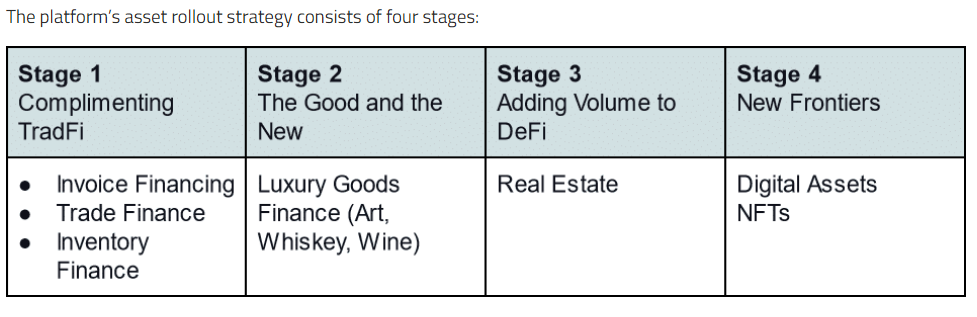 Source: D-Core (2021)
Defactor connects to DeFi Liquidity Pools (LPs) via Centrifuge. Defactor’s native token, $FACTR, is based on the Ethereum protocol. Collateral provided will be tokenized on the Defactor platform as Non-Fungible Tokens (NFTs) on Ethereum or Centrifuge’s Altair chain for NFTs to be funded through Centrifuge.
Defactor, with a grant from the Algorand Foundation, is building a series of LPs on their platform and on the Algorand blockchain. Their mission is to accelerate the adoption of DeFi to become a true competitor in the financial services market and lower the entry barriers for SMEs and developing countries to allow them access to alternative sources of credit.
Conclusion: Opportunities for the future
Distributed ledger technologies (DLT) such as blockchain can play an important role in the digitization of the traditional letter of credit as well as supply chain finance. Using real-world assets in mutually trusted, legally recognized, and auditable digital forms can improve global liquidity for individuals, private companies, governments, and societies in times of high inflation, high debt, and shrinking economies. Some of the advantages of DLT technologies are:
- Creating trust between unfamiliar parties and trust in data and documentation. Applied to trade finance, DLT-based technologies like blockchain can increase trust in digital documents by certifying their origin and correctness.
- Digital identification of trading (financial) actors and thus addressing KYC compliance.
- Expand access to carriers, freight forwarders and brokers, and other supply chain stakeholders by increasing trust in digital trade and trade finance transactions.
- Smart contracts that could be used to automate trade logistics and payment processes.
- Reduce the number of rejected funding proposals by improving data availability and enabling a track record of trades.
By lowering barriers to entry and providing access to liquidity and capital, DeFi offers greater visibility and transparency to every step of the trading process. In reality, DeFi is a low-risk, secure solution with great potential to fill the ongoing growing trade finance gap of 1.7 TRN per year between supply and demand in the trade finance market.
Learn Crypto Trading, Yield Farms, Income strategies and more at CrytoAnswers
https://nov.link/cryptoanswers
Comments are closed.