
Concentrated liquidity increases the risk of temporary loss, Bancor and IntoTheBlock found


On-Chain Markets Update from IntoTheBlock Uniswap v3's concentrated liquidity improved capital efficiency but also increased the risks of temporary losses. Here's a breakdown of liquidity provider profitability and how it could potentially be improved. An interesting paper was recently published by the Bancor team on the topic of temporary loss when providing liquidity on…
On-chain markets update from IntoTheBlock
Uniswap v3's concentrated liquidity improved capital efficiency, but also increased the risk of temporary losses.
Here's a breakdown of liquidity provider profitability and how it could potentially be improved.
Recently, the Bancor team published an interesting article about temporary losses when providing liquidity in the protocol. The study collected data from the launch of Uniswap v3 in May through the end of September. It concluded that temporary losses (-$260.1 million) overshadowed trading fee income ($199.3 million). Furthermore, no evidence was found that certain highly active management strategies would perform better at readjusting liquidity than the more passive strategies.
The methodology used for the study considered a total of 17 liquidity pools, which accounted for 47% of the platform’s TVL at the time. The rest of the TVL was not analyzed because it was in liquidity pools with stablecoins or price-pegged coins, or in pools with insufficient liquidity (less than $10 million). The data is divided into three main categories: positions, wallets and pools. This is useful because many wallets tend to provide several different liquidity positions, on average between 1.25 and 4 positions depending on the pool. So performance can be measured either by wallet or by position.
In addition, it allows measuring which type of pools suffered more temporary losses or incurred more fees. This can help learn how to mitigate temporary losses and provide liquidity to minimize risk. Although gas fees are measured in the study, these conclusions were made without taking them into account, so it would be expected that they would exacerbate losses if taken into account.
Positions, wallets and pools
At IntoTheBlock, we had access to the study's raw data and were able to reproduce the results. We were particularly interested in how the performance was per wallet and per position and comparing each. In summary, 53.50% of positions were profitable while 46.50% were not. Looking at wallets, those that made profits were in the minority at 48.25%, versus 51.75% that were unprofitable. So, up to the date of the study, we can see that the majority of addresses providing liquidity in Uniswap v3 have not made any money.
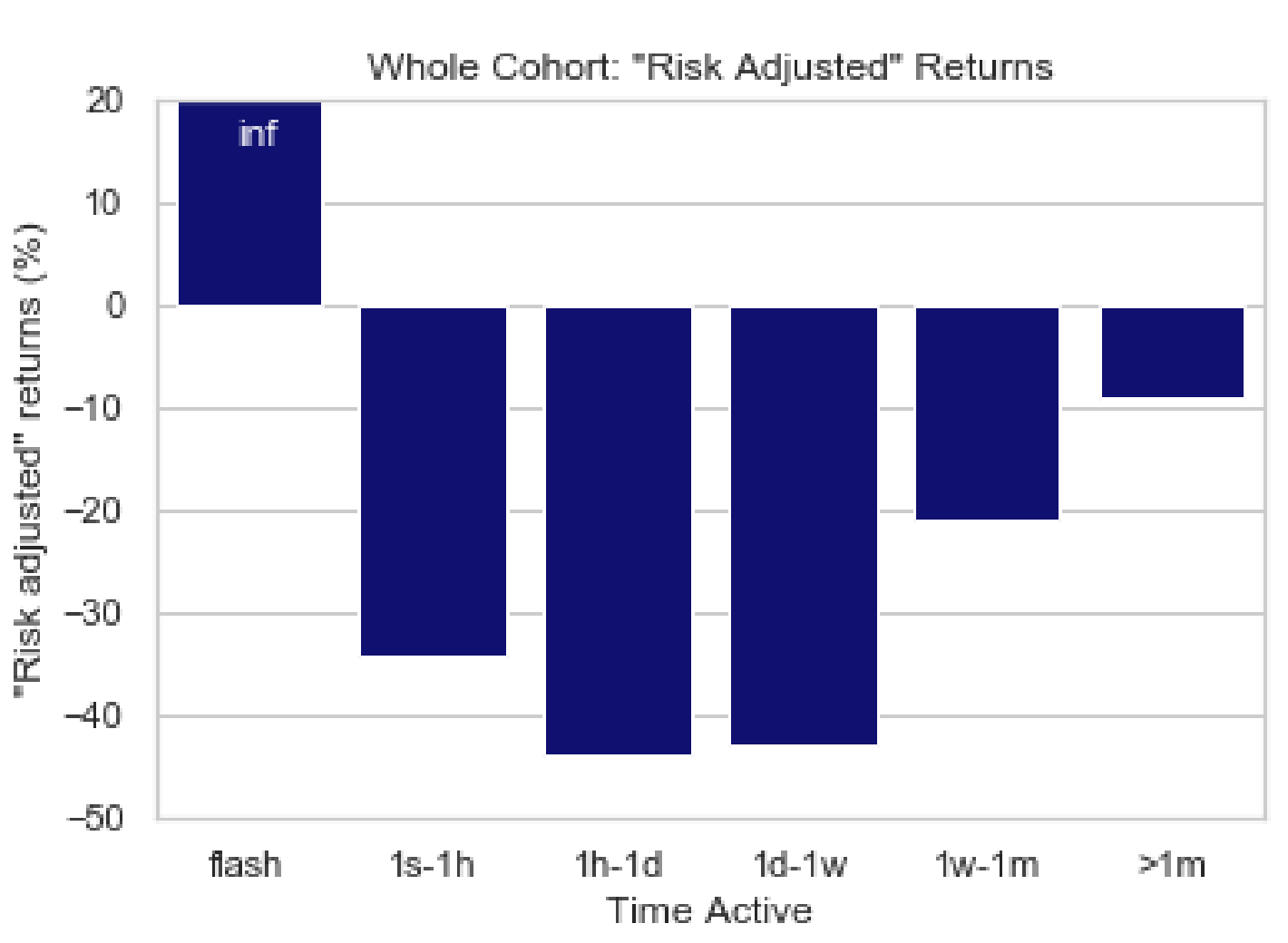
The study goes even deeper and analyzes the risk-adjusted returns of each position, taking into account the time they were active. After analyzing the activity of the positions over different time periods, it can be seen that, apart from flash liquidity providers, there were no periods in which positions earned more fees than temporary losses. This is an advanced and complicated strategy known as just-in-time liquidity, which is achieved by providing and removing liquidity in the same block as a large trade is about to occur in the mempool. Active management of liquidity does not result in certain time frames remaining longer than others.
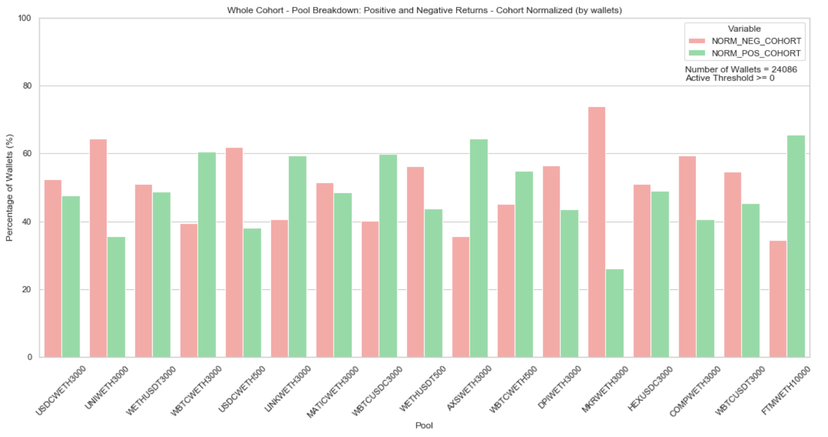
The study also found that it is common for wallets to have multiple different positions for the same pool. Therefore, the performance of wallets was examined by considering all their positions and separating them by pools. The pools where the majority of addresses providing liquidity are profitable are those that have high correlation (BTC-ETH, LINK-ETH, AXS-ETH, FTM-ETH).
Another uncorrelated price, strangely enough, is BTC-USDC. This is due to the high utilization rate (fees/TVL). This shows the importance of first keeping an eye on the price correlations between assets to minimize temporary losses, and then the utilization rates of each pool to maximize returns. While certain pools earn more in fees than temporary losses, they are in the minority.
Lessons and solutions
After analyzing the paper, we can conclude that providing concentrated liquidity is an activity with a higher risk but higher reward profile, which is more suitable for professional LPs and experienced DeFi users, similar to the way, how market making is done (liquidity by range is an abstraction related to this). central limit order books). New users looking to provide liquidity may find it easier to find other protocols where the impact of temporary losses is minimal or non-existent. Being profitable in Uniswap v3 can be approached by adjusting the way the user provides liquidity profitably or by having the protocol mitigate some of these losses through design changes.
A user should always keep best practices in mind such as pools with highly correlated assets will suffer significantly. Those who choose to place positions in narrow trading ranges can expect higher returns, but at the cost of a higher risk of incurring more temporary losses, and the length of time the positions are held open does not appear to have much of an effect. There is sometimes a risk in some pools that, although they initially consist of uncorrelated assets, they become highly utilized and trading fees compensate for temporary losses.
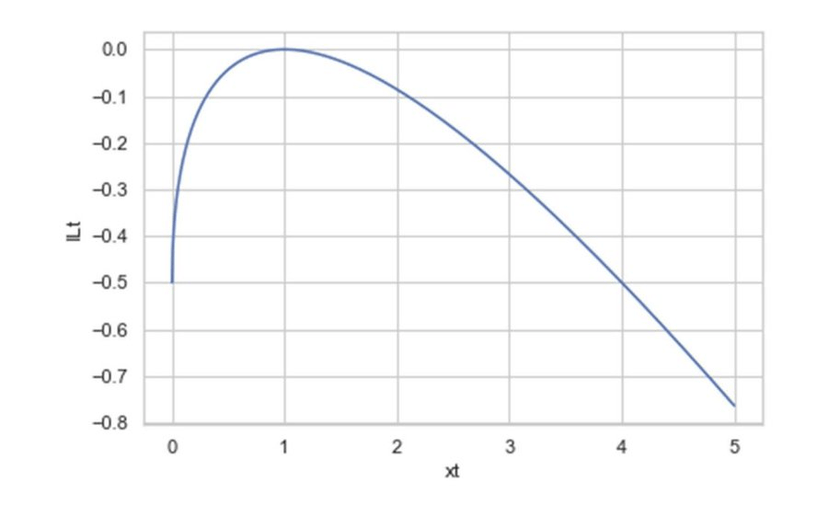
Comparison of the temporary loss incurred relative to the price fluctuation between two assets
From Uniswap v3's side, there are certain ideas that one could try to at least partially mitigate temporary losses for their users.
The most direct would be some kind of liquidity mining program that offers UNI tokens in the popular pools where larger temporary loss is expected due to their low correlation. Covering the losses with governance tokens can be implemented in a kind of temporary loss coverage or insurance for the positions that were actually affected (similar to Bancor). Another more adventurous venture would be to try out the popular theme of protocol native liquidity (Tokemak, Olympus).
Do readers think this change would be feasible for an already implemented protocol with such a large TVL? Let us know.
Learn Crypto Trading, Yield Farms, Income strategies and more at CrytoAnswers
https://nov.link/cryptoanswers
Comments are closed.