


The crypto space has been developing at an incredible rate, and one of the new growth cycles of the last 90 days is yield farming.
Yield farming refers to the process of deploying your wealth across different decentralized finance (DeFi) protocols to generate the best possible returns. Yield farmers could achieve returns in excess of 1,000% Annual Percentage Yield (APY) by employing different strategies with different levels of risk.
Yield farming really took off after Compound got it rolling COMP Yield farming incentives for lenders and borrowers on the Compound platform. Shortly after the launch of Compound’s yield farming program, many other DeFi protocols also included yield farming strategies such as balancers (BAL), Year.Finance (YFI), Curve.Finance (CRV) and SushiSwap (SUSHI) to name a few.
According to our data, the total market cap of YFI tokens is $3.5 billion, with YFI taking 25% of that stake as of September 21, 2020. According to DeFiPulse, DeFi as a whole had over $9 billion in total locked value, which is a 300% increase since July 2020.
However, yield farming is not as easy as it seems. Only experienced DeFi natives would know how to make it profitable as this farming game requires close monitoring and constant changes in strategies. At CoinGecko, we wanted to get some insight into the following three things about yield farming:
- Is the yield farming rage sustainable and here to stay?
- Do yield farmers understand the risks and benefits involved in farming?
- What are the top pain points for retail users who are a yield farmer?
To find out, we surveyed 1,347 people in August 2020. Here are four key findings:
- 23% of respondents have participated in yield farming in the last 60 days, showing that yield farming is still a niche but a growing trend.
- Each yield farming token accounted for less than 10% of farmer holdings.
- 52% of farmers invest less than $1,000 in capital in farming, and high gas fees are a top concern.
- 40% of farmers don’t know how to read smart contracts and the risks involved, despite claiming they do.

Key Finding #1 – 23% of respondents have participated in yield farming in the past 60 days, showing that yield farming is still a niche but a growing trend.
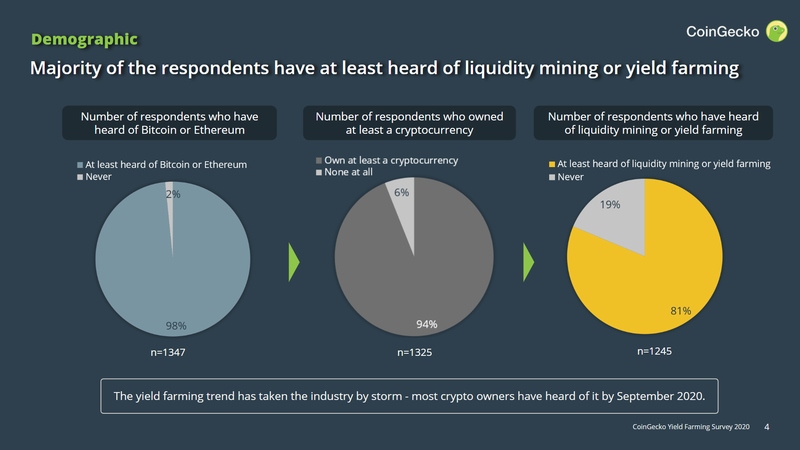
In our survey, we found that yield farmers are still a small subset (312 out of 1,012) of cryptocurrency users who have heard of yield farming. It is dominated by males between the ages of 30 and 59.

These results are expected as the crypto space is known to be male-dominated. Additionally, one needs a certain level of crypto experience to participate in yield farming.
Given that the yield farming craze started roughly three months ago, the number of farmers is substantial but remains a niche among the sophisticated DeFi natives.
key to take away: Yield farming is a niche game for those who are familiar and comfortable with financial metrics and have been in the crypto space for quite some time. You are familiar with existing and new DeFi protocols to create effective farming strategies.
Key Takeaway #2 – Each yield farming token represented less than 10% of farmer inventories.

To understand yield farmers’ portfolio diversification, we delved deeper into the coins they currently hold. Farmers are generally experienced crypto natives and hold a significant portion of Ethereum (ETH) (83%) & Bitcoin (Bitcoin) (74%) in their portfolio, along with a mix of various DeFi-centric tokens.
Notably, yield farming tokens acquired through yield farming accounted for less than 10% of total farm ownership. chain link (SHORTCUT), which could only be farmed through Yearn’s Vaults, is mostly bought on exchanges and not farmed – it just had a much lower APY compared to some of the other farms out there.
key to take away: The small proportion of yield farming tokens in their portfolio may indicate that the tokens are currently locked in the smart contract pools of the respective protocols that farm them. On the other hand, we see behavior where farmers “farm and dispose” after accumulating sizeable reward tokens in the pool, suggesting that yield farming tokens should not be held long-term.
Key Finding #3 – 52% of farmers are investing less than $1,000 in capital in farming, and high gas fees are becoming the biggest concern.
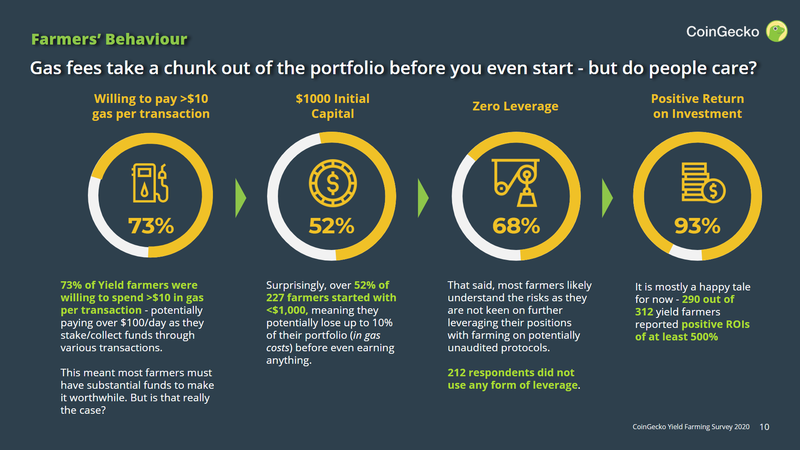
To understand how farmers behave in yield farming, we asked them the following questions:
- What is their average gas fee per transaction?
- What is your starting capital in your first farm?
- Have they used leverage in yield farming?
- Have they managed to make a profit from yield farming?
We found that more than half of the farmers invested capital of more than $1,000 in farming pools and the majority did not use leverage in their strategy. It remains unclear whether this is because these farmers did not want to take additional risks, as many of the farming pools are unaudited or have yet to learn to be.
However, those who have grown with less than $1,000 may not have made as much profit as high gas fees come with the constant movement between pools and logs when growing yields, apart from other associated risks such as fickle losses.
Regardless, these farmers claimed their return on investment (ROI) was as high as 500%. The result comes as no surprise as many of the current new pools offer insanely high APY of over 1,000%. In our opinion, these high yields on offer are unsustainable as they come with a high level of risk and the rise in gas fees will create a barrier to entry and exit for farmers.
key to take away: The high gas fees can hamper the smaller farmers, and their ROI may not be as great as those who have invested over $1,000.
Key Finding #4 – A large proportion of farmers do not know how to read smart contracts, although they claim to understand the risks involved.
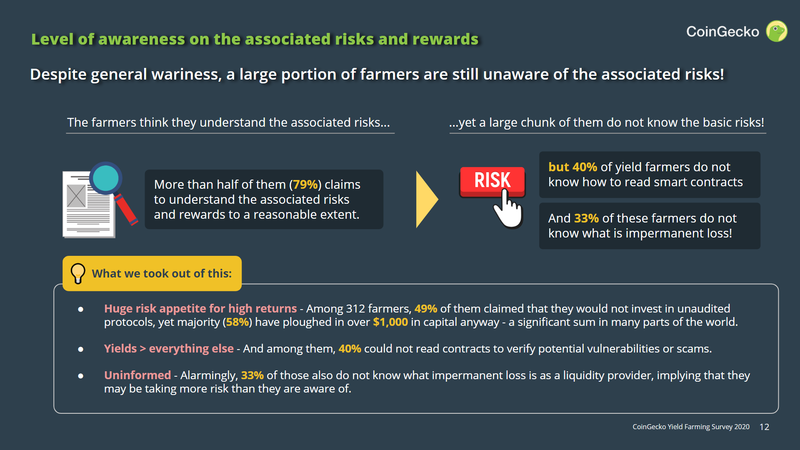
What shocks us (or maybe not) is that a large proportion of farmers do not know how to read smart contracts (40%) and do not even know what impermanent loss is (33%), implying that they not do it. They don’t know their actual ROI and take extreme risks because of the high returns.
Perhaps this is why 49% of farmers are generally suspicious of unverified smart contracts and rely on smart contract auditors to verify the security of the contract. However, auditing firms themselves have repeatedly pointed out that audits are no guarantee of contract security and that preventative measures should be taken wherever possible.
key to take away: All farmers should do their research before farming in pools as there are more copy-paste yield farming tokens that could potentially put them at greater risk such as: B. Code vulnerabilities or fraud.
Below is a summary of the four key findings from our survey:
Key to take away #1: Yield Farming is a niche game for those who are at least knowledgeable and familiar with financial metrics and have been in the field for quite some time as they are familiar with the existing and new protocols to strategically plan their leverage.
Key to take away #2: The small proportion of yield farming tokens in their portfolio may indicate that the tokens are currently locked in the smart contract pools of the respective protocols that farm them. On the other hand, we see behavior where farmers “farm and discard” after accumulating a significant amount of reward tokens in the pool, suggesting that yield farming tokens are not held long-term.
Key to take away #3: The high gas fees can hamper the smaller farmers, and their ROI may not be as great as those who have invested over $1,000. It can harm their capital if they are affected by the temporary loss.
Key to take away #4: All farmers should do their research before farming in pools as there are more copy-paste yield farming tokens that could potentially put them at greater risk such as: B. Code vulnerabilities or fraud.
Diploma
Back to our goals in conducting the survey:
- Is the yield farming rage sustainable and here to stay?
- Do yield farmers understand the risks and rewards involved in farming?
- What are the top pain points for retail users as a farmer?
We think high yield pools are unsustainable, but yield farming products are here to stay. It is now evident that the yield farming pools recently launched by Uniswap on September 17th have cemented the yield farming craze. In fact, it’s no longer just a high, but has matured considerably now.
However, until the high gas fee is resolved, it is unlikely that retail users will be able to get into farming without hurting their capital, and that is without considering other associated risks such as temporary losses.
We also urge users to learn how to educate themselves about smart contracts and the associated risks and rewards before jumping into any pools. As much as we want to be a rapier* and capitalize on the high return, the downside risks are even more evident as many projects come in with little effort to do undifferentiated product development this cycle.
*Degen is short for “degenerate,” often used in cryptography to indicate traders who are taking big risks in expectation of big profits.
We would like to express our gratitude to all of our survey respondents who have allowed us to gain a better understanding of yield grower behavior in this new cycle. For those interested in our methodology of this study, you can read it here.
Tell us how much you like this article!

Erina Azmi
Erina is CoinGecko’s market research analyst. Current expertise is finance and crypto – DeFi. Previously active in research consulting and often in market analysis.
Read more from Erina Azmi
Learn Crypto Trading, Yield Farms, Income strategies and more at CrytoAnswers
https://nov.link/cryptoanswers
Comments are closed.