


The crypto market has seen countless developments since the introduction of Bitcoin in 2009. A recent development in this area is the “Ethereumization” of Bitcoin. This term was coined to describe the adjustments within the Bitcoin network that appear to make it more reminiscent of Ethereum.
This transformation process has positives and negatives and is raising concerns among crypto community leaders.
The Ethereumization: A New Dawn
The introduction of BRC-20 has significantly advanced the Ethereumization of Bitcoin. This is a protocol that bears a striking resemblance to Ethereum’s ERC-20.
The BRC-20 protocol, based on the Ordinals system, has enabled the Bitcoin network to mint non-fungible tokens (NFTs) by assigning unique identifiers to each satoshi – the smallest unit of Bitcoin. This development has expanded Bitcoin’s capabilities and opened up new possibilities for its network.
Interestingly, due to its diverse potential, BRC-20 allows for the creation of meme coins. While this might seem like a disadvantage at first glance, it plays into the hands of the digital age. Meme coins have repeatedly demonstrated their ability to engage audiences and create viral trends.
In fact, speculators are rapidly issuing and minting tokens under the BRC-20 standard. There is a noticeable hype surrounding these tokens. CoinMarketCap reports that 8,500 tokens have been issued on Bitcoin in just a few weeks since the launch of the BRC-20 standard.
However, Bitcoin’s ethereumization does not mean that it loses its unique identity. NFTs minted on the Bitcoin network are more decentralized than those on Ethereum.
NFT sales worldwide. Source: Statistics
While Ethereum only stores metadata of NFTs on-chain, Bitcoin NFTs are fully stored on-chain, bringing them closer to the nature of non-fungible tokens. This advantage could pose a significant challenge for Ethereum’s NFT market, which has been in decline as of late.
The BRC-20 effect: transaction fees explode
The BRC-20 phenomenon has sparked significant activity on the Bitcoin network, driving transaction fees to their highest levels since 2018.
The new token standard has sparked fierce bidding wars that resulted in block rewards in excess of 12.5 BTC. This has created a significant payday for bitcoin miners as transaction fees make up a significant portion of their block rewards.
Interestingly, the BRC-20 token standard has created a first-come, first-served mentality among users, leading to more competition and high transaction fees. This has led to a scenario reminiscent of the transaction bidding wars that overwhelmed Ethereum in 2021 and 2022.
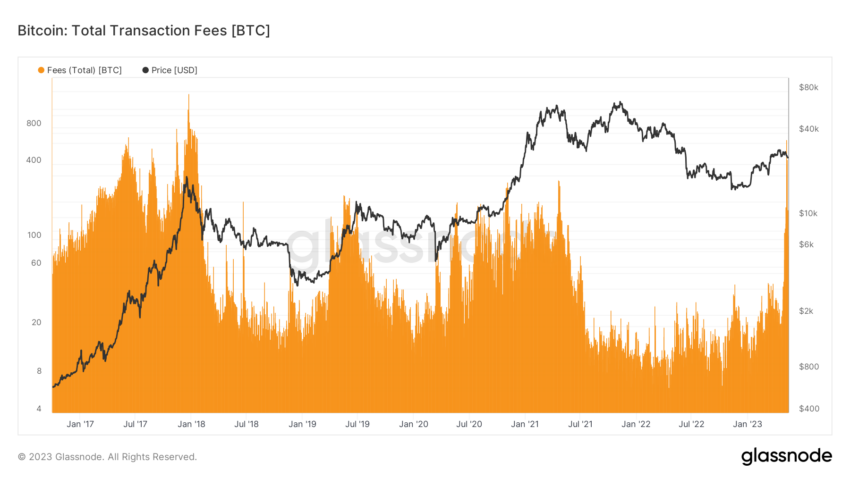 Bitcoin transaction fees in BTC. Source: Glassnode
As the BRC-20 protocol gains traction, it is impossible to ignore the Bitcoin network’s scaling issues.
As average transaction fees against the US dollar rose to a 2-year high of US$30.15 on May 8, 2023 after having been stable at US$2 since July 2021, the issue is clear.
The surge in fees has led to controversial measures such as censorship of BRC-20 tokens and other assets based on the “Ordinals” issuance method being considered.
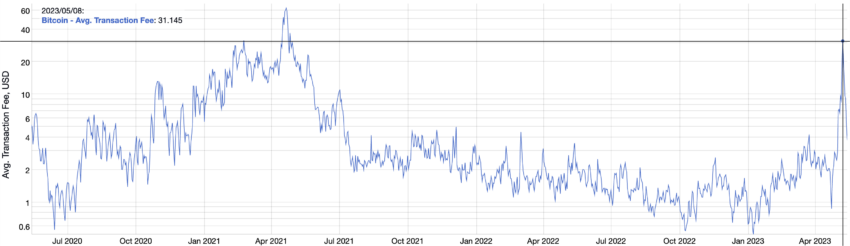 Bitcoin transaction fees in USD. Source: BitInfoCharts
The design of BRC-20 tokens has also contributed to increased block space congestion. Stored in JSON format, these tokens consume more block space due to their larger size and flood the mempool — where transactions await validation and are ordered based on the attached fee bid.
Data shows that the Bitcoin mempool is currently experiencing unprecedented congestion. While there were 200,000 transactions in line at the last major peak in April 2021, the number recently rose to 450,000 transactions.
Colin Harper, head of research and content at Luxor Technologies, believes that storing BRC-20 tokens as binary code rather than JSON files can mitigate this issue. The initiative could potentially reduce bandwidth usage by as much as 80%.
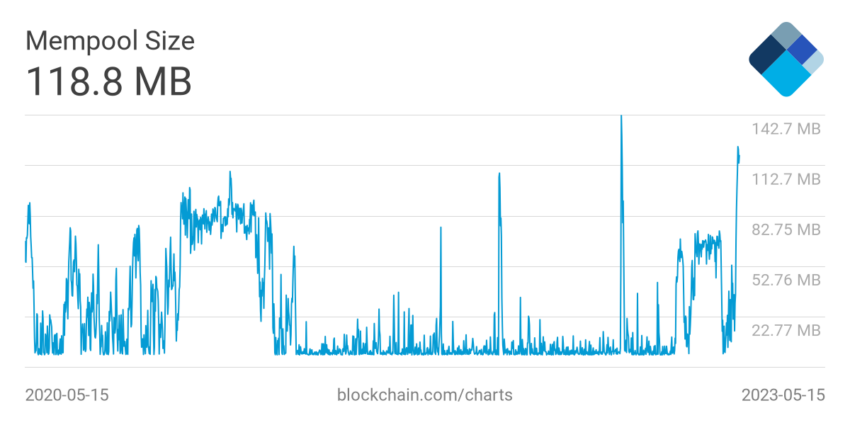 Bitcoin mempool size. Source: Blockchain.com
While debate surrounding the release of BRC-20 is heated, Michael Saylor, former CEO of MicroStrategy, has called its emergence “optimistic.”
“What has happened with ordinals and NFTs is that we have crossed that abyss from a bearish scenario to a bullish scenario. If I were a miner, I’d be thrilled,” Saylor said.
Still, one fundamental problem plays a role: Bitcoin is struggling to scale.
Bitcoin’s Ethereum-Like Traits: The Good, the Bad, and the Ugly
The “Ethereumization” of Bitcoin through the BRC-20 protocol has advantages and disadvantages. For example:
- On the plus side, it expands Bitcoin’s usefulness beyond a simple store of value and medium of exchange. It enables the creation of complex decentralized applications, smart contracts and tokens. This could potentially attract a wider audience to the Bitcoin network and increase the overall value and utility of the ecosystem.
- On the other hand, the launch of BRC-20 tokens and the subsequent surge in transaction volume has put a strain on the Bitcoin network. This has resulted in higher transaction fees and slower transaction times, negatively impacting the user experience. However, these problems are not inherent flaws of the BRC-20 protocol, but rather symptoms of the broader scaling problems of the Bitcoin network.
From a broader perspective, this phenomenon highlights the growth challenges associated with expanding Bitcoin’s functionality. While Ethereum has long faced similar scaling challenges, the Ethereum community has made significant strides in addressing these issues through strategies such as sharding and Layer 2 solutions.
For example, the transition from Ethereum to Ethereum 2.0 aims to significantly increase the scalability and efficiency of the network.
For Bitcoin to continue its development and adoption, it will likely need similar solutions. These could be Layer 2 solutions like the Lightning Network, which move off-chain to enable faster and cheaper transactions.
There are also potential improvements within the BRC-20 protocol itself that could reduce the size of token transactions and reduce some network congestion.
Disclaimer
Following the Trust Project guidelines, this feature article presents opinions and perspectives from industry experts or individuals. BeInCrypto is committed to transparent reporting, however, the views expressed in this article do not necessarily reflect those of BeInCrypto or its employees. Readers should independently verify information and consult a professional before making any decisions based on such content.
Learn Crypto Trading, Yield Farms, Income strategies and more at CrytoAnswers
https://nov.link/cryptoanswers
Comments are closed.