


 Source: Adobe Stock
Bitcoin (BTC) chart analysis suggests that the price has formed an important short-term technical pattern that could be a harbinger of extreme volatility to come. Depending on how the pattern is broken, a quick drop to $38,000 or a rise towards $48,000 is possible.
As BTC price has reconsolidated from year-to-date highs of around $45,000 that it reached earlier this month, it has formed a pennant structure characterized by the price gradually moving through higher lows and lower highs is put under pressure.
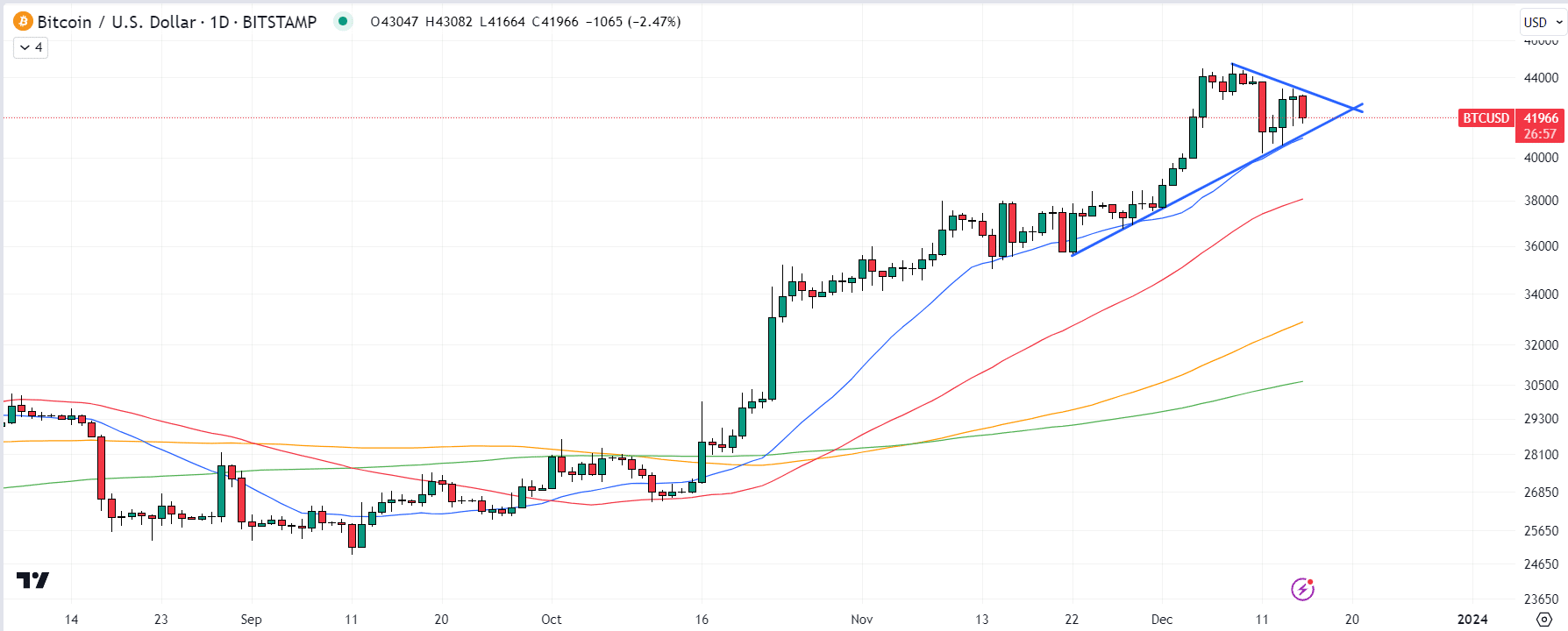 Bitcoin (BTC) price forms a pennant / Source: TradingView
These patterns often form during periods of market consolidation (as we have seen over the last week) and usually result in a significant breakout up or down.
Should BTC break its pennant structure to the downside, which would also mean a break below its 21DMA, a quick test of $40,000 would be very likely due to technical selling.
A retest of $38,000 would also be very likely as many Bitcoin bulls may be unwilling to reduce their purchases until they see the $38,000 level (where the 50-day moving average is also located). See support tested and confirmed.
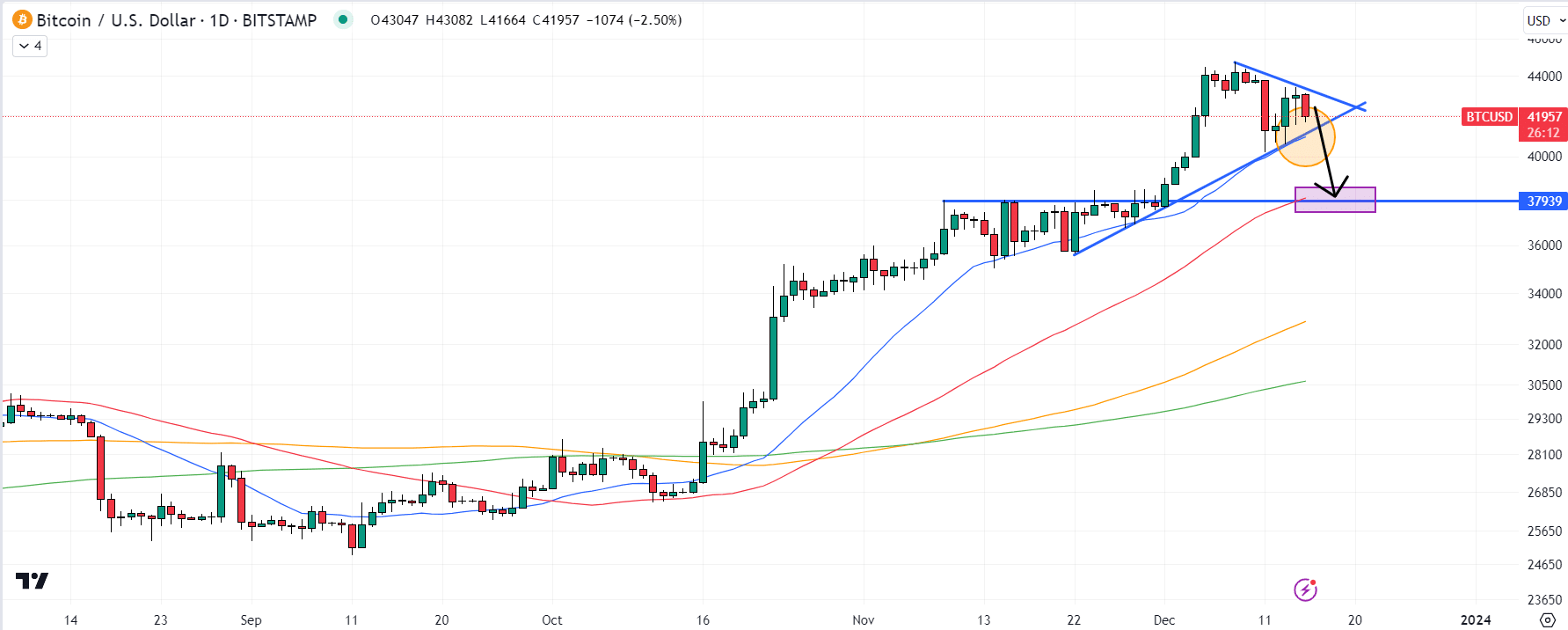 Bitcoin (BTC) bearish scenario / Source: TradingView
Conversely, if BTC were to break through its recent pennant, a quick rise to yearly highs near $45,000 would be in order, and bulls would likely push for a retest of highs above $48,000 in 2022.
Is there a lack of fresh short-term bullish catalysts to further propel the uptrend?
Bitcoin's powerful nearly 70% rally from its October lows was fueled primarily by 1) expectations that spot Bitcoin ETFs would soon be approved in the U.S., boosting institutional demand, and 2) easing restrictions Macroeconomic conditions driven as traders increase bets on a Fed interest rate cutting cycle beginning in early 2024.
But some are now arguing that the optimism for spot Bitcoin ETFs has now been priced in (e.g. analysts at JP Morgan) and with approvals still a few weeks away, it could be difficult for the market to attract new spot Bitcoin -ETF catalysts that can create a lasting uptrend in the short term The approval confirmation is officially received.
Additionally, the Fed's messages to the market this week were confused; First, they sent dovish signals on Wednesday, signaling no further rate hikes and three rate cuts next year.
But on Friday, influential Fed policymaker John Williams pushed back against market bets on rate cuts, saying it was premature to talk about them (even though the Fed is literally forecasting them) and saying rate hikes were still on the table (even though they weren't ). Fed Chairman Jerome Powell sent a very different message on Wednesday.
The risk of profit-taking due to a pause in spot Bitcoin ETF optimism and confusion over Fed policy is increasing, increasing the risk of Bitcoin sliding to the bottom of its pennant structure.
Various indicators point to a cooling off in bullish bets
Various market sentiment indicators are also pointing to a cooling of bullish bets, which could also predict a higher probability of a short-term price decline compared to a further price increase.
For one, the 25 percent delta skew of Bitcoin options, which expire in 60, 90, and 180 days, respectively, has just reached its lowest level since October, according to data from The Block.

This shows that with BTC price rising over the past two months, investors are paying a smaller premium for Bitcoin options that will pay off in the event of a rise in the next two to six months.
This could be due to waning optimism about the sustainability of the Bitcoin price rally, although the fact that the delta skew remains positive suggests that investors overall still see upside risks to the price.
Elsewhere, the funding rate paid by Bitcoin futures traders opening leveraged positions has stabilized at around 0.015%, well below the multi-month highs it reached above 0.035% earlier this month, according to Coinglass.com reported.
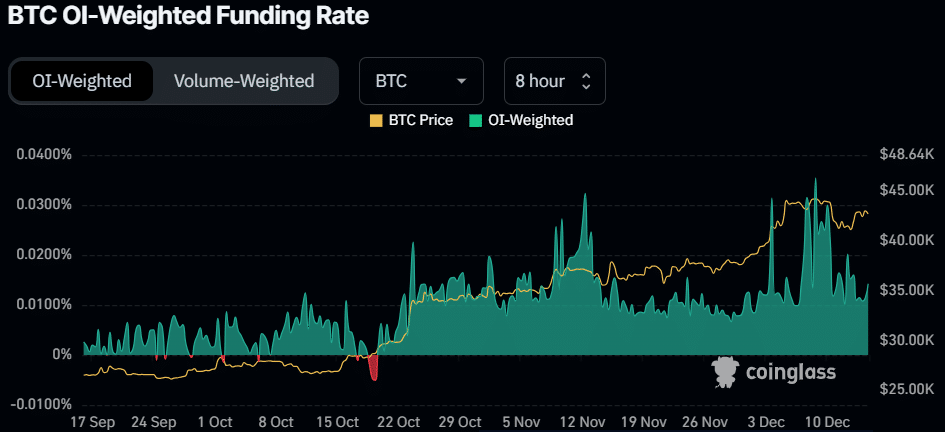
A positive funding rate means that leveraged long traders are paying funds to leveraged short traders, which is due to the higher relative demand for long positions compared to short positions.
If this funding rate falls, it means the bulls’ dominance is waning.
Data from Coinglass.com also shows that the outstanding value of leveraged futures positions (also known as “open interest”) has continued to decline in recent days, even as BTC has consolidated around $42,000.

While some welcome lower leverage in the market as a good thing, speculators using leveraged long futures positions can be an important source of buying pressure supporting the market, at least in the short term.
So if bulls take a wait-and-see approach (as indicated by a falling funding rate and open interest), it could be worrisome for BTC's near-term price outlook.
What's next for Bitcoin (BTC)?
Price risks appear to be trending towards a correction.
But the long-term positive case for Bitcoin remains strong, so declines remain open to aggressive buying from longer-term investors.
The approval of spot Bitcoin ETFs in the US marks a historic moment in the broader societal acceptance of cryptocurrency, as it opens the door for BTC to become part of every average American's retirement or ordinary investment portfolio.
By halving the Bitcoin issuance rate in late March/early April, the rewards paid out to miners will be halved, which will systematically reduce selling pressure (since miners always have to sell some coins just to keep the lights on in their investments).
And while there may be confusion over the timing and pace of Fed rate cuts in 2024 (not helped by recent Fed communications), we are in for easier financial conditions.
All of these longer-term price drivers are likely to support BTC price as it continues to closely follow its historical market cycle, characterized by one-year bear markets (November 2021 to November 2022) and subsequent approximately three-year bull markets (November 2022 to November 2025?).
Short-term setbacks are a feature of every bull market.
Longer-term investors should not lose faith that Bitcoin could reach record highs again in 2024/2025.
Enter your email address to receive our free daily newsletter
A quick 3 minute read on today's crypto news!
This website is protected by reCAPTCHA and the Google Privacy Policy and Terms of Service apply.
Learn Crypto Trading, Yield Farms, Income strategies and more at CrytoAnswers
https://nov.link/cryptoanswers
Comments are closed.