


Validity rollups could be coming to Bitcoin soon. Researcher John Light says rollups could significantly improve the functionality of the Bitcoin blockchain. It includes making transactions faster, more private, and increasing throughput by a factor of 100.
“Validity rollups could enable up to 100x higher throughput than Layer 1 (L1) without requiring an increase in block size and without increasing (maybe even decreasing!) the cost of full node verification,” Light tweeted.
He wrote a lengthy report on the subject as part of the Human Rights Foundation’s ZK Rollup research grant. Light received input from cryptocurrency luminaries such as Ethereum co-founder Vitalik Buterin, Alex Gladstein, Eric Wall and others.
“We conclude that validity rollups have the potential to improve Bitcoin’s scalability, privacy, and programmability without sacrificing Bitcoin’s core values or functionality as a peer-to-peer electronic cash system.” , says the report.
“Given the ‘trusted’ nature of validity rollups as cryptographically secured extensions of their parent chain, and given Bitcoin’s status as the most secure settlement layer, one could even say that these protocols are a perfect match,” she added.
Bitcoin Validity Rollups: What Are They?
Zero-knowledge (zk) proofs are a technique used by blockchain networks or companies to prove the validity of something like a transaction. They do not reveal any other information about the same transaction other than that it is valid.
Blending services use this technology to obfuscate crypto transactions to make them harder to track. ZK proofs first appeared in a 1985 paper by Goldwasser et al. with the title: “The knowledge complexity of interactive proof systems”.
In his white paper, Bitcoin founder Satoshi Nakamoto mused on how zk-proofs “could be used to improve the electronic cash protocol he invented.”
Cryptographer Greg Maxwell later picked up the idea.
Maxwell’s 2011 paper “Zero Knowledge Contingent Payments” became the basis for future development of zk-proofs in blockchains. The first crypto asset to use the technology was Firo (Zerocoin) in 2016, Light said. Zcash followed soon after, primarily as a privacy tool.
As “rollups”, zero-knowledge proofs are built as a layer two solution (L2) on top of an existing protocol, such as Ethereum or Bitcoin, to improve scalability, efficiency, data protection and security. For example, Optimism and Arbitrum on Ethereum and Bitcoin’s Lightning Network.
The idea is that for blockchain networks to grow as viable alternative payment systems, they must be able to handle a large volume of transactions, data, and users. This is commonly referred to as scalability.
Light believes it is “a misnomer” to define those protocols that implement zk proofs as “zk rollups.”
That’s because not all zk rollups use zero-knowledge proofs, “But they all use proofs of validity! So the more accurate term is ‘validity rollup,'” he said.
Source: Layered Rollups on Bitcoin
Bitcoin network scaling via rollups
There is a long list of issues that have hampered the growth of Bitcoin (BTC) over the years. This includes the failure to attract developers who are building more viable protocols and applications on top of the blockchain.
Bitcoin also had trouble handling increased transaction volumes. In comparison, competing blockchains such as Ethereum or Solana have stepped up to fill this gap.
John Light, the crypto researcher, said in his report that validity rollups could improve Bitcoin transaction throughput by 100x.
That means increasing the number of transactions processed on the network to over 700 per second. Currently, Bitcoin processes an average of seven transactions per second, or TPS, at a cost of around $0.68 per transaction.
It compares to 20 TPS for Ethereum priced at $0.52 and 3,000 for Solana (SOL). Solana has some of the lowest transaction fees in crypto, averaging $0.00025. But Ethereum has layer-twos like Arbitrum, which was charging $0.04 per transaction at press time.
feature improvements
Validity rollups will improve smart contracts functionality on Bitcoin. “An L2 validity rollup could implement an execution environment that supports a more flexible smart contract language or more advanced data protection without requiring further changes to Bitcoin,” Light said.
According to analysts, Bitcoin’s transparency tends to “make on-chain privacy protocols inherently vulnerable and therefore inadequate to maintain privacy over the long term.”
Developers have been looking for ways to improve Bitcoin privacy for many years.
“Validity rollups make it possible to implement these new privacy protocols on Bitcoin while inheriting full ownership security from BTC, which resides at Layer One,” the report reads. “This would provide Bitcoin users with state-of-the-art privacy without giving up self-custody of their BTC.”
It states, for example, that Zcash-level privacy protocols utilizing zero-knowledge, end-to-end encrypted transaction techniques could be built on top of Bitcoin. Also known as “shielded transactions,” this type of technology makes transactions completely undetectable.
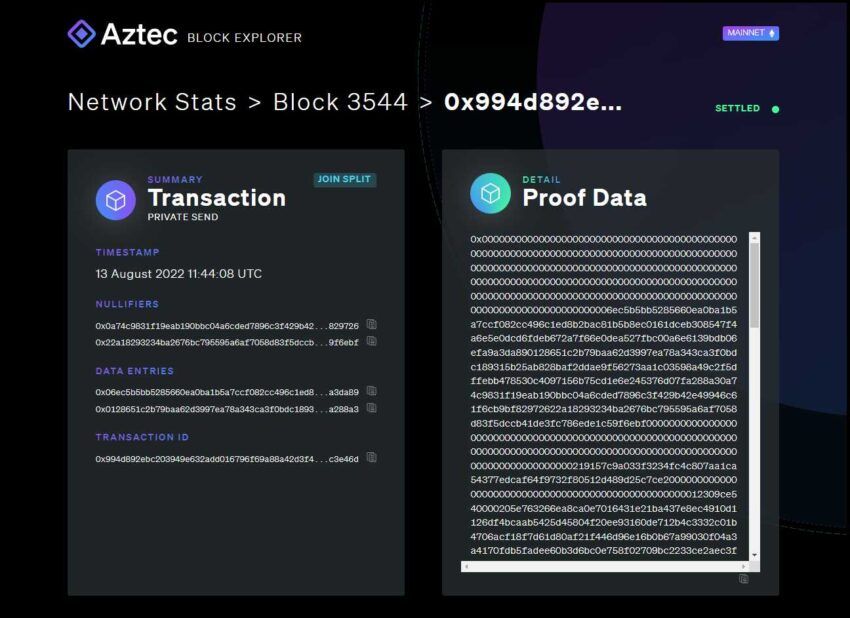 Source: Aztec shielded transaction
Aztec Network already operates a similar layer of data protection on Ethereum, helping users reduce costs. “Bitcoin users could similarly realize both strong privacy and cost savings for private transactions by switching to a zk-zk rollup instead of trading bitcoin,” the report reads.
Validity Rollups: “Great for Bitcoin”
John Light explained that the rollups he is proposing “have strong synergies with the Lightning Network,” Bitcoin’s payment layer. They “allow more transactions to open/close/rebalance channels that require block space.”
“The additional transaction capacity enabled by validity rollups could be used to support more Lightning transactions and increase the potential number of users who can self-manage and consume Lightning,” he explained.
Light cites a number of benefits that he believes could add value to the Bitcoin network, such as roll-up layering. This could include one specialized in providing data availability and another specialized in high security payments and contracts.
“By enabling more efficient, creative, and private uses of Bitcoin, validity rollups can generate new sources of demand for Bitcoin block space. This would result in increased revenue fees for bitcoin miners, thereby increasing the security of bitcoin as well,” he explained.
“Given that Validity Rollups are inherently ‘trustless’ and could be implemented without introducing new risks or sacrificing Bitcoin’s core values or functionality, I believe Validity Rollups could be an excellent fit for Bitcoin.”
Had great discussions with many bitcoin developers and researchers @tabconf about validity rollups on bitcoin. Opinions range from neutral to generally supportive, although of course the implementation details matter.
Some questions that arose from these discussions:
— lightcoin.btc (@lightcoin) October 17, 2022
Regulatory Crosshair
A more privacy-focused Bitcoin network is likely to run afoul of anti-money laundering (AML) laws, which are now increasingly being demanded by regulators from around the world.
Regulators have long targeted the top cryptocurrency. These regulators often view Bitcoin as a tool for criminals.
The US government agency Financial Crimes Enforcement Network tracks financial transactions and curbs money laundering and terrorist financing. Earlier, in December 2020, the agency revealed concrete plans to track crypto assets.
It proposed new rules obliging financial intermediaries like crypto exchanges to report and verify the identities of users transacting through non-hosted wallets. Regulators in Europe are also tightening legislation surrounding AML, specifically targeting crypto transactions.
John Light agrees that more privacy could be an issue.
“While the mere existence of bitcoin itself is a provocation for authoritarians…validity rollups could add whole new provocative dimensions to bitcoin,” he admitted. There are other pitfalls for Bitcoin validity rollups.
You could increase the block storage from the current 4MB to allow for more rollup transactions. They would also incite “Reorg wars” between competing blockchains, incentivizing miners. Rollups incur new charges for full L1 nodes to verify transaction validity.
Disclaimer
All information contained on our website is published to the best of our knowledge and for general information purposes only. Any actions taken by the reader based on the information contained on our website are entirely at your own risk.
Learn Crypto Trading, Yield Farms, Income strategies and more at CrytoAnswers
https://nov.link/cryptoanswers
Comments are closed.