


The winds of change are blowing across the Bitcoin landscape. On March 14, 2024, the network experienced a monumental change – mining difficulty skyrocketed to a record-breaking 84 trillion hashes. This unprecedented challenge coincides with another significant event on the horizon: the Bitcoin halving scheduled for April.
According to BTC.com, the rate has increased by almost 5.80% since the last change. The mining hashrate for the original coin has also peaked, indicating that more people are now participating in the mining process. The value is currently 617 EH/s.
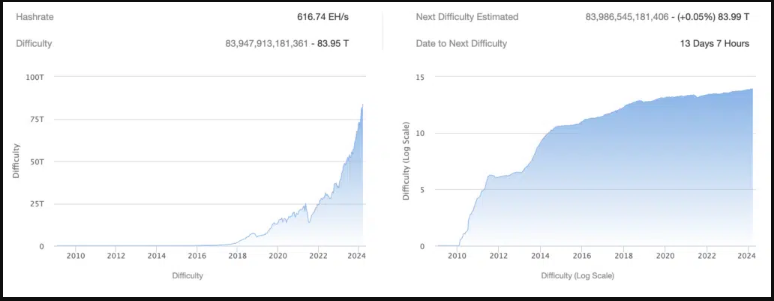 Source: BTC.com
Bitcoin Mining: The Difficulty Dilemma
Mining Bitcoin is not an easy task. Miners compete to solve complex cryptographic puzzles, and the difficulty of these puzzles adjusts based on the overall hash rate of the network. As more miners join the network, it becomes more difficult to ensure a consistent block production rate (approximately 1 block every 10 minutes).
This recent increase in difficulty indicates an influx of new miners, likely due to Bitcoin's recent price rally, which reached a high of a staggering $73,800 on the same day.
The halving effect
The upcoming halving in April brings another variable into play. Every four years, the block reward for miners – the amount of Bitcoin earned for successfully mining a block – is halved.
This economic policy is a cornerstone of Bitcoin's design and aims to control inflation and maintain scarcity over time. The last halving in May 2020 resulted in a significant price increase in the following months, and many analysts expect the upcoming halving to follow suit.

BTCUSD is weakening today, trading at $68,178: TradingView.com
Here's the logic: As the supply of new Bitcoins is halved, the existing ones become relatively more scarce, potentially driving up the price due to increased demand.
A balancing act for miners
Despite the increasing difficulty, the potential for a post-halving increase in Bitcoin's price could give miners incentive to weather the storm. This economic incentive is reinforced by the recent increase in mining rewards, which reached almost $79 million
This suggests that miners are still making significant profits despite the increased difficulty due to the high Bitcoin price. However, the long-term sustainability of this model is controversial.
As the difficulty level continues to increase, the energy consumption required for mining will also increase. This raises concerns about the environmental impact of Bitcoin mining, especially given the dependence of some regions on non-renewable energy sources.
Beyond the headlines
The narrative surrounding Bitcoin's recent surge often focuses on its price and the upcoming halving. However, there are crucial underlying factors to consider.
The ever-increasing mining difficulties raise questions about the long-term viability of Proof-of-Work, Bitcoin's current consensus mechanism. Alternative, more energy efficient mechanisms are being investigated, but their widespread adoption remains uncertain.
Featured image from Unsplash, chart from TradingView
Learn Crypto Trading, Yield Farms, Income strategies and more at CrytoAnswers
https://nov.link/cryptoanswers