


Athletes from almost every national sports organization in Canada are rising up, hurt and angry, to denounce toxic cultures of abuse, neglect and discrimination.
Athletics, artistic swimming, gymnastics, rugby, bobsleigh, hockey, soccer and rowing come together to demand a respectful, healthy and inclusive sports system for all. Athletes from across the country are calling on sports leaders to make a system change.
While I am encouraged that Canada’s Sports Minister Pascale St-Onge is requiring sports organizations to follow the new independent third-party audit process and explore better oversight frameworks, it is not enough. As an athlete and sports researcher, I believe we need to move beyond conversations, roundtables and working groups to a positive vision for sport in Canada; something to fight for, not just fight against.
The sport-oriented model
When I rowed for Canada in the 1980s and 1990s, the sport faced a similar crisis in the form of doping. At the 1988 Olympics, the Eastern Bloc countries won all but two of the 18 medals offered in women’s rowing – a virtually clean victory in medals, though hardly “clean”.
After several sixth and seventh places, we knew we had to change our mindset to compete in this new, uprated arena. We started by putting sport at the heart of our common goal: performance, not podiums; a gold medal time standard, not a gold medal.
Marnie McBean (left) and Kathleen Heddle display their gold medals in the coxless double rowing event at the 1992 Spain Olympics.
THE CANADIAN PRESS/Ron Poling
The goal of rowing isn’t to have more muscle mass, size, or strength than your competitor, it’s more speed. When optimal speed became our common goal, we formed a true partnership with our coaches, administrators, sports scientists and competitors. We were all seen as equal – the key to a psychologically safe environment where everyone can be free, contribute, learn and challenge one another.
With the partnership came a more global perspective on the sport. Speed in rowing can only be achieved by utilizing synchronicity, power, rhythm, balance and variety. Optimal speed, like any optimal performance, is the pursuit of beauty and excellence for the benefit of mankind and the world.
With human and social development at our center, we had to take care of ourselves and each other, be open to innovation, include newcomers with potential, be aligned in our focus, trust our process and be committed to our relationships, our community and our sport feel .
At the 1992 Olympic Games we won several gold medals in a sport that is still heavily doped. We have emerged as leaders in our community and still remain intact as a team.
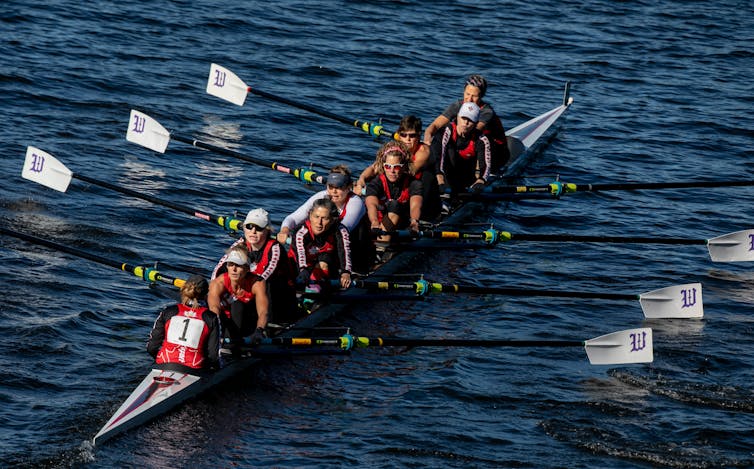
Still going strong, Canada competes in the women’s Senior Master Eights in the 2019 Head of the Charles Regatta, the largest two-day regatta in the world.
(row 2K), author provided
Members of the 1992 team inspired our Tokyo 2021 gold in the women’s eight to draw on the same core principles: shared purpose, communication, clarity and respect. This is a blueprint for what sport can be in Canada.
Sports is the solution
As an educator and leadership and communication scholar, I work to identify the organizational mechanisms that ensure quality sports experiences to harness the full benefits of sport to society. I have always found the truth in sport.
Our research team, made up of professors and PhD students from Royal Roads University and the University of Victoria, found that sport held the solution to its own problems.
We propose a partnership model for sport in Canada that places “optimal sporting experiences” at the heart of decision-making, addresses the power imbalance at the root of abuse, and provides a blueprint for cultural and organizational change that shifts the focus from podiums to achievements.
Our goal is to restore sport to its rightful place in society as a source of human and societal growth and development. We recommend concrete strategies for organizational and procedural changes, such as: B. Expanding measures of success to include leadership impact, physical and mental health and safety, and performance outcomes.
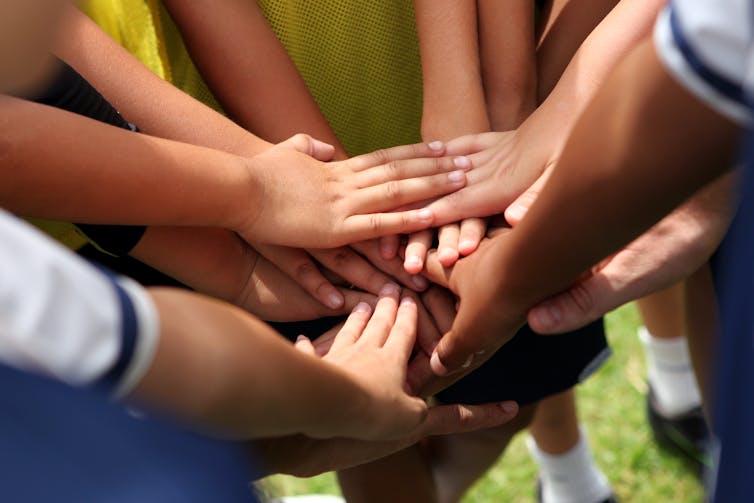
Sport in Canada misses the point: the purpose of sport is human and social development, not medals. Sport is a partnership, not a struggle, and competition is collaborative, not a zero-sum game.
(Shutterstock)
Cultural integrity depends on embedding the principles of human and social health and development in all organizational texts, practices and behaviors. Achieving a balance of power in sport therefore relies on transparent information sharing, explicit selection criteria, role clarity and expectations, and published accountability.
Canadian sport misses the point
Sport in Canada misses the point: the purpose of sport is human and social development, not medals. Sport is a partnership, not a struggle, and competition is collaborative, not a zero-sum game. After all, the Latin derivation for competition is “competite” or “to strive together”.
Sport has the greatest involvement and support of any human endeavor in the world and therefore can have the greatest impact on human development. Good sport benefits athletes, sport organizations and society at large.
A sports-centric model in Canada would make optimal sports experience our common goal and balance the forces in our system. From minor leagues to beer leagues to professional leagues, when human and social development is at the heart of sport, health, joy, community and success are the natural outcomes.
Comments are closed.