


MArcel Hug was named World Athlete of the Year with a Disability by Laureus on Sunday and he’s enjoying the feeling. “For me it’s the most important award we can win in sport,” he says, “so I’m very happy and proud of it.”
The Laureus World Sport Awards are international awards chosen by a tiny electorate of 71 people each year. Each of them are past winners – the best of the sport’s best – and every success therefore shows the respect with which athletes are held by their peers.
That Hug should be the winner of this year’s award – his fourth nomination and second success – shouldn’t come as a surprise. The “Silver Bullet”, as the Swiss wheelchair racer is known because of his distinctive metal helmet, dominated the Paralympic Games in Tokyo. He won four gold medals in the T54 in the 800m, 1500m, 5000m and marathon, setting world and Paralympic records in the process.
“I think it’s the pinnacle of my career,” says Hug, reflecting on what he describes as a “crazy” year. “Of course it was a challenge to come to Tokyo because we didn’t have a lot of competitions. I really didn’t know where I was compared to my competitors. So winning the first gold in the 5,000m was a huge relief and I was full of confidence for the next races.”
It was in the 5,000m heats that Hug finished almost a minute ahead of ParalympicGB’s David Weir, a feat that signaled the beginning of the end of their fierce rivalry, which dates back to London 2012 “Weirwolf,” but he says the two remain cordial. He received a text message from the British racer to congratulate him on his award, and Hug has already set two world records in the 5,000m this year.
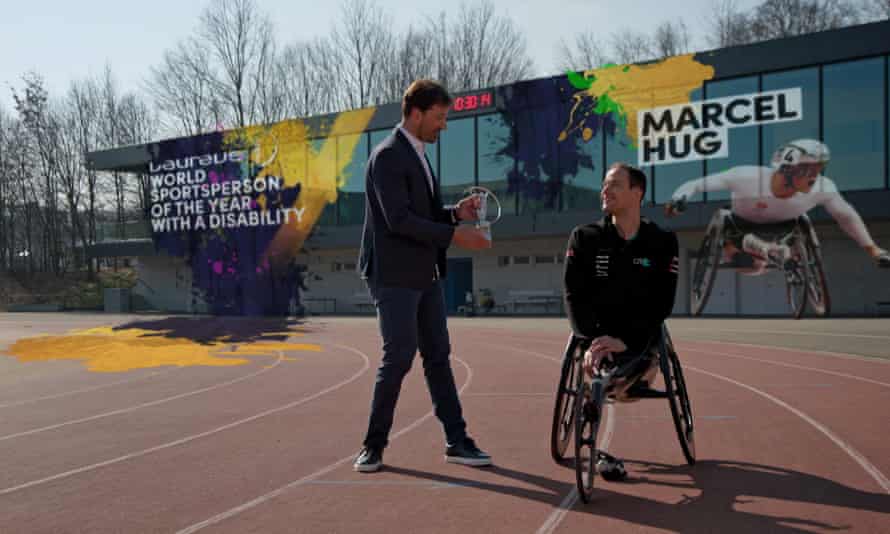 Marcel Hug receives his Laureus award from his compatriot, the cyclist Fabian Cancellara. Photo: Getty Images
“The rivalry with David is very important to me and means a lot to me,” says Hug. “We’ve competed together for so many years and being great rivals means we’ve pushed each other to our limits and made ourselves stronger. I think he was also a very important person for the London Paralympics. London 2012 was a very important game for parasport and having David there as a multiple winner gave us an extra boost.”
Hug is gracious in reflecting on Weir’s status as a parasports icon and says it never occurred to him to reflect on his own legacy until he wrapped up his Tokyo events last year. “After that everything was different. After the Paralympics I was thinking about my future, but I was also thinking, ‘What is my legacy in this sport’? Now I think for the years that I’m still racing I hope to have more influence. I really hope so.”
Hug says he has no idea what he’s going to do when he retires, but at age 35, that thought is becoming a reality. He has adjusted his sporting ambitions, shifting from plans built around four-year Paralympic cycles to ones lasting just 12 months. “It took me a long time to realize what happened in that crazy season last year,” he says, “now I want to take advantage [the time] to feel how motivated I am and how I want to continue. I’ll take it year after year from now on.”
In addition to his track record, Hug will also leave a legacy through the way he has pushed the development of technology in parasports. It was his racing chair, designed by a consortium of engineering teams including Formula One company Sauber, in which he completed his first drive in Tokyo, which Weir described as “a Ferrari of a chair”. It sparked debate about the possibility of a technological divide in a rapidly professionalizing sports world.
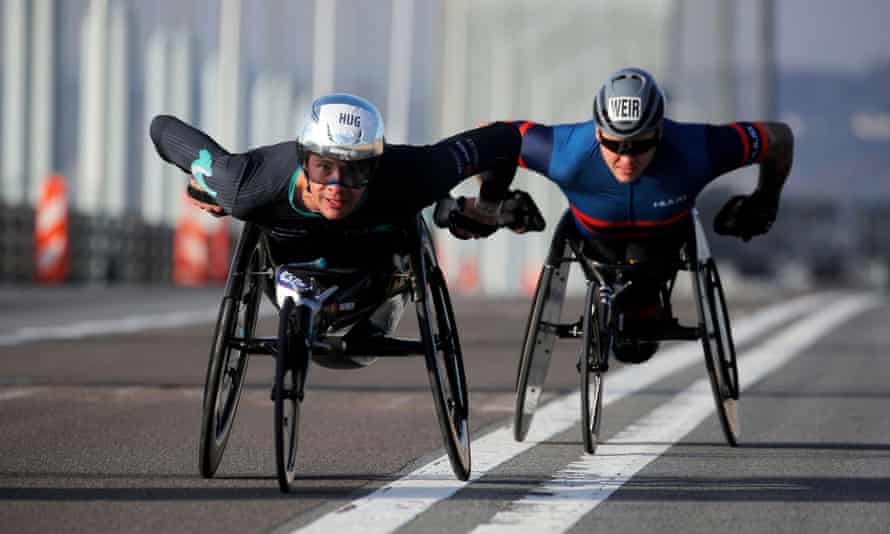 Marcel Hug and David Weir cross a bridge during the men’s wheelchair race at the New York Marathon. Photo: Brendan McDermid/Reuters
Hug says he understands such concerns but believes the benefits far outweigh them. “I totally understand that there is a lot of discussion about materials and my wheelchair in particular, and there are people who say it’s not fair,” says Hug.
“My opinion is that we are also a professional sport that we should try to develop and that includes the materials. I hope my chair will help take our sport a step further to motivate other brands of racing wheelchairs to further develop their chairs. I very much hope that it will be perceived in the same way as in a non-disabled sport like cycling or motorsport.”
Sign up for The Recap, our weekly editorial picks email.
He may not have carved his legacy in parasports for himself, but increased professionalism could well be a part of it. The dedication he has shown to his sport has not only led to great achievements but also pushed the boundaries, just as Weir has done as well.
“I really hope that we can continue on our way to become more professional, do more tour events and attract more athletes to our sport,” says Hug and is happy. “But I think we’re on the right track. The interest in parasport is greater today than in my time many years ago. I think we should continue like this.”
Comments are closed.