
Bareilly girl Khushbu takes up Malaysian sport, wins medal, gets job in army | Sports-other news


An Express Investigation: In the past few months, 15 reporters have collected data on all of India's Asian Games medalists in Hangzhou. The analysis revealed some clear trends and some fascinating athlete journeys that highlight them.
* 9 girls from low-income, low-education families availed basic SAI facilities and were able to transform their lives and increase family income.
At the age of 14, Khushbu saw a few boys playing sepaktakraw – a popular sport in Malaysia – at the SAI Center at Major Dhyanchand Stadium in Bareilly. At first, she thought the sport was another version of volleyball. She asked her father Gopal, a home guard by profession, who was stationed at the stadium, about the sport.
“There is a sports hostel in the stadium and earlier only boys from the north-east region played this sport. “My father asked one of the athletes about the game and then explained it to me,” Khushbu told The Indian Express.
Khushbu was impressed by the game and insisted to her father that she wanted to pursue the sport.


“The coach told my dad that they needed three more girls, so he started a coaching program for the girls. I brought three of my friends from school with me. We were all involved in athletics and the game is so unique that they wanted to give it a try,” she says.
In a nutshell: Khushbu was part of the team that won India's first medal in women's sepaktakraw at the Asian Games.
In addition to financial problems, the family also faced the relentless interference of annoying neighbors and nosy relatives.
“Although my family was very supportive, there were a few neighbors who had problems with me wearing shorts. “Aapki ladki ladkon ke saath khelti hai, chhote kapde pehenti hai (your daughter plays with boys, she wears short skirts).” My family was subjected to such contemptuous comments from society that anyone would have suffered mental scars. But my grandmother was built differently. She was a strong personality,” says Khushbu.
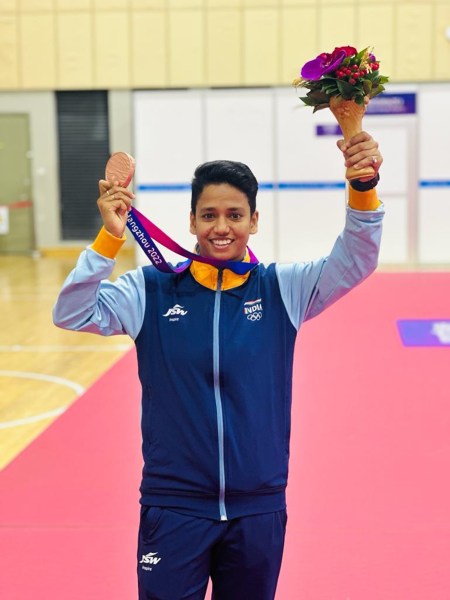 Khushbu's grandmother had a dream of seeing her in an Indian Army uniform but unfortunately she couldn't as she passed away when Khushbu completed her Sashastra Seema Bal (SSB) training.

“After hearing all these taunts, my grandmother took me to the nearest barber shop and asked the barber to give me a boy’s cut. When we returned home, before entering our house, she shouted, “Dikh rahi ye ladko ki tarah ab, khabardar ab kisi ne kuch kaha toh” (She looks like a boy now and I request everyone to do something from now on). to say to her). Since then, I’ve kept the short Hari hairstyle,” laughs the 27-year-old medalist.
Khushbu's grandmother had a dream of seeing her in an Indian Army uniform but unfortunately she couldn't as she passed away when Khushbu completed her Sashastra Seema Bal (SSB) training.
“She wanted to see me in my Indian Army dress. When she died, I was actually training. Whatever I have achieved in my life, it is all thanks to their dedication and support,” she says.
Khushbu wants more girls from Bareilly to take up the sport and she believes there will be more like her from the city to represent India.
“The reception I received upon my arrival was historic. In Bareilly, the streets are clogged because of politicians. It was a welcome change. From the stadium to the house, thousands came to greet me. It was overwhelming,” she says.
© The Indian Express Pvt Ltd
First uploaded on: 01-01-2024 at 08:27 IST
Comments are closed.