


MesquitaFMS/E+ via Getty Images
The pandemic has hit Latin America hard and its economic recovery has been slower than other regions of the world. In addition to the legacy of higher public debt, the pandemic left scars on the labor market and human capital training of future workers.
The COVID-19 crisis has receded in Latin America but has taken a significant toll. Reported deaths from the pandemic are currently low and approaching global levels. Average excess mortality during the pandemic was among the highest in the world: twice the global average and second only to Central Europe, Eastern Europe and Central Asia, according to the World Bank’s latest Latin America and the Caribbean Economic Review (Figure 1). .
Figure 1 – Excess mortality due to the COVID-19 pandemic in 2020-21 (percentage)

World Bank
Employment and GDP have already returned to pre-pandemic levels in most countries in the region. On the other hand, as the World Bank report notes, growth forecasts for the next few years suggest that they are “resiliently mediocre”. Economic growth is not expected to exceed the pace of the 2010s.
The post-pandemic recovery partially reversed the poverty rise of 2020-21. But the permanent losses in gross domestic product (GDP) during the pandemic have not been recouped, nor have the long-term scars on health, education and future inequality been removed.
The Russian invasion and war in Ukraine also had an economic impact on the region, mainly through the shock to commodity prices and the consequent rise in domestic inflation rates. While commodity exporters (importers) had positive (negative) impacts on their GDP, they all faced higher food and energy inflation due to trade conditions, which particularly affected the bottom of the income pyramid, given the weight of these goods in their consumption basket.
Growth forecasts for the region this year have risen steadily since January – in contrast to downgrades for the rest of the world over the war in Ukraine. The GDP of net food and fuel importers such as the Caribbean and Central American countries has been negatively impacted. Rising prices for these commodities have also hit households across the region. On the other hand, the overall increase in commodity prices relative to GDP has been a boon for regional exporters such as Argentina, Brazil, Chile, Colombia, Ecuador and Peru.
For commodities as a group, 2022 was a very volatile year. After a dramatic rise in the first half, prices fell in the third quarter, reflecting the slowdown in China and the appreciation of the US dollar. The supply shock caused by the war in Ukraine was followed by falling demand.
According to the IMF’s World Economic Outlook published two weeks ago, the tailwind from commodity prices should change direction. As for oil prices, futures markets are pointing to a decline in the coming years after rising 41% in 2022. Russia’s invasion of Ukraine has pushed base metals prices higher, but they are expected to end 2022 at an average of 5.5% lower levels and decline a further 12.0% in 2023. The IMF report forecasts a more modest decline in precious metals prices: 0.9% in 2022 and another 0.6% in 2023.
Food commodity prices, which also rose sharply after Russia invaded Ukraine, fell to pre-war levels this summer, ending a two-year rally. Not before average food price inflation rates are increased by 5 percentage points in 2021, plus an estimate of 6 percentage points in 2022 and 2 percentage points in 2023.
The asymmetric impact of higher commodity prices on the region’s population, which primarily undermines the purchasing power of the bottom of the pyramid, has been accompanied – to varying degrees – by social transfers and other forms of support. The lack of readily available fiscal space for such use was a limitation.
The increasing frequency and reporting of adverse weather events, which are likely already reflecting climate change, has also been another source of shocks in food and energy prices. In recent years, more frequent floods and droughts have affected food and energy supplies in China, India, Europe, the US, Africa and Latin America itself. Climate change, plague (pandemic), war and the increased risks of hunger formed a “perfect storm”.
In addition to the impact of these three shocks, a fourth source has emerged with the tightening of global financial conditions. The high global inflation was countered with a more restrictive monetary policy by the central banks in the advanced economies.
Growth momentum surprised to the upside for most of the region, helped by the return of services and employment to pre-pandemic levels and by until recently benign external conditions – including still high commodity prices, still-strong external demand and additional remittances to return of tourism. These were the explanatory factors for the growth forecasts for this year, which have been revised upwards since January.
But tightening global financial conditions are now pushing in the opposite direction. The availability and cost of domestic financing has become less benign as the region’s main central banks have raised interest rates in a bid to control domestic inflation. Capital inflows fell and borrowing costs rose due to investors’ reduced appetite for risk.
The region is generally more resilient to a sustained monetary and financial shock like this than in previous periods. Banking systems are healthier and public balance sheets in general are not as vulnerable as at other times in the past. The cushion of foreign exchange reserves also makes a difference in many cases.
However, corporate debt outside the banking system is an issue that deserves attention. Higher domestic interest rates will also tighten conditions for government debt rollovers (Figure 2).
Figure 2 – High debt
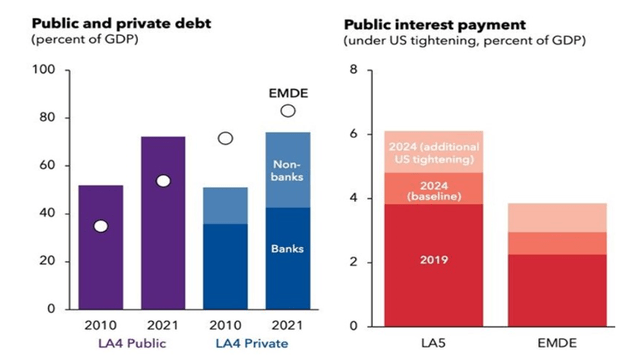
IMF
Note: LA4 = Brazil, Chile, Colombia and Mexico; LA5 = LA4 plus Peru; EMDE = Emerging Market and Developing Economies.
After the upside surprises in GDP growth in 2022, the expected performance for next year is weaker. While the IMF and World Bank expect an average GDP growth rate of 3.5% and 3% respectively for 2022, their forecasts are falling to 1.7% and 1.6% respectively in 2023.
Latin America’s recovery from the perfect storm should not be limited to a simple return to pre-pandemic “moderate” manufacturing growth. Investing in green infrastructure, exploring areas of digital connectivity opened up by the pandemic, and improving the business environment and education can lead to a shift towards more resilient, inclusive and dynamic growth patterns.
Comments are closed.