
Why Black Wednesday still matters – It was the start of markets telling politicians what to do


I spent Black Wednesday – the day the markets successfully bet against the UK government’s power to support the pound sterling – on the 28th floor of Dresdner Bank’s headquarters in Frankfurt. I had just been hired as an exchange student in the FX Options and Interest Rate Derivatives back office. Although all days were busy on the trading floor, I had never seen anything like this before.
From one end of the room to the other, men in suits (there were few women) were yelling through the phone lines, yelling at each other, or doing both at the same time. There were piles of feather-light trade notes with numbers scrawled on them: 10, 50 or 100 million Deutschmarks, dollars, francs or pounds.
The excitement centered on the Exchange Rate Mechanism (ERM), the framework put in place by the European Economic Community in 1979 to keep its members’ currencies in a “trading band” of similar values. If a currency threatened to break its bond, central banks had to intervene. This precursor to the euro was designed to avoid wild currency fluctuations and high inflation and has performed quite well for years.
Eight countries initially joined: France, West Germany, Belgium, Luxembourg, Ireland, Denmark, Italy and the Netherlands. As a traditionally strong currency in a country with low and stable inflation, the West German Deutsche Mark (DM) acted as a de facto anchor.
France has even coined a new term for the impact of the ERM on its national currency. “Frankenfort” or “strong franc” was not only a homage to the strong anchor, but also a cheeky reference to the German financial metropolis.
Enter the British
The British famously stayed out of the ERM in the 1980s because Margaret Thatcher did not want monetary policy to be subordinated to Brussels. When she finally agreed to join in October 1990, in the last days of her tenure as Prime Minister, she fixed the pound at £1.00 = DM2.95 plus or minus 6%, meaning that it would be between 2, 77 DM and 3.13 DM could fluctuate.
However, the nation had just entered a recession. Amid high inflation, high interest rates, high government deficits, a collapsing housing market and poor competitiveness, traders became increasingly doubtful about the Bank of England’s ability to defend the DM2.77 floor.
To rub salt in the wounds, after German reunification in 1990, West German Prime Minister Helmut Kohl generously offered a 1:1 exchange rate for East Germans exchanging GDR marks for D-marks. This spurred inflation in Germany, and the Bundesbank responded by raising interest rates.
This strengthened the Deutsche Mark, making it harder for the pound and other currencies to stay within their ranges. Nonetheless, Thatcher’s successor, John Major, pledged to defend the pound at all costs. Those were the days when interest rate decisions were ultimately made by the government, not the Bank of England.
On the morning of September 16, 1992, after weeks of mounting pressure, the Bank of England was forced to unexpectedly raise interest rates from 10% to 12%. Interest rates had been at these levels in 1988-91 to stave off a boom, but a hike was the last thing the economy needed during a recession.
Norman Lamont.
Allstar Picture Library Ltd
Forex traders were unconvinced that a rate hike would work and doubled their bets that the band wouldn’t hold. And even when the bank frantically announced in the afternoon that it would hike interest rates to 15%, it did not buoy the pound. At 7pm it was game over: Chancellor Norman Lamont announced Britain was leaving the ERM.
The pound has now returned to ‘swimming’. Or more specifically, it went down like a rock, falling from over $2 to under $1.50 in the coming weeks. The whole event caused the ruling Conservatives a severe loss of credibility. George Soros, a leading currency trader, reportedly made £1 billion betting against sterling.
Central bank independence
Black Wednesday can be placed alongside other turning points in contemporary British-European political history, such as leaving the euro, not joining the Schengen area of free movement and of course Brexit.
But from an economic point of view, its effects are arguably unique. The crisis, which also put the Italian, Swedish and Finnish currencies under pressure, led to a consensus that central banks should become independent of their governments and focus on inflation and essentially nothing else.
The Bank of England became officially responsible for fighting inflation in October 1992 before gaining independence in 1997 under the administration of Tony Blair. The European Central Bank (ECB), modeled mostly on the Bundesbank, has focused only on fighting inflation since its inception in 1999, and many others have followed suit.
But Black Wednesday’s true legacy is that it was the day the state fought the markets and the markets won. The financial markets took over and few have dared to challenge them since.
The new rulers
Of course, there are other events that symbolize the rise of market thinking: Thatcher’s “Big Bang” deregulation of the City of London in 1986, the fall of the Berlin Wall in 1989, and arguably even Blair’s election victory in 1997. But Black Wednesday’s timing was perfect. The ideological and institutional foundations for free markets had been laid.
Capital was allowed to flow across borders. Financial innovations had ensured that markets had grown just big enough to be reckoned with. When they struck the heart of the establishment in September 1992, it killed any notion that they could be tamed through democratic means.
Increasingly larger and more powerful, they evolved into machines that immediately deliver unsentimental judgments about the history that politicians and policymakers are attempting to write. It has become futile to fight back because the markets are considered “right”.
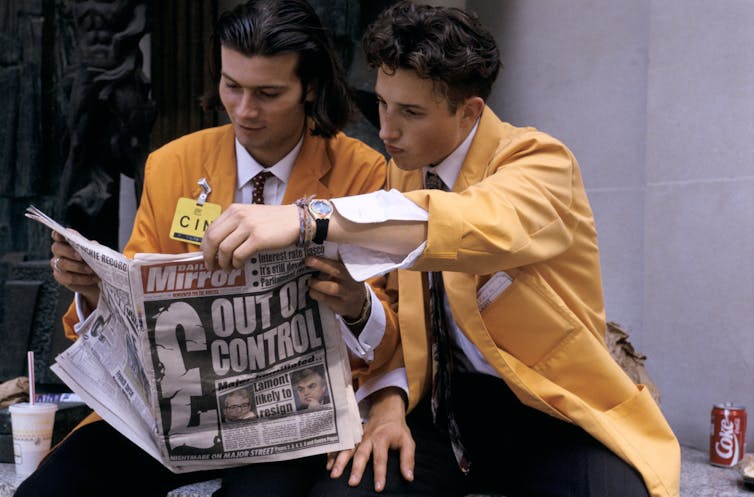
The era of dealer dominance had begun.
John Sturrock/Alamy
Instead, politicians compete to please these new rulers. Look no further than former Chancellor Rishi Sunak, who warned that Liz Truss’ campaign promises would cause markets to lose confidence in the UK economy. He may not have won voters over, but Truss will no doubt change course if there are any signs that investors are losing faith in her policies.
To paraphrase the late philosopher Mark Fisher, it has become easier to envision an end of the world than an end to market domination. If I had to pick a day in history to symbolize the supremacy of markets over states and democracies, Black Wednesday would be it.
Comments are closed.