


DNY59/E+ via Getty Images
When does the bear market end? That’s the question everyone wants an answer to. While there is no specific answer to this question, there are indicators and technical measures that provide some guidance. From a portfolio management perspective, they are are the parameters by which we must work to minimize capital destruction and limit emotionally driven failures.
2022 was a year that many investors have not experienced in their investment lives. While some weathered the 2008 bear market, fewer still survived the dot.com crash. Such is the nature of “true” bear markets, which tend to destroy investors and discourage them from investing in the financial markets on a sustained basis.
While there are many “buy-and-hold” practitioners who suggest to investors that they only make it through a downturn at the average dollar cost, the reality tends to be quite different. When the markets fall enough, there comes a point where every investor goes from “buy the dip” to “get me out.”
When it comes to investing, most armrest portfolio management systems work great when markets are rising. However, when the eventual correction comes, the psychology of “loss aversion” disrupts the best plans.
It’s also important to understand that “bear markets” are just the natural conclusion of a “full market cycle.” Excesses are built up during bull markets, which are reflected in valuations as investors overpay for assets on the expectation of never-ending growth. Since the business cycle is not infinite, the ensuing bear market is obviously the reverse of these excesses. ‘Bear markets’, while often surprising investors, are the logical conclusion of the previous uptrend.
With a potential bear market looming while the Fed hikes rates, inflation stays high and the economy continues to slow, we come to the question at hand:
“When will this bear market end?”
evidence of the bear
There is considerable technical evidence that US financial markets are in a “bear market”. The NYSE Composite (US stocks + ADRs + bond ETFs) has fallen below its 100-week moving average. For the past 25 years, every recession and/or crisis has coincided with a break of this long-term moving average.

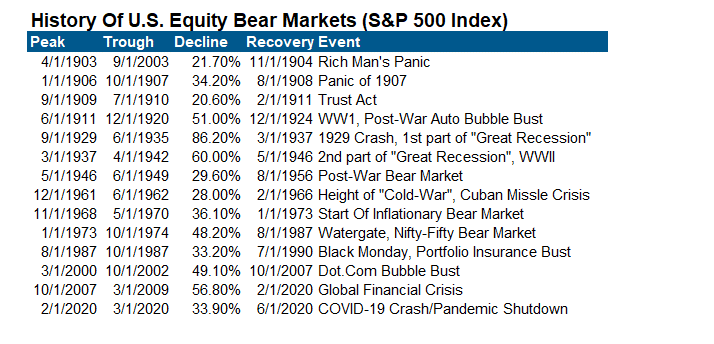
As mentioned above, bear markets are not uncommon and follow previous bull market excesses. Over the past 120 years, there have been 14 bear markets that have averaged declines of about 33% from peak to trough.
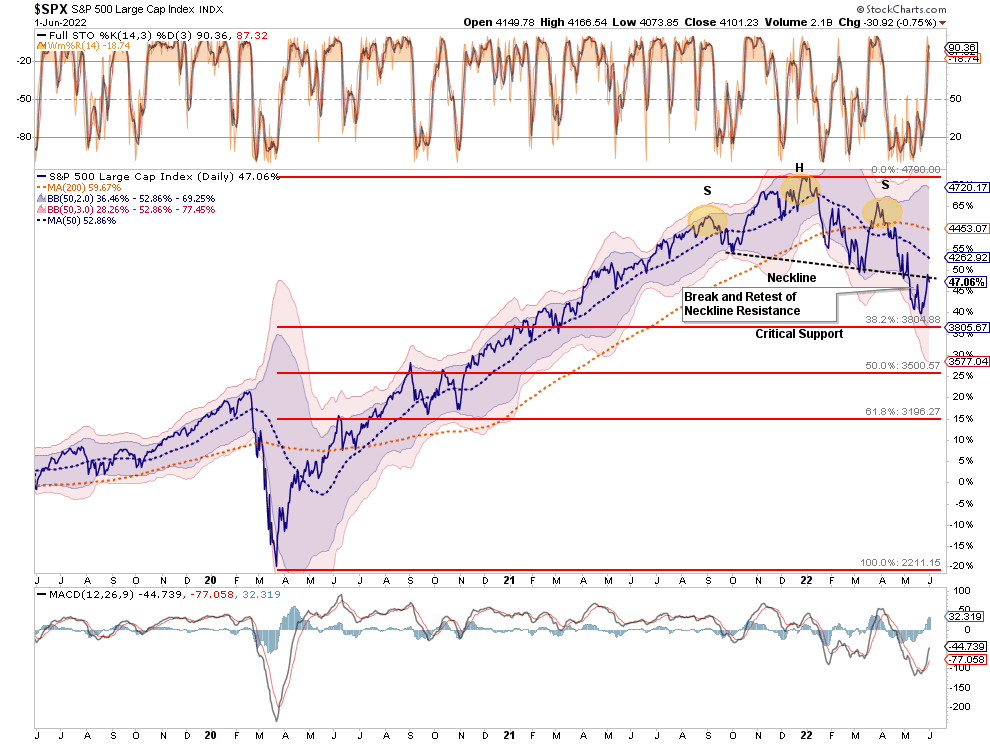
As I recently discussed The market’s price action in 2022 bears many similarities to what we saw in 2008 before the collapse of Lehman Brothers.
“The head and shoulders topping pattern is pretty obvious. The break of the rising neckline was the first warning of a recessionary bear market.

We see the same market action in 2022.
Again we see the topping process, the clear break of the neckline and a failed test of the neckline turning it into resistance. With the market sitting at critical support, any failure will confirm a recession and a bear market is underway.
The technical data only confirm what we are already seeing from an economic point of view. The EOCI (Economic Composite Output Index) is shrinking rapidly as the Leading Economic Index (LEI) confirms the data trend. While the negative Q1 GDP could easily reverse in Q2, that will not change the eventual recessionary outcome.

The bear market will end… Eventually
There are certainly many technical and economic reasons supporting negative market views, but it’s important to remember that bear markets eventually end. Yes, while this may seem tautological, investors tend to extrapolate current market trends indefinitely into the future.
The question is how will we know when the current bear market cycle is over? As financial markets lead business cycles, the market can provide several clues as to when things may turn more positive from an investment perspective.
The first is the most obvious; Asset prices stop falling. Using our 2008 analogy, after emerging from a bear market, stock prices begin to establish a series of higher highs and higher lows. More importantly, you are starting to see that the momentum gauges are also establishing a more positive trend and the moving averages are trending up.
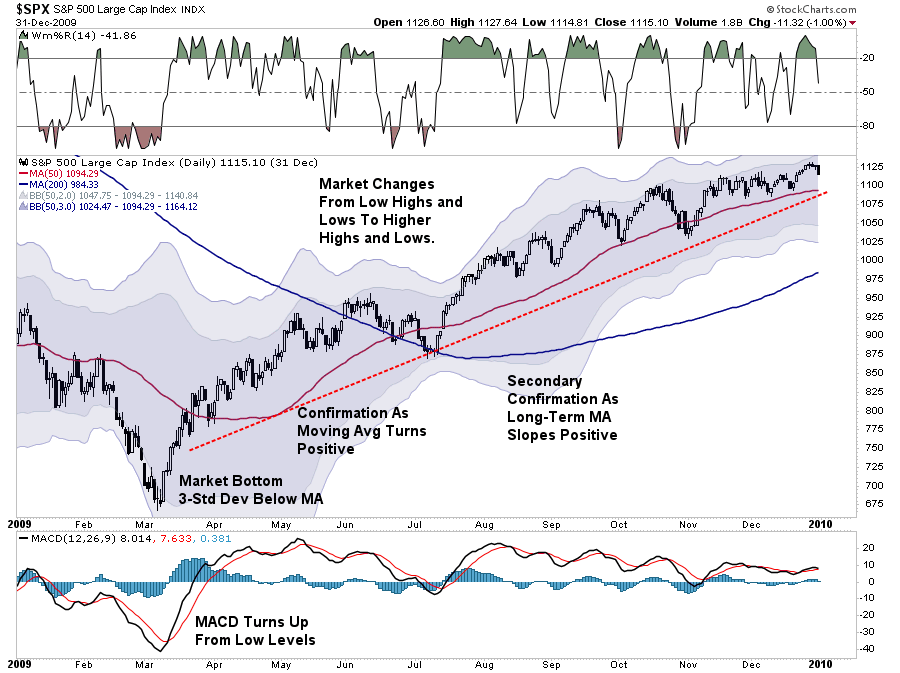
Remarkably, the economy did not emerge from recession until June 2009, but the financial markets hopefully began to recover.
Furthermore, during the last four recessions and subsequent bear market, the typical revision of consensus EPS estimates before the onset of a recession ranged from -6% to -18%, with a median of 10%. After the recession, analysts start raising estimates significantly. Currently, we are just beginning the negative revision phase, but the reversal of this trend will be crucial to see the end of the bear market.

While there are many other indicators worth watching to signal an end to the bear market phase, the most critical aspect of investing results is staying disciplined in your process.
Stick to your process
There is a significant number of investors and advisors who have never experienced a true bear market. After a decade-long bull market cycle fueled by central bank liquidity, it’s understandable why mainstream analysis believed markets could only go higher. What always worried us was the rather easygoing attitude they took towards risk.
“Sure, there will be a correction at some point, but that’s just part of it.”
What is lost during bull cycles, and always found in the most brutal of ways, is the devastation inflicted on financial wealth during the inevitable decline.
Therefore, following your investment discipline remains important. If you don’t have one, here’s the process we follow in troubled markets.
7 rules to follow
- Move slowly. There is no rush to make dramatic changes. Doing something in a moment of “panic” tends to be the wrong thing to do.
- If you’re overweight stocks, don’t try to fully adjust your portfolio to your target allocation in one go. Again, after large declines, individuals feel like they “have to” do something. Think logically about where you want to be and use the rally to adjust to that level.
- Start selling laggards and losers. These positions weighed on performance as the market rose and led on the way down.
- Add to sectors or positions that are performing or outperforming the broader market when you need risk exposure.
- Move the “stop loss” levels to recent lows for each position. Managing a portfolio without “stop-loss” levels is like driving with your eyes closed.
- Be prepared to sell into the rally and reduce overall portfolio risk. There are many positions that you will sell at a loss simply because you overpaid for them to begin with. Selling at a loss doesn’t make you a loser. It just means you made a mistake. Sell it and continue managing your portfolio. Not every trade will always be a winner. But remaining a loser will make you a loser of capital and opportunity.
- If none of this makes sense to you, please consider hiring someone to manage your portfolio for you. The extra effort is worth it in the long run.
I hope it helps.
Original post
Editor’s note: The summary bullet points for this article were selected by Seeking Alpha editors.
Comments are closed.