


RollingCamera/iStock via Getty Images
By Brett Friedman
As is usual in war, its course was unpredictable and even surprising. Yogi Berra put it best: “It is difficult to make predictions, especially when it comes to the future.” The Russians, like most foreign policy, defense and strategy experts, initially speculated that their armed forces would quickly and easily overwhelm Ukraine and Putin and his new nomenklatura would emerge victorious.
Needless to say, it didn’t quite turn out that way. Ukrainian resistance is more widespread and the Russian military faces major logistical, tactical and leadership problems. To say that, as usual, the consensus was wrong and the outcome unclear is a gross understatement.
The number of options traders who have seen the onset of geopolitical hostilities seems to be shrinking each year (and that’s a good thing, as it means protracted gunfights are becoming less common). Institutional memory is fading and lessons learned the hard way, such as the ins and outs of analyzing and trading options in an environment where an extreme fundamental shock dominates the market, are being forgotten. The implications are not obvious, usually go against consensus, and are sometimes counterintuitive. In short, the short-term ramifications can hold some interesting surprises, and the long-term ramifications aren’t as drastic as one might think.
Short-term market implications: Crude oil volatility is behaving unusually
Russia’s economy is commodity-based (crude oil, natural gas, coal, wheat, and base and strategic metals), so it’s not surprising that related futures markets have shown the greatest short-term impact on both underlying prices and implied volatility. Some examples:

OptionMetrics
OptionMetrics

OptionMetrics
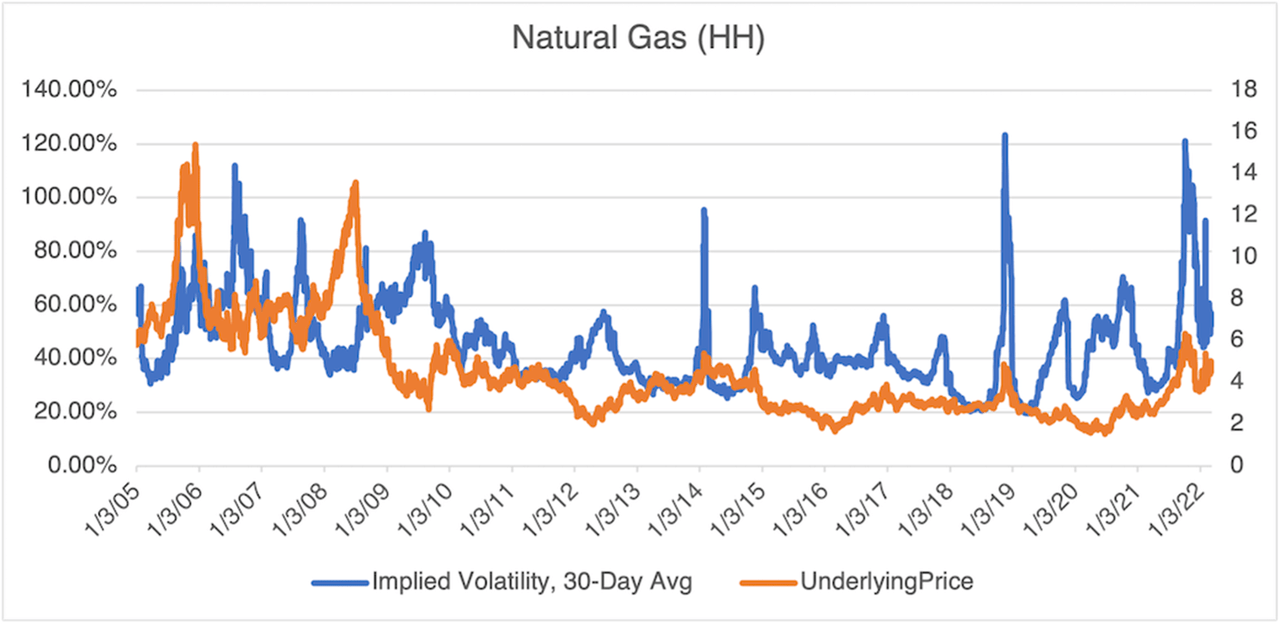
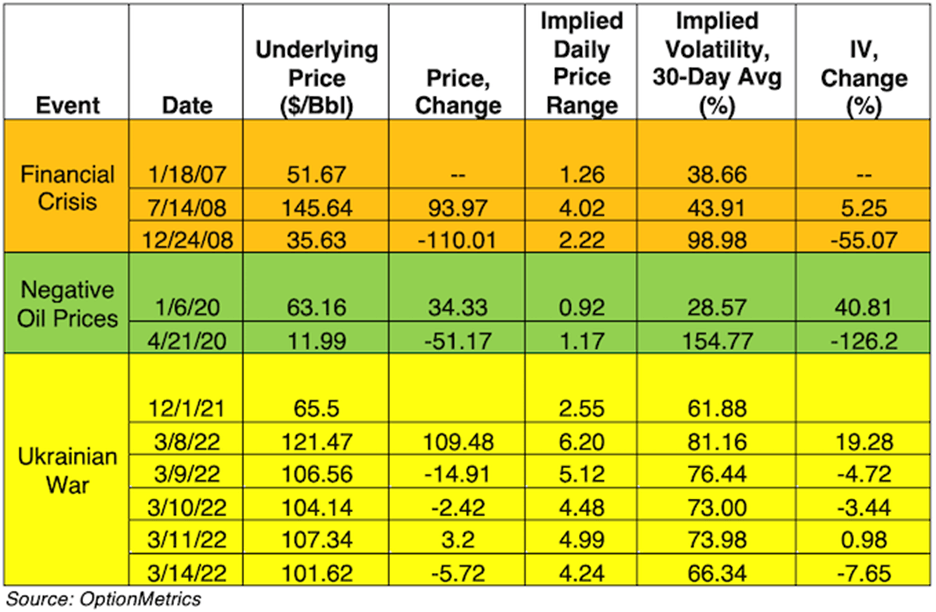
Crude Oil (WTI) futures experience implied volatility shocks that often occur during periods of major geopolitical, societal and financial disruption: Gulf Wars I and II, the 2008 financial crisis, the outbreak of Covid and negative oil prices. Given the seriousness and potential of the Ukrainian war, this is not surprising.
Historically, crude oil’s implied volatility has tended to rise fastest and most when prices are falling rapidly. In fact, the highest implied volatility ever recorded for crude oil (198.25%) was recorded in April 2020 when the front month futures price temporarily turned negative during the trading session. Conversely, when crude oil prices rise sharply, the upward reaction of implied volatility (IV) tends to be more muted. This behavior has obvious implications for options strategy and positioning in crude oil.
The war in Ukraine is obviously having an impact on the market, but its impact on implied volatility has not been as impressive. Since early December last year, around the time the war news began to affect the market, Crude Oil has peaked at $121.47, up about $56. At the same time, implied volatility increased by just 19.3% at its peak. It’s even lower now: Crude IV is up just 4% since early December as the market grows more accustomed to the war. However, this is somewhat deceptive, as we shall see below.
Converting the daily implied volatility values into the daily implied price range yields a range that is the widest since 2007, and by a wide margin:

OptionMetrics
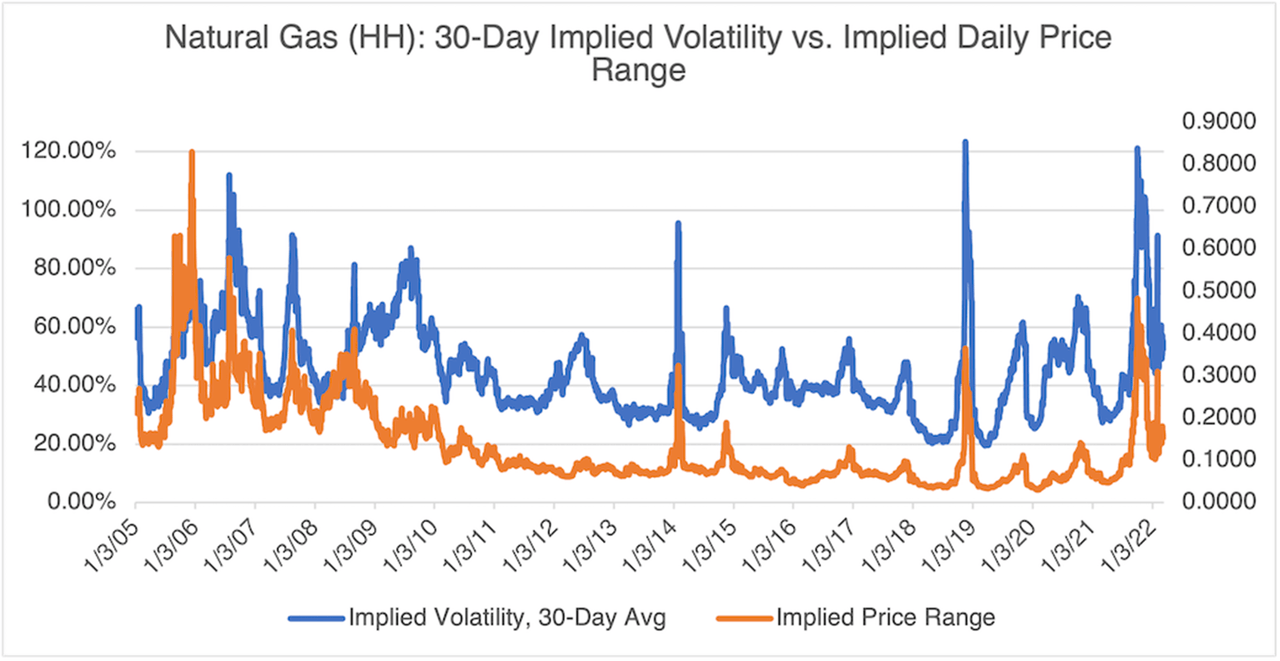
The high implied daily price range is not shown for natural gas:
OptionMetrics
For Crude Oil, this suggests that the current implied volatility levels are unlikely to be warranted given the abnormal implied range.
Long-Term Market Impact: Not what you might think
Despite the current uncertainty and accompanying concerns, one should keep an eye on the Russia-Ukraine conflict. As the table below shows, the long-term effects of wars and other acts of violence on financial markets are not as significant as one might think.

Our conclusions:
- Geopolitical shocks that have a truly lasting impact on stock markets (i.e. longer than about three months in the S&P 500 Index from bottom to recovery) are rare: only two out of 21 events, Pearl Harbor and the First Gulf War, qualify in the last 81 years .
- Pearl Harbor, one of the most momentous events of the 20th century, resulted in a market decline of a little under 20% (the level commonly perceived as a bear market). Still, the market recovered in less than a year, and one can hardly get a bigger shock than World War II.
- Geopolitical shocks assume pre-existing economic conditions and must be truly global in nature to have lasting effects. In other words, they tend not to change the underlying trend, but rather act as a catalyst for the factors that previously weighed on the market. In the current environment, for example, the war in Ukraine has served to accelerate the inflation trend that was already in place before the war.
Originally published on MoneyShow.com
Publisher’s Note: The summary bullet points for this article were selected by Seeking Alpha editors.
Comments are closed.