


The strongest to the weakest of the major currencies
USD is strongest and NZD is weakest as markets are in turmoil. Flight to safety is in play as the JPY is also sharply higher. That EUR
EUR
The Australian dollar (AUD) is the official currency of Australia, which is also used in Christmas Island, Cocos (Keeling) Islands, Norfolk Island and independent Pacific states. Introduced in 1966, the AUD is currently the fifth most traded currency in the world, behind only the US dollar, the euro, the Japanese yen and the British pound. The currency is very important to the FX markets and is routinely used as a carry trade against other majors. The Reserve Bank of Australia (RBA) is the central currency banking authority charged with managing and issuing AUD banknotes. What Factors Affect AUD? The AUD is more sensitive than other currencies to macroeconomic factors. Overall, monetary policy is the biggest mover of currency, including interest rate differentials. Beyond Australia, commodity prices such as precious metals and others are also important to the AUD and can cause its value to fluctuate relative to other currencies. Global Risk Sentiment and Confidence are also indicators that are closely followed due to their correlation to the AUD. This is because the AUD is considered a commodity currency and is also used as one of the most popular growth and risk indicators in the global financial markets. All Positive Sentiment in the world market is likely to cause the AUD to rise, while when pessimism prevails, the AUD will often fall. Domestically, government credit ratings can also affect the AUD. Australia’s credit rating affects the risk profile of its debt. This trend directly impacts the cost the government has to pay for the debt it owes.
The Australian dollar (AUD) is the official currency of Australia, which is also used in Christmas Island, Cocos (Keeling) Islands, Norfolk Island and independent Pacific states. Introduced in 1966, the AUD is currently the fifth most traded currency in the world, behind only the US dollar, the euro, the Japanese yen and the British pound. The currency is very important to the FX markets and is routinely used as a carry trade against other majors. The Reserve Bank of Australia (RBA) is the central currency banking authority charged with managing and issuing AUD banknotes. What Factors Affect AUD? The AUD is more sensitive than other currencies to macroeconomic factors. Overall, monetary policy is the biggest mover of currency, including interest rate differentials. Beyond Australia, commodity prices such as precious metals and others are also important to the AUD and can cause its value to fluctuate relative to other currencies. Global Risk Sentiment and Confidence are also indicators that are closely followed due to their correlation to the AUD. This is because the AUD is considered a commodity currency and is also used as one of the most popular growth and risk indicators in the global financial markets. All Positive Sentiment in the world market is likely to cause the AUD to rise, while when pessimism prevails, the AUD will often fall. Domestically, government credit ratings can also affect the AUD. Australia’s credit rating affects the risk profile of its debt. This trend directly impacts the cost the government has to pay for the debt it owes.
Read this term follows the NZD.
The S&P is expected to open in bear-marker territory (down over 20%) as shares take another big move lower in premarket trading. That Nasdaq
NASDAQ
The Nasdaq Stock Market or NASDAQ is an American stock exchange. It trails only the New York Stock Exchange (NYSE) in market capitalization and is part of a network of stock markets and options exchanges. Founded in 1971, NASDAQ is the acronym for the National Association of Securities Dealers Automated Quotations. It has since been known simply as NASDAQ and has grown to become one of the most influential exchanges in the world. The NASDAQ was the world’s first electronic stock market and has since taken over the majority of large trades that were previously executed over the counter (OTC) trading system. What makes the NASDAQ different? Notably, the exchange also offers the NASDAQ Composite, which includes almost all stocks listed on the NASDAQ exchange. Along with the Dow Jones Industrial Average (DIJA) and the S&P 500 Index, this is one of the top three most visited stock market indices in the United States. Overall, the NASDAQ stock market has three distinct market tiers. This includes the capital market, or a stock market for companies with relatively small market capitalizations. Listing requirements for small-cap companies are less stringent than other Nasdaq markets, which list larger companies with significantly larger market capitalizations. In addition, the Global Market consists of stocks representing the Nasdaq Global Market. The Global Market consists of 1,450 stocks that meet the stock market’s financial and liquidity requirements and corporate governance standards. Finally, the Global Select Market is a market capitalization-weighted index composed of 1,200 US-based and international stocks representing the Global Select Market.
The Nasdaq Stock Market or NASDAQ is an American stock exchange. It trails only the New York Stock Exchange (NYSE) in market capitalization and is part of a network of stock markets and options exchanges. Founded in 1971, NASDAQ is the acronym for the National Association of Securities Dealers Automated Quotations. It has since been known simply as NASDAQ and has grown to become one of the most influential exchanges in the world. The NASDAQ was the world’s first electronic stock market and has since taken over the majority of large trades that were previously executed over the counter (OTC) trading system. What makes the NASDAQ different? Notably, the exchange also offers the NASDAQ Composite, which includes almost all stocks listed on the NASDAQ exchange. Along with the Dow Jones Industrial Average (DIJA) and the S&P 500 Index, this is one of the top three most visited stock market indices in the United States. Overall, the NASDAQ stock market has three distinct market tiers. This includes the capital market, or a stock market for companies with relatively small market capitalizations. Listing requirements for small-cap companies are less stringent than other Nasdaq markets, which list larger companies with significantly larger market capitalizations. In addition, the Global Market consists of stocks representing the Nasdaq Global Market. The Global Market consists of 1,450 stocks that meet the stock market’s financial and liquidity requirements and corporate governance standards. Finally, the Global Select Market is a market capitalization-weighted index composed of 1,200 US-based and international stocks representing the Global Select Market.
Read this term is about 30% below its high (at premarket levels).
Yields are higher after Friday’s stronger than expected US CPI. Yields rose double digits in the US earlier in the week. Meanwhile, Italian 10-year yields are up nearly 17 basis points as yield spreads continue to widen in Europe (German 10-year is up 10.6 basis points).
Bitcoin crashed over the weekend when Celcius — one of the largest crypto lending companies — abruptly halted customer withdrawals. Bitcoin is down -13.86% today and traded as low as $23424. As a reminder, the digital currency traded above and below the $30,000 mark on Friday.
The Fed and Bank of England are likely to hike rates this week in an environment of high inflation as markets fall and household wealth plummets. Gas is above $5 but oil is lower today.
China is testing almost all of Shanghai as it continues to battle the pandemic. The implications will reverberate around the glove
A snapshot of the markets shows:
- Spot gold is trading around -$20.30 or -1.10% around $1850
- Spot silver is trading down -$0.25 or -1.15% from $21.62
- WTI Crude Oil is trading down -$1.84 from $118.81
- Bitcoin is trading at $24,153 after Friday’s close, just below the $30,000 mark (see Celsius report above). Bitcoin low price reached $23,424.42
In the pre-market for US equities, the futures markets imply a notably lower open after Friday’s sharp declines
- Dow is trading down -493 points after Friday’s -880 point drop
- The S&P index is down -80 points after falling 116.96 points on Friday
- The NASDAQ index is down -307 points after falling -414.20 points on Friday
In Europe, the major indices are significantly lower
- The German DAX is down -263.22 points or -1.91% to 13497.13
- France’s CAC dropped -126.58 points or -2.05% to 6060.66
- The UK FTSE 100 is down -89.35 points or -1.22% at 7228
- Spanish Capricorn is down -154 points or -1.84% to 88236.89
- Italy’s FTSE MIB fell -503 points or -2.23% to 20244
In the US bond market, yields change slightly with the shorter end being higher and the longer end being lower:
- 2 years 3.17%, up 12.1 basis points
- 5 years 3.379%, +12.5 basis points
- 10 years 3.2572% +10 basis points
- 30-year 3.279%, up 8.3 basis points
In the European bond market, benchmark 10-year yields are all significantly higher, with Italian and Spanish yields leading the way higher:
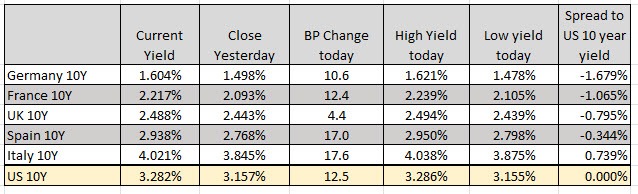 European 10-year yields are consistently higher
Comments are closed.