


Wall Street stocks rebounded from a sharp early sell-off on Thursday triggered by hotter-than-expected US inflation data.
The broad S&P 500 ended the day up 2.6 percent after falling as much as 2.4 percent at the start of the session. The Nasdaq Composite rose 2.2 percent, recovering from a decline of about 3.2 percent.
The latest bout of stock market volatility came after the closely-watched US CPI for September landed at 8.2 percent, marking a slight decline in the annual inflation rate from 8.3 percent in August, but above economists’ forecast of 8.1 lay percent.
Core CPI, which excludes food and energy prices, came in at 6.6 percent, ahead of expectations of 6.5 percent and the previous month’s reading of 6.3 percent.
There were many explanations for the dramatic recovery in stocks. Some investors argued that the sell-off in stocks over the past few weeks had been overdone and traders capitulated on Thursday. CPI data also tends to be backward-looking and some investors have suggested that more recent data, particularly on rental costs, shows falling prices.
“You had a complete reversal and it looks like a surrender. The sell-off was overdone,” said Andy Brenner, head of international fixed income at NatAlliance, who said he’s heard from some investors covering their short positions, which may have contributed to the reversal in stocks.
“The reasons the CPI number was bad were very backward looking. [Real estate broker] Redfin numbers show that rents are falling, so there’s a real disconnect between the CPI data and forward-looking numbers,” said Brenner.
The dollar rose immediately after the CPI report but later reversed gains, trading down 0.7 percent against a basket of six peers. The dollar’s strength helped the Japanese yen fall to its lowest level since 1990 at 147.67 yen on Thursday.
US Treasuries were hit by a sell-off following the release of CPI data, pushing yields higher, but this eased later in the session, with the US 10-year yield falling 0.06 percentage point to 3.96 percent rose. The two-year yield, which is more sensitive to interest rate expectations, rose 0.19 percentage points to 4.48 percent. Bond yields rise when their prices fall.
Market participants have been scrutinizing reports of price growth and employment in the US economy for signs of how aggressively the Federal Reserve and its international peers will tighten monetary policy. Fears have increased this year that the string of rate hikes to contain inflation will trigger a protracted slowdown.
Futures markets on Thursday signaled that investors had raised their expectations of how much the Federal Reserve will raise borrowing costs, and are now expecting interest rates to be close to 4.9 percent by May 2023, versus forecasts of just under 4 .65 percent the day before.
The Fed has already hiked borrowing costs by 0.75 percentage points at each of its past three meetings and raised its benchmark interest rate to a range of 3 to 3.25 percent. Markets are pricing in expectations of a fourth straight rise of a similar magnitude.
The Fed said in minutes of its September policy meeting released on Wednesday that the central bank was concerned about doing “too little” to stem rising inflation.
Recommended
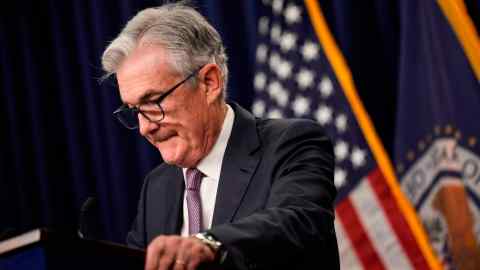
“Rising prices, combined with last month’s stronger-than-expected jobs report, almost guarantee the Fed will deliver its fourth 0.75 percentage point rate hike when officials next meet in November,” said Richard Flynn, managing director of Charles SchwabUK.
The stock and bond markets have come under massive pressure this year due to rising interest rates and the prospect of further monetary policy adjustments.
Higher borrowing costs have hampered the appeal of more speculative stocks that were winners earlier in the coronavirus pandemic and hurt their projected cash flows, which are typically modeled into the future. The tech-heavy stock index Nasdaq Composite is down about a third this year.
Elsewhere, Europe’s regional Stoxx 600 stock index closed 0.8 percent higher, recovering from earlier losses. Hong Kong’s Hang Seng closed 1.9 percent lower.
The pound rose 1.9 percent against the US currency to $1.13 on news that UK Prime Minister Liz Truss was in talks of a U-turn on the government’s ‘mini’ budget.
Comments are closed.