


US Highlights
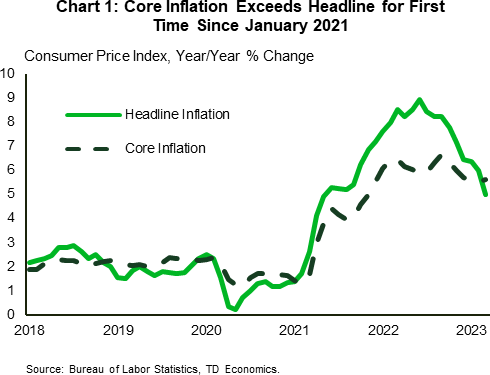
- Headline inflation rose 0.1%m/m in March, while core inflation rose a strong 0.4%m/m. The 12-month change in the headline slipped to a nearly two-year low of 5%, while the core rose to a still-uncomfortable 5.6%.
- Retail sales (-1.0% m/m) fell again in March, falling for the second straight month after an unusually strong start to the year. Declines were seen in most categories, resulting in a weak handover in Q2.
- Although there are tentative signs the economy is cooling, the US Federal Reserve is likely to hike another 25 basis points in May before pausing to better assess the full impact of the rate hikes.
Canadian Highlights
- The Bank of Canada kept interest rates on hold at 4.50% for the second consecutive month. Markets believe rate cuts are coming in 2023, but Gov. Macklem has balked at that notion.
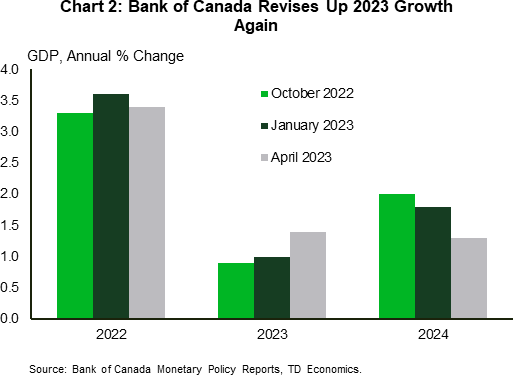
- The Bank of Canada again revised upwards GDP growth for 2023 in its latest Monetary Policy Report (MPR). Canada’s economy continues to grow and expectations for growth in 2023 now stand at 1.4%, revised up 0.4 percentage points from January’s MPR.
- Canadian CPI inflation data is looming for next week where we expect a slowdown in both headlines and core readings.
US – Calm prevails as the economy shows tentative signs of slowing down
With the start of the earnings season this week there seemed to be a sense of calm in the financial markets. However, since the reporting season was not officially in full swing until Friday morning, investors’ focus was squarely on the economic data. The two headlines this week were the March readings of CPI inflation and Retail Sales, although the release of the FOMC meeting minutes also attracted some attention.
The Federal Reserve’s latest move came during the recent regional banking crisis, which ultimately forced the FOMC to reconsider its course on the federal funds rate. The uncertainty was evident in the minutes, where several participants felt it appropriate to keep the target range constant last month given recent events. This was an abrupt reversal from what policymakers had communicated just weeks before the interest rate announcement, where the thought had to be that rates would move both higher and faster compared to assumptions in the December Summary of Economic Forecasts would have to move. But perhaps the most notable takeaway from the minutes was the explicit mention that given the recent banking crisis, “…the staff forecast included a mild recession beginning later this year, with a recovery over the next two years.” Indeed, participants agreed that the actions taken by the Federal Reserve and other government agencies have helped calm conditions in the banking sector, but felt it was too early to assess confidence and the magnitude of the impact of the credit crunch to assess the real economy.
This morning’s retail sales gave a first glimpse of the impact tighter credit conditions may already be having on households. Both nominal and real spending fell 1.0%m/m in March, marking the second consecutive month of declines. But even after accounting for the pullback, consumer spending is still a robust 4.2% in the first quarter. However, March’s weak handover suggests that the last quarter may have been the ‘last hurray’ as the cumulative effect of higher interest rates combined with the recent tightening of lending standards appears to weigh on consumers.
From an inflation standpoint, the weakness in demand has not yet translated into a significant easing in core consumer pricing pressures. In fact, thanks to lower food and energy prices, headline inflation slipped to 5% yoy – almost a two-year low (Chart 1). However, core CPI rose 0.4%m/m, leaving the 3-month (annualized) and 12-month rates of change at 5.1% and 5.6%, respectively. Underpinning the gains was an acceleration in commodity prices alongside continued strength in accommodation (0.6% m/m) and non-housing services (0.3% m/m).
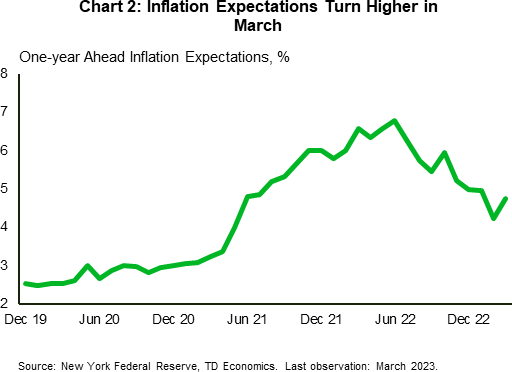
For a central bank that has become increasingly data-dependent, ongoing core inflation may not sit well alongside the recent uptick in inflation expectations (Chart 2). Assuming there is no further flare-up in financial markets, the FOMC will likely need to hike interest rates by another 25 basis points in May before pausing to better assess the full impact of the 500 basis point hike.
Canada – Bank of Canada versus Markets
The Bank of Canada (BoC) interest rate decision was in the spotlight this week. As widely expected, the bank left interest rates unchanged at 4.50% for a second straight decision. However, where the markets and the bank differ is how long this policy pause will last.
Markets remain steadfast in their belief that interest rates will be cut later this year. However, when asked about the potential for short-term rate cuts, Governor Macklem’s response was unequivocal: “That doesn’t look like the most likely scenario for us today.” Markets eased slightly, deferring the timing of a 25 basis point cut from September to December. When the dust settles, we too would lean against the markets expecting the 4.50% policy rate to stay here for the remainder of 2023.
At that meeting, the BoC removed the reference to its “conditional stance” and distorted its language towards possible further tightening. The BoC acknowledged that returning to the 2% inflation target could prove more difficult than expected. Inflation is cooling and our forecast is for Canadian inflation to hit 3% yoy (y/y) by the summer. That’s progress, but it’s not the 2% level the BoC is aiming for. The message was cemented by Macklem at an IMF meeting the following day, where he stated, “This band is not a zone of indifference. You have to aim for the middle if you want to be in the band most of the time.”
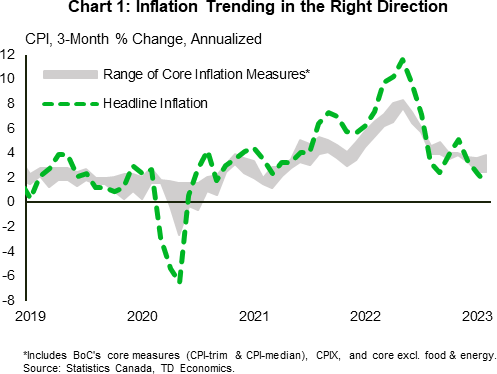
As inflation remains contained, the BoC will take a narrower view in assessing whether the easing price pressures are sustainable. Core inflation is trending down (Chart 1), but you will continue to monitor inflation expectations and wage growth, which are proving to be a little tougher.
Canada’s economy is still showing signs of resilience, forcing the BoC to reconsider growth estimates. The April MPR shows 2023 GDP growth revised upwards to 1.4%, 0.3 percentage points (ppts) higher than the January MPR (Chart 2). A consumption-driven slowdown by the end of 2023 makes for a weak carry-over into 2024, leading to a downward revision of the growth forecast to a modest 1.3% (1.8% in January MPR).
A bit of Canadian data this week continued to support a strong first quarter. February manufacturing sales gave back some of January’s 4.5% gain (-3.6% m/m) but sales are still positive for the quarter. Existing home sales and prices rose 1.4% and 2.0% mom, respectively, in March. This reinforces that the housing markets are bottoming out.
Next week’s highlight is the March CPI release, where we expect headline and core inflation readings to cool further. We expect headline inflation to ease for the fifth straight month to 4.6% yoy (y/y) and core inflation to 4.5%. Retail Sales for February also post another increase after consumer spending has been strong for the past two months.
Comments are closed.