


naphthalene/iStock via Getty Images
The stock market rose for the fourth week in a row last week.
The climb wasn’t much, but it was a climb.
Why is that important?
Well, on March 16, 2022, the Federal Reserve announced this raised its interest rate. The policy range would now be 25 basis points wider than before, raising the range to 25 basis points to 50 basis points.
The effective federal funds rate jumped to 0.33 percent from 0.08 percent.
And the debate on Fed monetary policy shifted to how many more hikes there will be in 2022…five or six…and…and how big the additional hikes could be…25 basis points or 50 basis points.
Added to this was the discussion about how the Fed intends to reduce its securities portfolio.
The stock market rose in the week leading up to the March 16 Federal Open Market Committee meeting and continued to rise in the days immediately following the meeting.
On Friday, March 11, the S&P 500 stock index closed at 4,204.
On Friday, April 1, 2022, the S&P 500 closed at 4,546.
What is market signaling?
OK, the Federal Reserve is tightening monetary policy.
Shouldn’t stock prices go down… not go up?
What is going on here?
Well, the Wall Street Journal’s latest stock market analysis picks up the debate again after a very volatile performance on Friday.
“The shaky trading session (on Friday) came a day after the S&P 500 completed its biggest quarterly decline since early 2020, falling 5 percent for the first three months of the year.”
This is what the first three months of the year looked like for the S&P 500.

S&P 500 Stock Index (Federal Reserve)
The low shown on this chart is for March 14, two days before the Fed’s rate hike announcement.
My interpretation of this market behavior is that investors are having a hard time believing that Mr. Jerome Powell, the Fed Chair, and the FOMC are actually going to tighten that much.
I’ve written several articles over the last week discussing these concerns and how the concerns are represented in the data we are now receiving.
Additionally, investors have just received the new fiscal budget from the Biden administration and it is looking very expansionary as the national debt is set to rise significantly.
Add this to the fact that there is a great deal of uncertainty surrounding the Russian invasion of Ukraine and the expenses it may entail.
In other words, the Federal Reserve may be talking about tightening its monetary policy, but there are questions about whether or not it will, especially with higher government spending looming.
government bonds
Another unknown regarding the investment community is the fact that longer-term interest rates are rising.
Here’s what happened to the US 10-year Treasury yield.
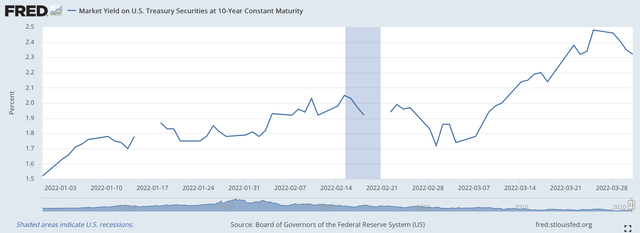
Yield on 10-year Treasury bills (Federal Reserve)
At the end of 2021, the 10-year yield was exactly 1.50 percent.
Last week, the yield on the 10-year bond was around 2.40 percent.
And inflation expectations built into that yield were around 2.90 percent on Friday, up from 2.50 percent late last year.
Yes, inflation expectations on the bond market have risen, but the inflation rate experienced is over 6.0 percent.
That is, “real” bond yields are in negative territory.
This is not a picture of restrictive monetary policy.
The point is that even though the Fed is talking about how it is tightening monetary policy, investors still feel that financial markets are not really being constrained at this time and that this is not the “talk” of the Federal Reserve “officials”. really convincing.
Hence, share prices continue to rise.
economic data
Additional economic data continues to support stock market stance.
“Employers added 431,000 jobs in March, making 11 straight monthly gains above 400,000, the longest streak of growth of this kind since 1939. The unemployment rate fell to 3.6 percent from 3.8 percent.”
And “the unemployment rate is fast approaching the February 2020 pandemic rate of 3.5 percent, which was a 50-year low.”
Commodity prices also fueled the conversation.
Prices that have been fueling inflation, such as oil, grain and metals prices, continue to raise expectations that consumer price inflation will not abate anytime soon.
As one analyst added:
“Inflation floods everything!”
Go forward
Radical uncertainty still rules the world.
There’s just too much we can’t imagine about our future.
So we try to develop a narrative.
The primary narrative currently appears to be that the Fed is attempting to “ease” its way forward, hoping not to “overdo” its policy tightening efforts.
The Fed isn’t slamming on the brakes…like Chairman Volcker did in the 1980s.
But the market seems to be saying the Fed isn’t even doing enough to really be accused of tightening monetary policy.
So in the future, investors will drive stock prices higher.
This seems to be the current market narrative.
Comments are closed.