


The initial public offering (IPO) related to small and medium-sized enterprises (SMEs) works wonders for small businesses that don’t have much funding or investment to start with. These companies can be friends and family based companies or single investments with little investment and funds etc. A recent Reserve Bank of India (RBI) report found that listed SMEs are performing better than unlisted SMEs in India. Although the stock market has many hurdles to overcome and many gaps to fill; its future will depend on how well SMEs are promoted and supported in this country.
SMEs play a central role in the Indian economy. The amount of job opportunities, export and regional development this sector offers accounts for 29 percent of the country’s GDP, according to the Ministry of MSME’s annual report, 2018-19 and 2019-20.
Despite being such an integral part of the country’s economy, this sector faces various hurdles when it comes to getting the proper support and funding from the government. This is also due to the fact that this sector does not lack symmetry due to the minimal hard information about it and the higher per-unit cost of surveillance.
According to World Bank research, demand for debt and equity financing by MSMEs in India is estimated at Rs. 87.7 trillion.
India’s bid for an SME exchange platform
The attempt to create an alternative exchange focused on SMEs dates back to 1989. The over-the-counter exchange (OTCEI) set up specifically for SMEs has not had much success. In 2012, the Bombay Stock Exchange (BSE) SME Platform was established together with the NSE Platform for SMEs, also known as NSE Emerge, to take a deeper and broader step towards building a platform to support SMEs.
“Since the launch of BSE’s small and medium-sized enterprise (SME)-focused platform, more than 380 companies have been listed there. BSE has taken several steps to date to grow this segment by organizing awareness seminars and signing memoranda of understanding with several state governments, financial and educational institutions,” says Mitesh Shah, Partner, Physis Capital.
Although the platform saw a significant increase in the number of IPOs, the market capitalization of SMEs is far from that of the main market.
According to International Organization of Securities Commissions (IOSCO), 2015, the market capitalization of SMEs in India is around 0.07 percent, which compares to other countries like Korea at 10.96 percent, Turkey at 0.16 percent and Egypt considerably low is 0.33 percent, South Africa 0.21 percent and Malaysia 0.75 percent.
The outlook of the SME market in India
In recent years, the government has focused on the national policy goal of creating jobs and increasing productivity. To that end, it has nurtured and given prominence to the startup ecosystem in India.
The SME exchange platform is still in its infancy. Not much research has been done on this area, but creating a capital risk market is also vital to developing an entrepreneurial ecosystem.
In order to understand the core issues faced by the SME exchange platform, we need to focus primarily on three important aspects, namely the extent of undervaluation, aftermarket liquidity and abnormal returns over the long term.
How the SME exchange platform can help start-ups
“Being able to take your company public is the ultimate dream for entrepreneurs. It offers market validation for the valuation of the company and not only provides liquidity for the private investors, the ESOP holders and the founders. An added benefit is a significant reduction in borrowing costs, enhancing the ability to scale and improve margins,” says Ashok Kumar Damani, member of the Bombay Stock Exchange (BSE) and co-founder of Artha Group.
Additionally, listing your company for an IPO has many other benefits including early access to capital, improved visibility and prestige, promoting SME growth, enabling liquidity for shareholders, equity financing through venture capital (VC), efficient risk distribution and employee incentives.
“BSE’s SME platform offers growth-oriented SMEs a way to raise capital through equity injections. It also benefits SMEs by giving them greater credibility and improved financial status, creating demand for the company’s shares and leading to a higher valuation of the company,” emphasizes Manoj Dalmia, Founder and Director of Proficient Equities Limited.
“Self-financing offers growth opportunities such as expansions and mergers and acquisitions while being cost-effective and tax-efficient at the same time. A listing also incentivizes VC funds by providing an exit route and reducing their lock-up period. Capital markets ensure that capital is put to its best use and that riskier activities are funded with higher payouts,” says Dalmia.
- tax benefits – While the sale of unlisted shares incurs a long-term capital gains tax of 10 percent without indexation or 20 percent with indexation, the long-term capital gains result in a far more efficient tax regime for companies listed on the SME exchange.
“For the listed shares, the long-term capital gains tax is 10 percent and the short-term capital gains tax is 15 percent if the transaction was subject to the Securities Transaction Tax (STT). . This preferential tax treatment for the transfer of listed shares also applies to shares listed on the stock exchange in the SME category. A listing on the SME Exchange is a valid tax planning tool and therefore could result in huge tax savings for entrepreneurs and investors,” said Rajan Bhatia, a renowned chartered accountant and India’s leading IPO advisor.
- listing requirements – According to the SEBI website, it takes 2 to 3 months for a company to be listed on the SME exchange. The listing procedure is relatively well defined on government agencies and BSE/NSE websites. For starters, the issue must have at least 50 allotted shareholders, and 100 percent of the IPO must be underwritten, of which a merchant banker must hold 15 percent.
“There are several steps to the process and the conditions attached are: There must be a minimum paid-up capital of Rs 1 crore and the maximum paid-up capital cannot be more than 25 crores, while the minimum number of allocators cannot be less than 50. For investors, the lot size of the IPO application is at least Rs 1 lakh while it is mandatory for the MSMEs to be listed to appoint a commercial banker to underwrite the IPO. The reporting obligation applies to MSMEs on a semi-annual basis once they have been included in the list and it takes an average of 3-4 months to complete the process,” explains Dalmia.
Current trends on the SME exchange
According to a recent RBI study, listed SMEs have performed better than non-listed ones in terms of profitability, liquidity and asset utilisation. The average daily trading turnover for the BSE SME exchange has been estimated at around Rs. 18.5 crores in July 2022, which is expected to grow steadily over time.
“In the last quarter, multiple listings on the KMU-Börse resulted in an average of about one IPO per week. There were more than 10 IPOs in September alone, and the average initial listing premium was over 25 percent. Many of these companies are in the infrastructure space, but two of these companies have stood out. EKI Energy Services debuted a year ago and quickly generated 100x returns for its investors; Gensol Engineering has been doing well in the market lately and attracting investor interest,” says Damani.
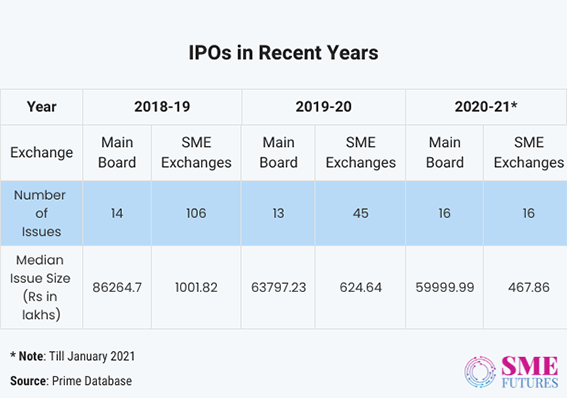
“Currently, more than 700+ SME companies have successfully launched SME IPOs. It has tremendously helped companies raise capital and multiply their wealth many times over. The stock market can either go up or down depending on market sentiment. This is quite normal as market sentiment changes constantly over time,” Bhatia asserts.
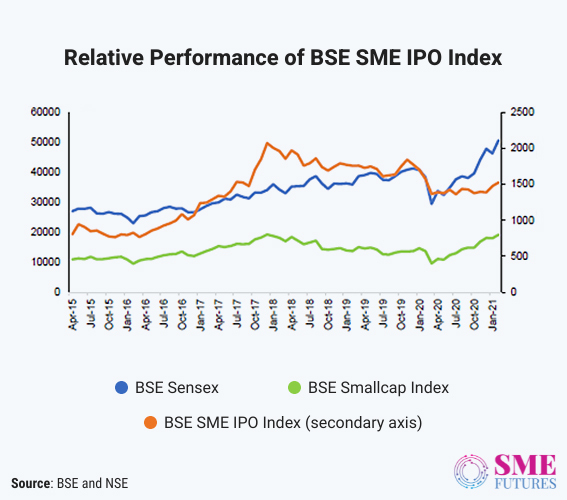
The number of SME companies listed to date is 392 and their combined market capitalization is Rs 6,0230 crores. Some of these companies are:
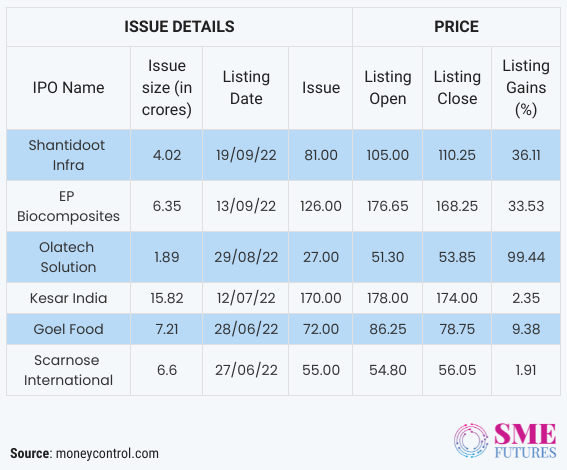
“All of these companies have done well with good earnings, much better than the other IPOs. Investors should exercise caution when investing in these SMEs as they are volatile. It’s important to read the company’s Draft Red Herring Prospectus (DRHP) before investing,” warns Dalmia.
The way forward for the SME exchange platforms in India
The BSE SME Exchange Platform acts as a torchbearer for SME exchanges in India. It provides help and support for the early start-ups, educating entrepreneurs about the benefits of listing their companies on the stock market and alerting them that it can be a revolutionary step in building a start-up ecosystem. UPS.
“The BSE SME platform has companies from 20 states listed and part of their future expansion will involve extending to all states. As SMEs are the backbone of the Indian economy, bringing all stakeholders together to formalize this sector is likely to yield good results in the future. There is a strong existing pipeline of companies and startups that need to be listed and it will be important to nurture and grow that pipeline,” says Shah.
BSE’s SME platform is also trying to reach more VC firms and angel funds to access relevant and higher quality deal flows. It makes sense for BSE to invest in some of these funds to gain access to and knowledge of what the Indian startup ecosystem needs from an SME IPO platform.
“They can pick a few startups and guide them through the listing process, making them the poster child for the larger startup ecosystem, to make it clear that SME listings are a viable and exciting option. This approach could encourage family offices and HNIs to get serious about SME IPOs by setting the stage for investing in exciting tech-enabled startups that have otherwise been monopolized by private investors piecing together complicated deal structures. It’s a long game, but someone has to play it!” says Damani as he signs off.
Comments are closed.