


Meanwhile, local brokers including CommSec are trying to make the U.S. ETFs accessible to domestic investors as the names of high-quality issuers provide assurance to compliance teams.
Digital gold
While Gensler, like many financial regulators, tends to focus on Bitcoin's facilitation of crime – something that isn't unique to cryptocurrencies, as cash is a popular method of evading taxes or paying for drugs – others see a range of more positive ones Possible uses.
For some, Bitcoin is a store of value, an asset similar to a form of digital gold. (Like the commodity, Bitcoin was developed with a limited supply.) Others focus on its potential as an alternative payment method, a digital token that can be used to purchase goods and services directly through apps, like a global borderless currency.
Bitcoin also allows funds to be kept away from the prying eyes of governments; to send money out of currency-controlled regimes; to protect wealth from the inflationary effects of measures such as central bank money printing; and to enable anonymous spending on the Internet.
David Tuckwell of Global X Australia says stock market listings will put Bitcoin on the radar of financial advisors.
The market has placed some value on all of these features: Bitcoin's capitalization was around $900 billion on Friday. Now it will be much easier for global investors to buy.
New investors will be pleased with the numerous regulations that apply to the products' issuers, brokers, trustees and custodians. This is monitored by US market operators and securities regulators and helps protect investors' money.
“A big challenge for crypto has been the simple fact that the quality of exchanges has been low, and we saw that in a dramatic way with FTX,” says David Tuckwell, senior strategist at Global EFTs operates in Australia, on the Cboe market.
“Bringing crypto into a descending environment with established, very well-capitalized exchanges and more transparency is a very good step.” And frankly, it also increases the quality of the offering by wrapping it in an ETF shell.”
Standard Chartered estimated this week that between $50 billion and $100 billion will flow into Bitcoin this year through the new ETFs. This is still a drop in the bucket compared to total global ETF assets, which BlackRock expects to reach $14 trillion by the end of this year. The inflows could see the price of bitcoin quadruple to $200,000 by the end of 2025 after reaching $100,000 by the end of this year, Standard Chartered predicts.
It was trading at $46,300 on Friday morning.
The predictions are based on the impact of gold ETFs, which drove the spot gold price four-fold over seven years as the products matured. But Standard Chartered believes it will only take two years for Bitcoin ETFs to become mainstream.
Previously, Bitcoin buyers were forced to use unfriendly decentralized exchanges like Uniswap, which required them to download wallets and store coins on USB sticks.
Meanwhile, centralized exchanges such as FTX and Binance also pose risks. FTX founder Sam Bankman-Fried was jailed for fraud after customers lost billions of dollars; US courts will convict Binance founder Changpeng Zhao on money laundering violations next month.

Venture capitalist Martin Rogers. “I tell the original crypto thugs to ‘relax’.”
ETFs eliminate the risks of self-storage and without the complexities of managing private keys, these structures will bring crypto to the mass market, according to other local product developers. They are also offered at low fees.
“ChatGPT has enabled people to understand the power of generative AI, but we haven’t seen that in crypto,” says Martin Rogers, who spent six years in the industry and listed one of the first Australian ETFs on Cboe ( since delisted, due). due to low trading volumes).
“These EFTs will provide a similar catalyst to stimulate retail interest in the technology.”
For Bitcoin purists, ETFs remain on the fence as they continue to believe the cryptocurrency was designed to bypass traditional finance. The pseudonymous creator Satoshi Nakamoto had railed against the printing of central bank money. However, access without intermediation represents a source of risk for inexperienced investors.
“The original crypto gangsters don’t like ETFs,” says Martin. “They say self-custody is the only way to store cryptocurrencies so that they cannot be confiscated by governments. But to them I say, 'Relax.' Very few people manage to self-preserve, and now they have a better option.”
Precautionary measure
Some local developers agree with Gensler's warning that EFT approval does not provide security regarding crypto valuations.
Justin Arzadon, head of digital assets at Betashares, says the products “remain very volatile and should therefore only represent a very small portion of an overall portfolio.” [and] Investors should not rush into allocating to the asset class.”
Tuckwell agrees that crypto poses an “existential risk” that the investment will one day go to zero. “[But] With any type of investment, there is always a trade-off between risk and potential reward,” he adds.
“Buyers should be wary – but the risk of an investment going to zero is not unique to cryptocurrencies, it happens all the time with stocks on the ASX.”
It remains unclear how many financial advisers, who drive most of the global volume in EFTs, will recommend the products, particularly as more of them are listed in Australia given strict fiduciary obligations. The products need to be assessed and placed on approved lists, and early signs suggest consultants will give the new offerings a wide berth. Vanguard, for example, said Thursday that its customers would not get access.
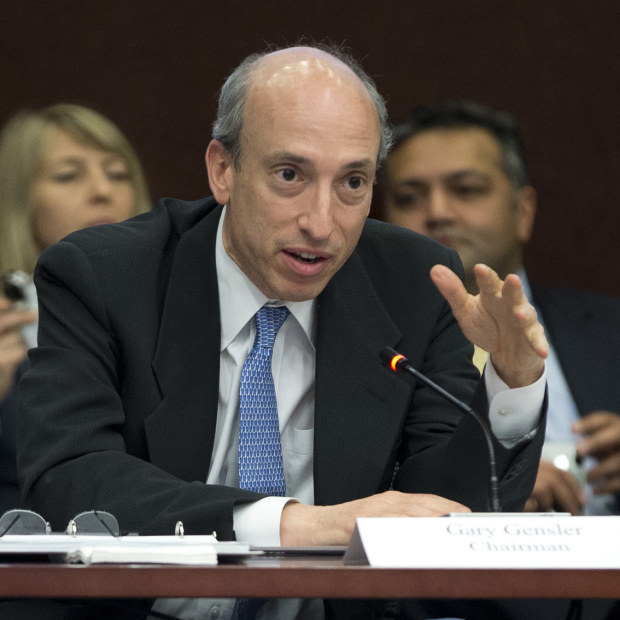
SEC Chairman Gary Gensler: “Investors should remain cautious about the myriad risks associated with Bitcoin.” `
However, Tuckwell expects that as more Bitcoin ETFs appear on the ASX, local advisors will consider them, as access is available via the HUB24 and Netwealth platforms.
“The kingmakers in the EFT market are financial advisors,” he says. “If you have Bitcoin and Ethereum on regulated exchanges where the quality of the exchange is higher, there is clarity and legal contingencies around custody,” he says.
Analysis of the SEC's reasoning this week shows that some of the major risks that led it to reject numerous applications in recent years have now been addressed.
One of their concerns was the manipulation of the underlying Bitcoin price. But this week, after examining Bitcoin futures market prices, the company expressed confidence that exchanges can “prevent fraudulent and manipulative acts and practices” and “generally protect investors and the public interest.”
The quality of the custodian banks has also improved. This includes the use of “cold storage,” where the actual Bitcoins backing the ETFs are stored “off-chain,” making them less vulnerable to hacker attacks. For most US products, the custodian is Coinbase, which is listed on the New York Stock Exchange; another is Gemini.
Market sources said the Australian Securities and Investments Commission and ASX would also be happy with them for products listed on the local stock market.
The EFT structures have also been refined. Many early offerings involved “feeder funds,” essentially derivatives or synthetic securities, but the SEC has become more comfortable with spot funds, where the actual cryptocurrency is held in trust for investors.
Regulatory basics
While the US got most of the attention this week, ASIC and ASX have been laying the groundwork in Australia over the past two and a half years and are expecting strong local demand for the products.
It was October 2021 when ASIC published updated regulatory guidance that created a special category of crypto assets to support “exchange traded products” in Australia and set out expectations for custody, pricing methods, disclosure and risk management.

ASIC Chairman Joe Longo. Despite its criticism of cryptocurrencies, ASIC issued a policy in 2021 that paved the way for Bitcoin EFTs. Alex Ellinghausen
ASX published an Eligibility Policy for Crypto Asset ETPs in August 2022. “Thereafter, issuers must compile documentation on custody, trade execution plans, benchmarks and experience of key participants,” it says.
ASX confirmed this week that any trading would be subject to special broker margin requirements to provide protection against intraday volatility as Bitcoin trades around the clock while ETFs clear overnight.
The new rules have helped change the perspective of U.S. financial leaders, who are now eyeing dollar signs when it comes to fees for brokering the new products.
Just last month, JPMorgan CEO Jamie Dimon called for a ban on Bitcoin, describing how “the only real use case for it is criminals, drug traffickers and money laundering.” [and] Tax avoidance.” This week, BlackRock named JPMorgan one of two brokers that will be responsible for funneling cash into its Bitcoin ETF.
Similarly, in 2017, BlackRock CEO Larry Fink described Bitcoin as “an index of money laundering” and compared the hype surrounding it to the Dutch tulip bulb boom in the 16th century. Now he says BlackRock's iShares offering will “democratize” access to the asset class.
“We are hearing from customers around the world about the need for crypto,” he said in October, attributing the rally to a “flight to quality” amid global tensions.
ASIC chairman Joe Longo has also been a long-time cryptocurrency bear, but said late last year that the Australian securities regulator was working to regulate the sector to increase investor protection.
Sheila Warren, CEO of the US lobby group Crypto Council for Innovation, says last week's dramatic events will lead to more appropriate and informed regulatory policy in the crypto space.
“This milestone will change public perception and portray Bitcoin as a legitimate part of a diversified investment portfolio,” she says. “A spot Bitcoin ETF is a bridge between traditional finance and the emerging world of crypto.
“Allowing investors to join the Bitcoin journey without the technical hurdles of direct ownership is a significant step toward inclusivity.”
Comments are closed.