


There is a feeling in the market that a new era for IPOs has begun. One of the most successful IPOs of recent times started at the beginning of June Cava Group (NYSE: CAVA)a fast-casual restaurant chain with a focus on Mediterranean cuisine.
Almost every investor who’s looked at Chipotle’s chart and valuation and asked, “Can it go any higher?” is now looking at Cava and wondering if it can do the same.
Chipotle’s stock has multiplied 47 times since its IPO in 2006. A ’47 hit! Of course, everyone wants to find the next one of these.
And the stock is off to a good start.
But will it mark a TSN turning point for the IPO market? Or will it be an anomaly before a bearish downturn?
let’s dive in
The Cava IPO
On June 15, Cava Group became the youngest company to go public on the NYSE, to a great deal of fanfare.
NYSE President Lynn Martin himself commented on the event, stating that Cava’s listing is a positive sign for the IPO market. This is particularly notable given that the past 18 months has seen the slowest IPO market since the financial crisis.
The IPO valued the restaurant chain at $2.45 billion and raised nearly $318 million in financing. Originally expecting a range of $17 to $19 per share, the IPO price was eventually set at $22 per share, beating expectations while the stock was up as high as $47 on opening day rise.
The following day, the stock plummeted, falling as low as $36, but the name has seen a significant rebound since then.
But who is the Cava Group?
Who is the Cava Group?
Founded in 2006 by Ted Xenohristos, Ike Grigoropoulos and Dimitri Moshovitis, the company began by offering shared plates and an inviting guest experience that quickly gained popularity.
Back in 2008, they began selling their signature dips and spreads at local grocery stores. Three years later, they opened their first retail store, taking a cook-your-own approach similar to Chipotle’s. This fast-casual model emphasized healthy, flavorful ingredients like harissa and tahini.
Cava Group states that its rapid growth is based on the idea that more people are health conscious. She cites that 70% of people want to be healthier, and according to an independent survey, about half of all people put healthy eating as their top priority.
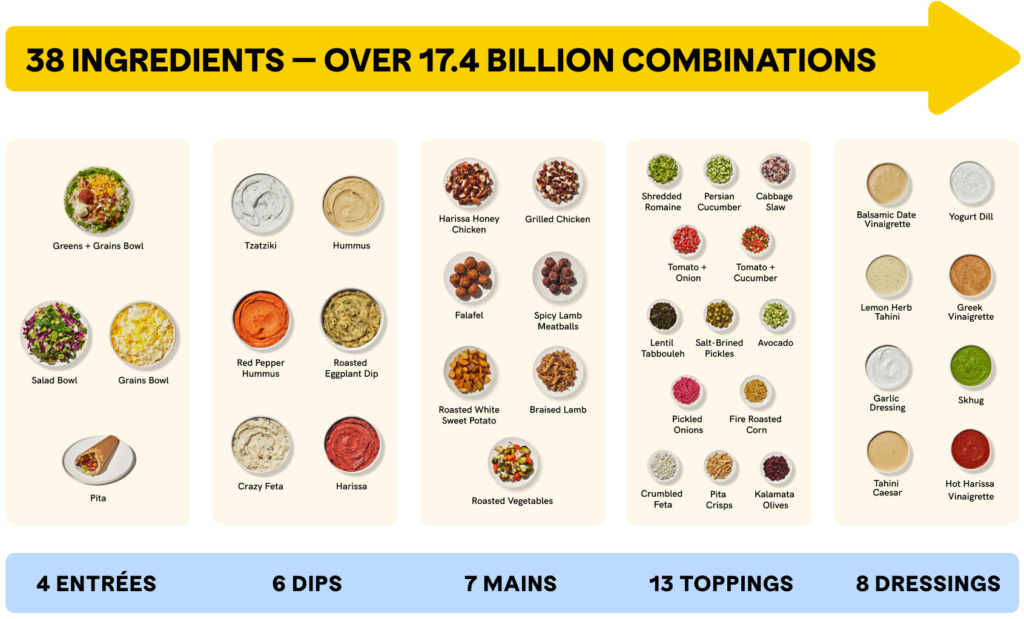
However, their success was not possible without a little acquired growth. The strategic acquisition of Zoes Kitchen, a competing Mediterranean chain, for US$300 million in 2018 marked a major milestone in the company’s history and played a key role in Cava’s expansion. Converting locations into Cava restaurants was a cheap and cost-effective way to increase the company’s presence.
Today, Cava operates 263 locations and offers a range of dishes such as avocado bowls, chicken pita and falafel.
The story is rather mundane compared to some of its peers – the biggest controversy the chain has so far seems to stem from a tweet it posted about its diversity in 2021 – which caused a crowd of white people to riot. A real shocker.
Your continued support has helped us make strides in improving our organization and the communities we serve. In such a challenging year, we could not have achieved any of this without you. We look forward to continuing this work and welcoming you to our table in 2021. pic.twitter.com/JBBdy2ats1
— CAVA (@cava) January 1, 2021
It’s not exactly like they’ve had a history of foodborne outbreaks like one of their peers – if you look at Chipotle.
While Cava has emerged as a front-runner in the “Mediterranean” category, that’s not enough for the sudden Wall Street star, who plans to use funds from his IPO round to spur more store openings, aiming to hit 1,000 by 2032 opening locations.
But what drives the growth?
The bull case for cava
Much of Cava’s growth can be attributed to the purchase of Zoe’s a few years ago, for two reasons.
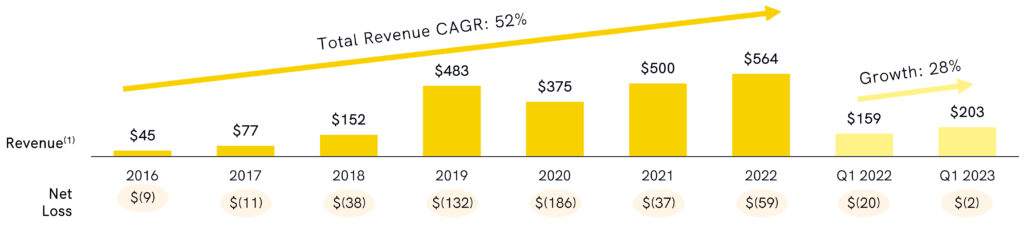
First, it made Cava the only international in the fast-growing category of fast-casual restaurants in the Mediterranean. This strong market share control enabled revenue growth at a 52% compound annual growth rate for more than half a decade, reaching $564 million in revenue in 2022.
Second, the acquisition allowed for a cost-effective expansion of the Cava brand simply by renaming the restaurant locations. To date, 55% of these locations have been rebranded, and at a significantly lower cost than if new locations had been opened.
In addition, Cava’s high annual unit volume allows it to leverage fixed costs and effectively achieve strong profitability at the restaurant level. The company averages $2.3 million in annual revenue from its stores, which translates to a 35% cash-on-cash return, or a three-year payback period.
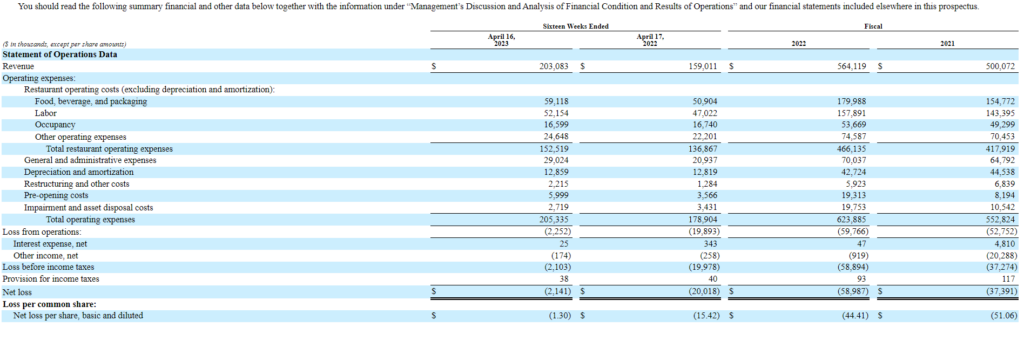
However, like many other companies that have recently gone public, the company is still struggling to make money. Cava posted losses of $37.4 million in 2021 and $59 million in 2022.
The comparisons to Cava
While the company doesn’t have direct competition, specifically in the Mediterranean fast-casual dining segment, that doesn’t mean it doesn’t have competition. A variety of public companies compete with Cava.
So let’s take a look at some of their competitors.
First is Sweetgreen (NYSE:SG), which markets itself as a “fast-casual” restaurant chain that serves only fresh, healthy foods like salads and rice bowls and has over 180 restaurants across the United States. They went public in 2021, largely experiencing the same initial buzz as Cava. Since then, the value has fallen nearly 80% as the company failed to live up to the hype and continues to underperform, with its market cap falling to $1.5 billion.
| Pursue | Market Cap ($USD) | price-sales | EV to EBITDA | Rating per branch (using market cap) |
|---|---|---|---|---|
| Chipotle (CMG) | $59 billion | 6.6 | 37 | $18 million per deal |
| CAVA Group (CAVA) | $4.5 billion | 8.0 | n / A | $17 million per deal |
| Shake Shack (SHAK) | $3.3 billion | 3.2 | 59 | $8.3 million per deal |
| Sweet Green (SG) | $1.5 billion | 3.0 | n / A | $8.3 million per deal |
Shake Shack (NYSE:SHAK), another company whose name is comparable to Cava, is your traditional American fast food company that serves burgers, crispy chicken and milkshakes. The company has around 400 locations. The company was listed on the NYSE in 2015 and today has a market capitalization of over $3.3 billion.
And last, Chipotle Mexican Grill (NYSE:CMG), a similar healthy “fast casual” alternative to fast food, sells a wide variety of Mexican dishes. There are currently over 3,200 restaurants around the world. The company has been one of its most successful investments since its IPO in 2006. Chipotle went public with a valuation of just $175 million. Today, the company is worth $58.6 billion.
But Cava’s high rating has caused quite a stir. With a market cap of $4.5 billion, cava is valued at a staggering $17 million per restaurant — almost on par with Chipotle’s boasted $18.3 million.
It’s not surprising that many people try to call cava “The Next Chipotle”.
A new bubble?
Cava’s successful listing and subsequent trading could herald renewed interest in IPOs.
And the IPO isn’t the only reason people are clamoring for a new bull market. The Federal Reserve’s decision to halt its rate hike streak bodes well and indicates progress in the fight against inflation.
Additionally, the market has been trending higher, with the S&P 500 up more than 20% since its October bottom. Employment numbers and consumer spending are resilient, and there is rising optimism about tech stocks, particularly Nvidia, which is up 197% this year largely on the back of the AI boom.
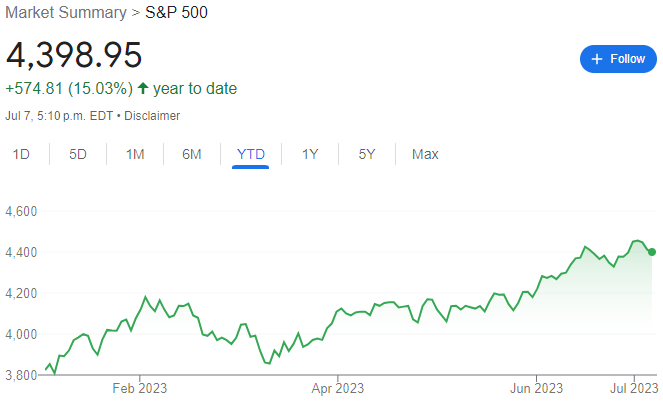
This optimism is partly supported by the belief that lower interest rates are favorable for IPOs and the notion that the Federal Reserve may have completed its cycle of tightening.
However, it is important to approach these developments with some caution. While Bank of America equity strategist Savita Subramanian thinks the S&P 500 has historically continued to rise after surpassing 20 percent from its bottom, there are analysts warning that the current rally may be temporary. Notably, Michael Wilson, chief US equity strategist at Morgan Stanley, has projected a 16% earnings drop for US companies in 2023, which is a much more severe scenario compared to consensus estimates.
While we shouldn’t get too pessimistic at this point, a seemingly buoyant IPO market overall could signal the emergence of a new bull market, and Cava’s IPO can be seen as a litmus test of the broader market’s appetite for new listings.
packaging
let’s wrap it up
Cava’s IPO is a positive sign in a market fraught with doom despite the S&P500’s rally. It remains to be seen whether this is a harbinger or a simple anomaly. However, in the current market environment, we take every sign as positive.
From an operational perspective, the company has seen impressive sales growth, and its expansion strategy is clear and fairly simple: it aims to hit a target of 1,000 locations by 2032. When the market values a restaurant chain at a multiple based on a simple location count, it’s easy to see where that’s headed — but who knows what value each location will ultimately be attributed to.
The company is also struggling with the problem most large growth companies have been facing lately: continuous net losses. Whether it can become profitable remains to be seen.
That being said, the clear consumer choice in any market is certainly worth something. As always, the question is always the same – how much?
Information on this story was found through EDGAR, Reuters, Wall Street Journal and the sources and companies mentioned. The author has no securities or affiliations with the organizations discussed. No buy or sell recommendation. Always conduct additional research and consult a professional before purchasing any security. The author does not own any licenses.

As the founder of The deep dive, Jay focuses on all aspects of the business. This includes both operations and being the lead author of The Deep Dive’s stock research. In addition to The Deep Dive, Jay writes freelance for a number of companies and has published on Stockhouse.com and CannaInvestor Magazine, among others.
Comments are closed.