
Stock market investors are in the danger zone. This all-weather investment strategy offers protection


We are in a period of high inflation, where war is disrupting energy markets and the Federal Reserve is raising interest rates.
The bleak outlook requires a multi-year cycle of central bank monetary policy action that will hurt equity and bond markets.
An investment approach that can take advantage of the price movements of all assets — not just stocks and bonds — could serve you well, especially when volatility is keeping you up at night, tempting you to sell in a bearish market, or causing you to… chasing performance.
One such example is the Standpoint Multi-Asset Fund BLNDX, +1.16% REMIX, +1.23%,
which has approximately half of its assets invested broadly in developed market equities and bonds (mainly equities) through low-cost exchange traded funds. The rest of the money is used in futures markets, which include currencies, energy commodities, gold and silver, industrial metals like aluminum, copper, zinc and nickel, and grains and soft commodities like sugar and coffee.
In an interview, Eric Crittenden, who co-manages the fund, outlined his strategy and how he places long and short trades in non-equity investments to give investors “a smoother ride” over the long term.
Promising start
There are dozens of mutual funds that use futures trading strategies. Most are designed to mitigate risk in down markets by taking advantage of price moves up or down across asset classes. They can be used by investors to hedge against downturns in the stock or bond market, as an addition to a portfolio of stocks or bonds, or to funds that hold stocks or bonds.
The aim of the Standpoint Multi-Asset Fund is to fulfill both functions within the same portfolio, using a systematic approach to futures trading in order to limit risk while pursuing long-term growth. This way, an investor will not have to make their own risk management allocation decision among funds and will hopefully be able to limit their own emotional reactions to market turbulence.
“ There’s always a bull market somewhere, in any asset class, or in any region of the world.”
The Standpoint Multi-Asset Fund was launched in late 2019 and currently has approximately $250 million in assets under management. The fund is too new to have a Morningstar rating. However, within Morningstar’s macro trading fund category, it has high performance rankings.
Here’s a look at the performance of its institutional stocks from inception through March 21, 2022 compared to the performance of the SPDR S&P 500 ETF Trust SPY, +0.49%,
which tracks the US benchmark, and two funds that primarily use futures trading strategies without the large equity component retained in the Standpoint portfolio:
fact set
There’s a lot going on in this chart showing total returns with dividends reinvested.
-
The Standpoint Multi-Asset Fund was the best performer for the entire period from late 2019 to March 21, 2022 as the S&P 500, represented here by SPY, retreated from its early January high.
-
The two pure play funds on the chart using futures trading strategies are American Beacon Hill AHL Managed Futures Strategy Fund AHLIX, +0.87% and Pimco Trends Managed Futures Strategy Fund PQTAX, +0.71%.
-
Looking at the left side of the chart, SPY fell 34% from a year-end high on February 19, 2020 to its coronavirus pandemic low on March 23, 2020. During that period, the Standpoint fund was down only 8%, though about half was invested in stocks. Crittenden attributed this outperformance to short positions in the energy futures market. The two pure play funds performed very well during this brief stock crash, with AHLIX returning 6% and PQTAX 12%.
All four funds have done their job from the stock market crash at the start of the pandemic to the bull market that followed. The Standpoint fund has been the best performer since the end of 2019. Although it underperformed the S&P 500 during the bull run through Jan. 4, 2022, it has since outperformed during the stock market downturn. As expected, the two pure-play futures trading funds performed best during this year’s stock market decline, but the Standpoint fund once again held its own:
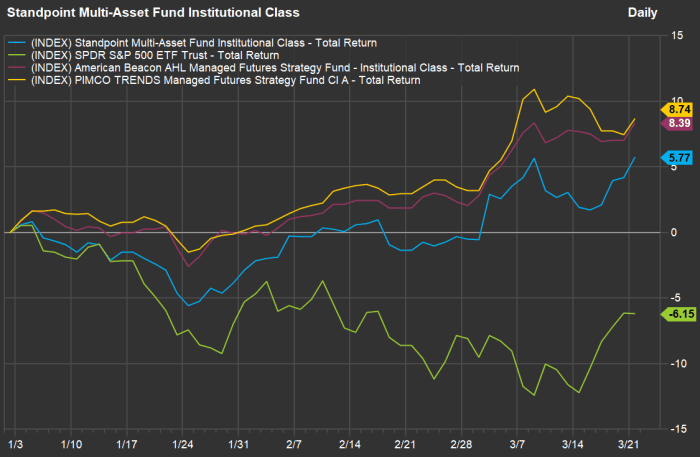
fact set
Returning to the first chart, the blue line showing the Standpoint fund’s performance illustrates the smoothing of long-term returns that Crittenden and his co-manager Shawn Serikov are aiming for.
Futures trades for a smoother ride
Crittenden, who previously managed a hedge fund and was formerly the chief investment officer for Longboard Asset Management, which he co-founded, emphasized that he and Serikov employ a disciplined, systematic process to profit from price movements rather than relying on fund managers’ intuition up or down in all developed markets. Only US-listed ETFs are used for the fund’s long equity positions. They are listed below.
For futures trading, “we only trade exchange-traded plain vanilla liquid futures contracts on regulated futures exchanges,” Crittenden said.
Speaking about the systematic futures trading approach, he said that “three variables are important to us and explain more than 90% of the success of any money manager”:
- The return on investment of the market – Without a crystal ball, decisions are based on recent price movements.
- The maturity structure of the market — This includes the timing of stock and bond dividends. For example, all other things being equal, if a company pays a dividend of $1 per share on a given day, its stock price will fall by $1 on that day. Structural considerations also include the timing of interest payments, call and maturity dates for bonds and, for commodities, futures contract structures.
- The liquidity of the market — Supply and demand imbalances create trading opportunities when prices rise or fall.
Without a crystal ball, Crittenden acknowledged that futures trades, like the short energy commodities positions the fund used in the early stages of the pandemic, will not find the best prices up or down. However, the fund’s approach is to place them early enough on large price swings to de-risk the equity portion of the portfolio.
“There’s always a bull market somewhere, in any asset class, or in any region of the world,” Crittenden said.
Describing the fund’s broad approach, he said, “What we’re giving up is all the fuss” as it avoids the highest highs and the lowest lows.
Warning sign – stagflation
The stock market’s fall so far this year seems mild given decades of high inflation, tightening monetary policy and the outbreak of war in Europe. With so many moving pieces, investors can expect a lot of volatility.
Crittenden sees stagflation as a possibility in the coming years. Stagnation is a combination of high inflation and slowing or negative economic growth. This can have a devastating impact on corporate profits, as companies are less able to pass rising costs on to their customers.
The Federal Reserve’s unprecedented economic stimulus, through very low interest rates and bond purchases that significantly increased the US money supply, combined with the federal government’s direct payments of stimulus cash to families, helped the economy recover quickly from the pandemic, it has but done now led to high inflation.
“The bill is due. The question is, who should pay for it? I think it’s going to be stagflation,” Crittenden said, stressing that as a portfolio manager he was prepared.
ETFs held by the fund
Crittenden said the Standpoint Multi-Asset Fund holds the same group of eight ETFs and that it will occasionally make changes to prevent positions from getting too big or too small. He doesn’t prefer regular rebalancing.
“I’ve found that people tend to rebalance too much and too quickly,” he said. “They incur transaction fees and tax implications that eat away at returns.”
The fund, which is available through major distribution platforms including Charles Schwab and Fidelity, steers clear of emerging markets, which Crittenden estimates account for only about 8% of the total international equity market in dollar terms.
Here are the eight stock ETFs held by the Standpoint Multi-Asset Fund, according to the latest information available from FactSet:
| Exchange Traded Fund | ticker | % of portfolio |
|
SPDR Portfolio S&P 1500 Composite Stock Market ETF |
SPTM, +0.43% |
7.4% |
|
Vanguard Total Stock Market ETF |
VTI, +0.43% |
7.3% |
|
iShares Core S&P Total US Stock Market ETF |
ITOT, +0.42% |
7.3% |
|
Schwab US Broad Market ETF |
SCHB, +0.41% |
7.3% |
|
Vanguard FTSE Developed Markets ETF |
SEE, +0.15% |
3.9% |
|
SPDR Portfolio Developed World ex-US ETF |
SPDW, +0.09% |
3.9% |
|
Schwab International Equity ETF |
SCHF, +0.11% |
3.9% |
|
iShares Core MSCI EAFE ETF |
IEFA, +0.09% |
3.8% |
|
Source: FactSet |
||
Do not miss: The best performing sector in the S&P 500 is still the cheapest, while technology stocks appear overvalued
Comments are closed.