


The same just different: After the financial crisis, there was a time when futures markets came under intense scrutiny from politicians and the media. At that time, criticism was primarily directed at index funds (i.e. speculators). They have been accused of driving up commodity prices and unduly punishing consumers.
I was reminded of the excitement last month when live cattle futures sold off their recent highs. While the opposite is true (prices are falling), the complaint is the same (the speculators). That means the funds fled the market, sabotaging livestock prices on their way out.
Balance: As a reminder, the futures markets are perfectly balanced. This means that for every buyer there must be a seller – and vice versa – otherwise no contract will be concluded. So when we complain about speculators, we need to ask ourselves a few questions:
- Can one side (buyer vs. seller) really dictate the market?
- Are speculators drivers or simply followers of the market?
The point is that any question about the activity of speculators, regardless of their particular market position, must also be asked of the parties on the other side of the equation. After all, futures markets are a zero-sum trade made up of matching pairs.
Markets: However, there is a widespread belief that speculators – either too many or not quite enough (there are always nuances) – are solely responsible for driving the market in one direction or another. This line of thinking often portrays the activity of speculators as driving open interest; More speculators mean more contracts (and vice versa) – and the price subsequently goes hand in hand with trading activity.
With this in mind, let’s turn to the data. The following charts show a sequential view of the open interest and weekly average close price of the nearby live cattle and corn contracts, respectively.
(Average price reflecting closing prices from Wednesday to Tuesday – according to the CFTC’s Commitment of Traders report, which reflects positions as of Tuesday’s close.)
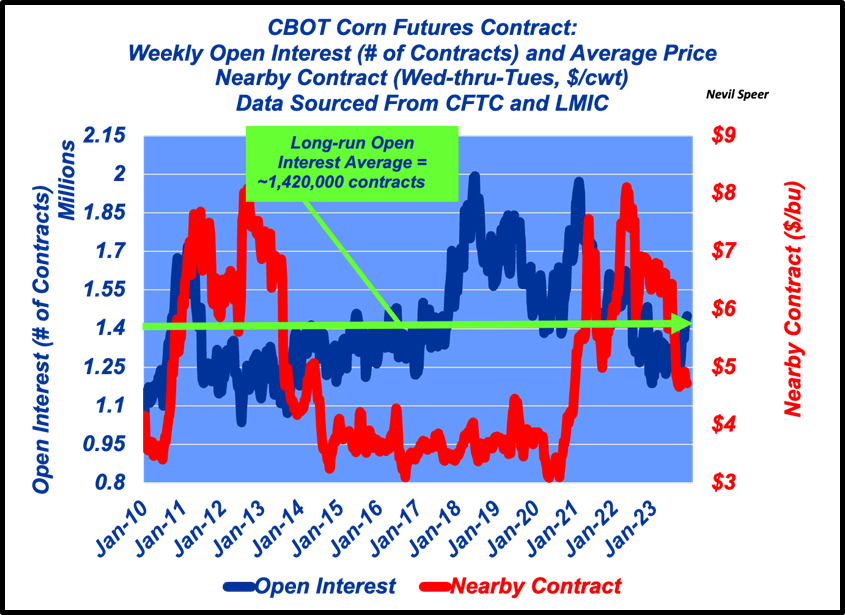
It’s difficult to discern a meaningful pattern. That’s because in both cases the relationship is very weak (and in the opposite direction of what is typically portrayed by market skeptics): the correlation is -0.07 and -0.20 for live cattle and corn, respectively. That is, there is little evidence here that speculators alone are able to steer the market in one direction or the other.
(We will address the relationship between changes in open interest and price in a later column.)
Hedging position: With all the hand-wringing over the recent CME live stock sell-off, it’s also important to assess what’s happening on the hedging side. The Hedger, once locked up, is indifferent. Even better, amid the recent selloff, the short hedger has seen his margin account grow over time.
Hedgers rarely complain about speculators – they represent the necessary liquidity with which a hedger can shift his or her risk (cf Last week’s column). Without speculators there would be no insurance option.
Denigration of Speculators: One final observation on all this is particularly timely and relevant. Dr. Craig Pirrong, University of Houston recently made the following comment on oil prices on his blog (streetwiseprofessor). He offers a meaningful context in the midst of this discussion:
Beating up speculators is what people who don’t like the price do. And since there is always someone who doesn’t like the price (consumers when it’s high, producers when it’s low), the denigration of speculators has been and remains the longest-running show in finance and markets.
The price is either too high or too low, but never just right. And there has to be someone to blame! The speculators – they are either too busy – not busy enough – never just right.
Comments are closed.