


Disclaimer: “Trading in futures products involves significant risk of loss that must be understood before trading and may not be suitable for all investors.” The introductory disclaimer Joe Vaclavik's daily podcast is a stark reminder that futures markets are inherently volatile (in both directions).
LRPs: That brings us to the recent sell-off on the CME. Along the way, some have suggested that LRPs (Livestock Revenue Protection Policies) were responsible. But much of this is completely unfounded; I haven't seen any details yet regarding:
- The volume of LRP policies sold.
- Scope of coverage of these LRP policies.
- Overall convergence of insurance companies' trading activities.
- And subsequent influence on the price.
Meanwhile, I have never heard anyone claim that milk margin coverage or crop protection programs have unduly influenced the market.
We've seen this movie before: Let's go back to my previous column. After the financial crisis, the futures markets came under intense scrutiny from politicians and the media. The controversy centered on the influence of long-only index funds; that is, some believed they were driving up prices. The controversy eventually led to the creation of The CFTC's disaggregated report This will make the agency's old reports more detailed.
The claim that LRPs are responsible for the sell-off makes the exact opposite argument. I once wrote a column about index funds that made an apt explanation Dr. Scott Irwin, University of Illinois To dispel the controversy: “It logically makes as much sense to call the long positions of index funds new demand as it makes sense to call the positions on the short side of the same contracts new supply.”
All these years later, the same statement discredits this current LRP smoke monster.
Feeder cattle index: A lot of it revolves around feeder cattle. The LRP critics tell us that insurance companies have to cover “too many” LRP policies, leading to “undo selling” in the futures market to offset their risk. And since the feeder cattle contract is cash settled (i.e. feeder cattle index), this impacts the cash market. Let's look at some data.
According to the first chart: 1) Nobody mentioned LRPs on the way up; 2) Amid the recent sell-off, open interest in feeder cattle has not increased, but rather decreased (~10,000 contracts) – so much for the claim of “too large” LRP volume.
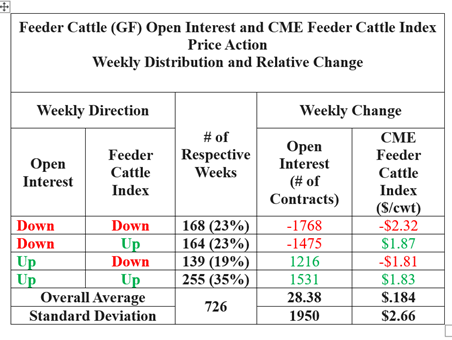
What about the argument that none of this is proper? This means that LRP coverage varies from week to week. The second chart shows the weekly change in Open Interest and the Feeder Cattle Index (see also data summary at the end of the column). A few things are important:
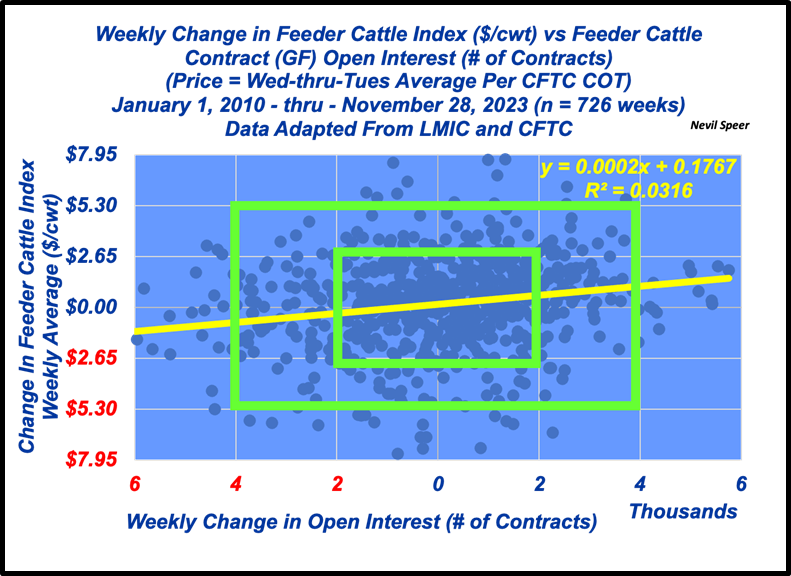
- The direction – it is positive – more volume means higher prices (opposite of the LRP argument). More importantly, week-to-week fluctuations in open interest explain only 3% of the fluctuations in the feeder cattle index.
- The regression – it requires a weekly change of 10,000 contracts (5 standard deviations = 1 in 3.5 million probability) to move the index by just $2.
LRP blame game is really a smoke monster.
Hedgers rarely complain: Back to the top. “Markets can remain irrational longer than one can remain solvent” (John Maynard Keynes). But you won't hear it Hedger or LRP policyholder complain. They proactively protect their equity (eventually Things that never happen happen all the time). It's a no-regrets, no-drama strategy. Warren Buffet says it best: “What the wise do at the beginning, the fools do at the end.”
Nevil Speer is an independent consultant based in Bowling Green, Kentucky. The views and opinions expressed here do not reflect or are in any way related to a customer or business relationship. He can be reached at [email protected].
Comments are closed.