


In 2022, the specter of government intervention has shrouded the gas markets: whether it’s price caps, encouraging benchmark diversification, bundling procurement on a centralized platform, or using state-owned banks to buy LNG cargoes directly, all ideas shone on the table to lie.
While pipeline gas and LNG share several fundamental properties, they also differ in many aspects. In this deluge of policy proposals and announcements, significant changes are taking place within the LNG industry itself. These changes relate to price indexation, market participation and trade flows.
This article, as part of a series of articles on changes in the LNG industry, will address the first issue: price indexation. LNG price markers are used in the spot market, while long-term contracts still tend to use surrogate oil or pipeline gas prices. As replacement prices differ significantly from the LNG market, a hybrid solution in long-term contracts that combines both mechanisms is finding some acceptance.
price indexation
The price benchmarks used in LNG trading have been in flux over the past 12 months, resulting in large changes in the relative values between them. While LNG has always been a difficult market to analyze from a pricing perspective, this complexity has deepened in 2022.
Here are some general points to get you started, based on data collected from January through August by market reporting teams at Platts, part of S&P Global Commodity Insights, and the IHS Connect Contracts Database:
1. Fixed price trading has been on the decline globally for some time, but fixed price usage in North Asia has plummeted significantly in 2022.
2. As LNG freight prices have converged and gas hub prices have diverged, more and more trade-related LNG-based benchmarks are increasing; and
3. Contracts signed for long-term volumes are on track to easily surpass 2021 totals, while crude oil-linked contracts have declined significantly relative to total trade.
Fixed-price trading has fallen to around 43% of total spot and short-term trade or cargo to be delivered within the next two years in 2022, down from 65% of trade in 2021.
Looking more closely, fixed price trading in North Asia has fallen from 52% in 2021 to under 20% so far in 2022. Fixed prices now appear widely in tenders from state-owned companies in South Asia, Thailand and Argentina. These locations will account for 75% of fixed price deals in 2022.
The significant decrease in fixed-price trades is due to increased market volatility and more developed futures markets.
It is well documented that LNG prices (JKM, Platts West India Marker, Platts Northwest Europe, Platts Gulf Coast Marker) move in a narrow range, while prices at gas hubs on both sides of the Atlantic (represented by Henry Hub and the Dutch) move Title Transfer Facility or TTF) have achieved record differences. Additionally, LNG prices were trading at large discounts to TTF in 2022. Platt’s Northwest Europe LNG benchmark hit a record $24.475/MMBtu discount to the Dutch TTF on Aug. 26.
In this context, the volume of JKM-indexed trading in the global spot and short-term markets increased to approximately 33% in 2022, more than doubling the level in 2021.
This data also shows that within Europe itself, a greater variety of indexing is used for LNG cargoes. For example, a recently published tender called for pricing versus the French PEG gas hub for 12 loads delivered between 2023 and 2025. Activity reported in S&P Global’s Atlantic LNG Market on Close assessment process shows this, with nearly 40% reported versus the UK NBP in 2022. In 2021, no NBP-indexed activity was reported in the process.

A peculiarity specific to LNG is the occurrence of substitute prices in the long-term contract period. It is also surprising that these replacement prices are very rare in the short-term contract area.
Henry Hub and Brent, which are widely used in long-term contracts outside the US and within Asia respectively, are used less than 5% each in short-term trading.
While Henry Hub has appeared significantly more frequently in long-term sales and purchase agreements (SPAs) in 2022 — largely because most projects seeking a final investment decision are based in North America — Brent-linked long-term contracts have failed.
Only 0.675 million tonnes of Brent-only SPAs have been signed so far this year, according to IHS Connect’s LNG contracts database, compared to nearly 18 million tonnes of such SPAs in 2021.
Companies involved in negotiations for contracts that may be based on Brent have complained that the relationship between LNG prices and Brent grade levels used in historical contracts has become a moving target.
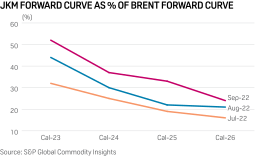
With LNG prices elevated relative to historical Brent climbs, buyers see a risk in agreeing to contracts now that would leave them at historically high climb levels, at the risk of LNG prices moving down. Given the potential for LNG to sell at significantly higher prices over the next few years — based on current forward curve values – than historical Brent slope levels would imply, sellers also don’t want to leave value on the table.

After many years of a reasonably stable relationship, starting in 2019, the relationship between LNG price and Brent maturity tilt started to break. However, the differences between the two have been greatest since 2021.
The few all-Brent-linked term contracts signed this year were agreed in January. Platts has heard from several companies that have been in lengthy negotiations for term contracts with a proposed Brent price base, but there has been little breakthrough from those yet.
For the few short-term tenders that have been secured at Brent-linked prices, from cargo strips for the winter season to agreements for delivery up to two years in advance, increases have reportedly ranged from 20% to 35%. This reflects the difficulty of using surrogate price benchmarks as they do not share the same market fundamentals as the LNG market.
The current impasse is unlikely to help the industry as consumers look to lock in volumes for years to come when the market is expected to get tight, and producers also seek to secure regular offtake for production planning purposes and funding collateral.
Hybrid contracts, where either Brent is part of the transaction formula or a Brent upgrade subject to an LNG price cap and/or collar, could be a way to break the deadlock. As both contract structures have recently been adopted, a compromise for medium-term contracts could be on the horizon.
Comments are closed.