
Russia heading for deepest recession since Soviet collapse, UK warns – business live | Business


05:57
UK: Russia heading for deepest recession since Soviet Union collapsed
Russia is heading for its deepest recession since the collapse of the Soviet Union, the UK government has predicted.
Economists expect Russia’s GDP this year to contract by between 8.5% and 15%, the UK says, as it announces sanctions on Vladimir Putin’s two adult daughters.
GDP growth is likely to be depressed over the longer term, as Russia is cut off from Western technology, it adds.
Around £275bn, or 60% of Russian foreign currency reserves, are currently frozen, the UK estimates, which has hampered Moscow’s ability to support its economy.
Foreign Secretary Liz Truss said:
Our unprecedented package of sanctions is hitting the elite and their families, while degrading the Russian economy on a scale Russia hasn’t seen since the fall of the Soviet Union.
But we need to do more. Through the G7, we are working with partners to end the use of Russian energy and further hit Putin’s ability to fund his illegal and unjustified invasion of Ukraine.
Together, we are tightening the ratchet on Russia’s war machine, cutting off Putin’s sources of cash.
Last month the Institute of International Finance forecast that Russia’s economy would shrink by 15% this year, and that any further boycotts of Russian energy would drastically impair its ability to import goods and services.
Those recession concerns prompted Russia’s central bank to cut interest rates from 20% to 17% this morning.
#Russia delivers surprise rate cut by 300bps from 20% to 17% amid recession, Ruble rebound. Financial-stability risk no longer rising, Bank of Russia says. Central bank says further cuts could come at future meetings. Ruble stays below 80 per Dollar. pic.twitter.com/olaQr7FMrh
— Holger Zschaepitz (@Schuldensuehner) April 8, 2022
The foreign currency freeze stopped Russia paying holders of its sovereign debt more than $600m earlier this week. The US Treasury blocked Russia’s ability to make debt payments in dollars through American banks, meaning Moscow had to set aside roubles instead. That could count as a debt default, after a 30-day grace period.
Updated at 06.03 EDT
31m ago08:15
Back in the UK, the cost of living crisis means households are more worried about their personal finances than they have been in at least a decade
The latest analysis from YouGov and the Centre for Economics and Business Research show that confidence about household finances is the lowest since the survey began 10 years ago.
Households were more pessimistic about the outlook over the next year, and reported a sharp deterioration over the last month, as rising food and energy prices hit budgets.
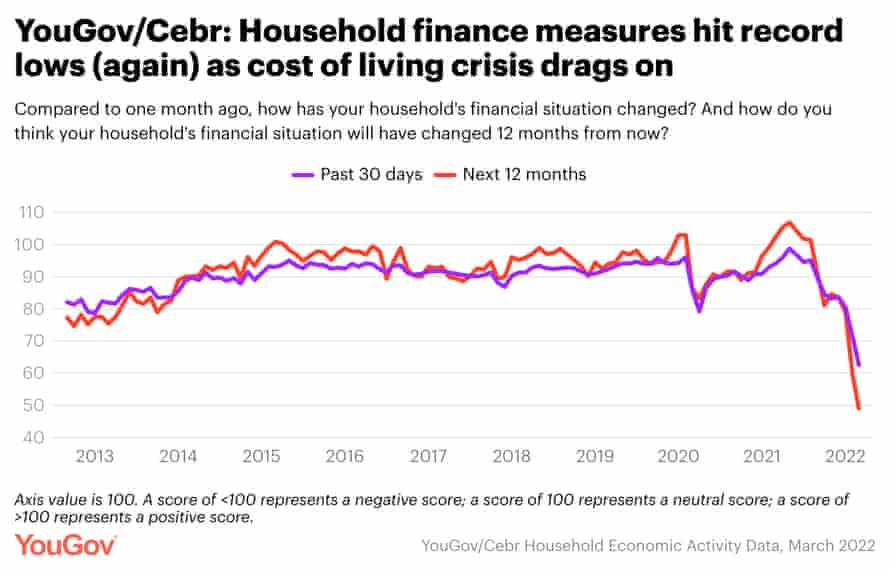 UK household finance confidence Photograph: CEBR/YouGov
Emma McInnes, Global Head of Financial Services at YouGov, says:
“The ongoing cost of living crisis and uncertainty caused by continued conflict in Ukraine has, once again, seriously impacted on both consumer confidence and the public’s household finances. For the second month running, tumbling household finance measures – both retrospective and forward-looking – find themselves at their lowest ever level since tracking began almost ten years ago.
Aside from a small uptick in job security outlook, confidence and household finance figures, combined with house price scores stagnating after four months of growth, have largely contributed to the overall consumer index continuing to fall”
2h ago07:152h ago06:57
Here’s Craig Erlam, senior market analyst at OANDA, on today’s cut to Russia’s main interest rate today:
The Bank of Russia [CRB] is seemingly buoyed by recent actions from the Kremlin despite severe sanctions continuing to be imposed by the West.
The capital controls that have been imposed have helped to shore up the rouble which appears to have given the CBR confidence that interest rates no longer need to be so high.
It cut the Key Rate by 3% and left the door open to further cuts depending on financial and economic conditions. At 17%, the rate remains extremely high as inflation is still expected to spike and the economy severely contract.
When the Ukraine war began, the rouble plunged from below 80 to the US dollar to as low as 135 roubles/$1.
But it has now recovered to near February’s pre-invasion levels, supported by capital controls including a ban on banks and brokers selling dollars, euros and other foreign currencies, and curbs on sending money abroad.
3h ago05:57
UK: Russia heading for deepest recession since Soviet Union collapsed
Russia is heading for its deepest recession since the collapse of the Soviet Union, the UK government has predicted.
Economists expect Russia’s GDP this year to contract by between 8.5% and 15%, the UK says, as it announces sanctions on Vladimir Putin’s two adult daughters.
GDP growth is likely to be depressed over the longer term, as Russia is cut off from Western technology, it adds.
Around £275bn, or 60% of Russian foreign currency reserves, are currently frozen, the UK estimates, which has hampered Moscow’s ability to support its economy.
Foreign Secretary Liz Truss said:
Our unprecedented package of sanctions is hitting the elite and their families, while degrading the Russian economy on a scale Russia hasn’t seen since the fall of the Soviet Union.
But we need to do more. Through the G7, we are working with partners to end the use of Russian energy and further hit Putin’s ability to fund his illegal and unjustified invasion of Ukraine.
Together, we are tightening the ratchet on Russia’s war machine, cutting off Putin’s sources of cash.
Last month the Institute of International Finance forecast that Russia’s economy would shrink by 15% this year, and that any further boycotts of Russian energy would drastically impair its ability to import goods and services.
Those recession concerns prompted Russia’s central bank to cut interest rates from 20% to 17% this morning.
#Russia delivers surprise rate cut by 300bps from 20% to 17% amid recession, Ruble rebound. Financial-stability risk no longer rising, Bank of Russia says. Central bank says further cuts could come at future meetings. Ruble stays below 80 per Dollar. pic.twitter.com/olaQr7FMrh
— Holger Zschaepitz (@Schuldensuehner) April 8, 2022
The foreign currency freeze stopped Russia paying holders of its sovereign debt more than $600m earlier this week. The US Treasury blocked Russia’s ability to make debt payments in dollars through American banks, meaning Moscow had to set aside roubles instead. That could count as a debt default, after a 30-day grace period.
Updated at 06.03 EDT
3h ago05:33
UK sanctions daughters of Putin, and Lavrov
The UK has added Russian president Vladimir Putin’s daughters to its sanctions list, matching a move by the United States this week.
Katerina Tikhonova and Maria Vorontsova, Putin’s two adult daughters with his former wife Lyudmila Shkrebneva, and Yekaterina Sergeyevna Vinokurova, daughter of foreign minister Sergey Lavrov, will be subject to travel bans and asset freezes.
The UK say the move will further target “the lavish lifestyles of the Kremlin’s inner circle”.
By freezing the assets and limiting the travel of Putin’s allies, the UK Government is sealing off reservoirs of cash funding the conflict, while also making sure those who have benefited from Putin’s rule feel the consequences.
New sanctions on Russia
🇪🇺 EU ban on Russian coal imports
🇪🇺 ban on Russian ships in EU ports
🇬🇧 UK sanctions Putin’s daughters
— Scott Beasley (@SkyScottBeasley) April 8, 2022
My colleague Rupert Neate wrote about Tikhonova and Vorontsova earlier this week:
Katerina Tikhonova, 35, the younger daughter, was born in Dresden in 1986 while Putin was working as a KGB spy. Tikhonova, who uses the surname of her maternal grandmother, studied at St Petersburg State University and Moscow State University and has a master’s degree in physics and mathematics.
As well as studying, Tikhonova has a passion for Japanese culture and acrobatic rock’n’roll dancing, an athletic form of boogie-woogie. In 2013 she and her dance partner came fifth in the world championships in Switzerland.
It was footage from her dance competitions, compared with pictures from the website of Moscow State University, where she works, that helped to first establish that Tikhonova was Putin’s daughter in 2015.
Putin’s elder daughter, Maria Vorontsova, 36, is a paediatric endocrinologist, studying the effects of hormones on the body.
In 2019 Vorontsova, who lives in a penthouse apartment opposite the US embassy in Moscow, gave an interview on Russian state TV revealing plans for a £500m medical venture aimed at helping to cure cancer.
Vorontsova married the Dutch businessman Jorrit Faassen, and the couple lived in the penthouse of an exclusive apartment building in Voorschoten, near the Hague. In 2014 some Dutch neighbours called for her to be expelled from the country after the downing of MH17 by pro-Russia forces over Ukraine.
Updated at 05.35 EDT
4h ago05:03
Russia’s central bank cuts interest rates to 17%
Just in: Russia’s central bank is cutting interest rates from 20% to 17%.
The move reverses some of the doubling of interest rates last month, when the Ukraine war triggered the first wave of sanctions on Russia and sent the rouble plunging.
⚠️BREAKING:
*BANK OF RUSSIA CUTS KEY RATE BY 300BPS TO 17%
🇷🇺🇷🇺
— Investing.com (@Investingcom) April 8, 2022
Explaining the move, which comes in on Monday, the Bank of Russsia said inflation pressures have eased as the rouble has partially recovered, and financial stability risks have stabilised, but are still present.
It also warns that Russia’s economic activity is still being “considerably” constrained by external conditions.
Today’s decision reflects a change in the balance of risks of accelerated consumer price growth, decline in economic activity and financial stability risks.
Data this week showed that Russia’s service sector contracted rapidly last month, with economists predicting a steep recession this year.
The Bank of Russia adds that it could cut interest rates again at future meetings:
In its further key rate decisions, the Bank of Russia will take into account risks posed by external and domestic conditions and the reaction of financial markets, as well as actual and expected inflation dynamics relative to the target and economic developments over the forecast horizon, and holds open the prospect of further key rate reduction at its upcoming meetings.
Updated at 07.11 EDT
4h ago04:424h ago04:37
On food, Ukrainian prime minister Denys Shmyhal has predicted that this year’s grain harvest is likely to be 20% less than last year because of a reduced sowing area following Russia’s invasion.
He said there was a shortage of fuel for farmers but Ukraine knew how to keep them supplied. He also said Ukraine had large stocks of grain, cereals and vegetable oil, and could feed its population (via Reuters).
4h ago04:35
Here’s a chart showing the jump in food prices:
Updated at 04.36 EDT
4h ago04:30
Global food prices surge to record highs
 An ear of wheat in a field near the village of Hrebeni in Kyiv region, Ukraine. Photograph: Valentyn Ogirenko/Reuters
World food prices jumped to new record high in March as the war in Ukraine rattled drove up prices, adding to the inflation pressures on people around the globe.
The U.N. food agency reports that food prices rose nearly 13% during last month, according to its index tracking food commodities.
Vegetable oils, cereals and meat all hit record highs, while sugar and dairy products prices also rose significantly.
The Food and Agriculture Organization says its food price index, which tracks the most globally traded food commodities, made “a giant leap” in March, to 159.3 points from 141.4 for February.
Cereal prices soared by 19.7% to a record in March, driven by the Ukraine war, the FAO explains:
This month’s increase reflected a surge in world prices of wheat and coarse grains, largely driven by conflict-related export disruptions from Ukraine and, to a lesser extent, the Russian Federation. The expected loss of exports from the Black Sea region exacerbated the already tight global availability of wheat.
With concerns over crop conditions in the United States of America (USA) also adding support, world wheat prices rose sharply in March, soaring by 19.7 percent.
Vegetable oil also hit record highs, up 23% in the month, as supplies from major exporters Russia and Ukraine fell.
The sharp rise of the index was driven by higher sunflower, palm, soy and rapeseed oil prices. International sunflowerseed oil quotations increased substantially in March, fuelled by reduced export supplies amid the ongoing conflict in the Black Sea region.
In the meantime, palm, soy and rapeseed oil prices also rose markedly, buoyed by rising global import demand in the wake of sunflower oil supply disruptions.
The Ukraine conflict also contributed to record meat prices last month, which rose another 4.8%, the FAO adds.
In March, pig meat prices registered the steepest monthly increase on record since 1995, underpinned by supply shortfalls of slaughter pigs in Western Europe and a surge in internal demand in light of the upcoming Easter holidays.
International poultry meat prices firmed, fuelled by reduced supplies from leading exporting countries following avian flu outbreaks, further impacted by Ukraine’s inability to export poultry meat amid the ongoing conflict.
Updated at 04.54 EDT
5h ago04:07
There’s further misery for some air passengers today, with travel journalist Simon Calder reporting British Airways has cancelled another 68 flights, while easyJet has cancelled 42.
There’s a handy list here.
Good morning from Heathrow airport, where British Airways has cancelled another slew of flights overnight – including to Athens, Larnaca and Prague. Along with easyJet’s cancellations, that’s at least 100 flights grounded today.
More on the weekend ahead🔽https://t.co/77bG9FEvf5
— Simon Calder (@SimonCalder) April 8, 2022
All of today’s flight cancellations, so far.
68 on British Airways, including late-notice groundings to Athens, Larnaca and Prague.
42 on easyJet, including Gatwick to Agadir and Bristol to Dubrovnik.
Airlines must get passengers to their destination todayhttps://t.co/RIPvYaY64x
— Simon Calder (@SimonCalder) April 8, 2022
Updated at 04.11 EDT
5h ago03:50
Next weekend will also be very busy on the UK roads, as millions of people embark on an Easter getaway.
The AA estimates that more than 27.6 million car journeys are planned between Good Friday and Easter Monday (between 15th and 18th April).
Some 13.6 million are expected on Good Friday alone, leading to fears of tailbacks on popular tourist routes.
AA spokesman Tony Rich said:
“The Easter holidays look set to give British tourism a much-needed boost as people cut back on overseas travel.
“With more than 27.6 million trips planned over the bank holiday weekend, we can expect significant congestion across the UK as people flock to coastal resorts and holiday homes.”
* Drivers are being warned to expect long delays next weekend as millions of people embark on an Easter getaway.
The AA estimates that more than 27.6 million car journeys are planned between Good Friday and Easter Monday. pic.twitter.com/tpGFN1XWRH
— TSC International News (@news_tsc) April 8, 2022
Updated at 03.52 EDT
5h ago03:37
Manchester Airport: We don’t have enough staff
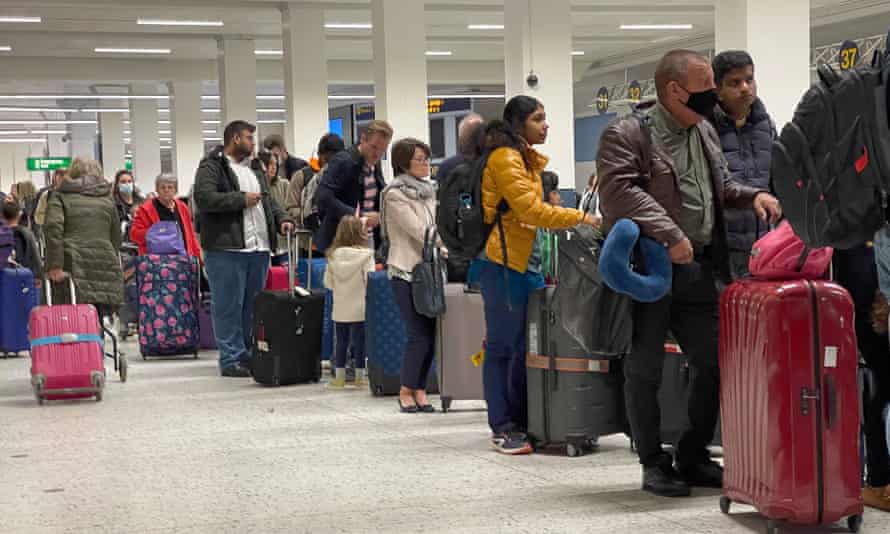 Passengers queuing for check-in at Manchester Airport’s terminal 1 this week. Photograph: Christopher Furlong/Getty Images
The boss of Manchester Airport’s owner has admitted the airport does not have enough staff, and warned that the long queues at the airport could persist for months.
Charlie Cornish, chief executive of Manchester Airports Group, has written an open letter to passengers, in which he apologises for the disruption, and explains that the the airport hasn’t been able to hire staff fast enough.
Cornish says:
“The simple fact is that we don’t currently have the number of staff we need to provide the level of service that our passengers deserve.
“Despite our efforts since last autumn, the tight labour market around the airport has meant we have just not been able to hire people quickly enough to establish a full-strength team.
“Practically, staff shortages mean that we cannot open all the security lanes we need and, at times, this results in longer queues than we want to see.
“While we still expect most passengers to get through in less than 30-40 minutes, there will be times over the next few months when waiting times will rise to between 60 and 90 minutes.”
Cornish explains that the airport has interviewed 4,000 staff in the last two months, and expects around 250 new security staff to start in the operation by early May. Staff with the right level of security clearance are also being deployed to help.
Cornish advises passengers to arrive at the airport three hours before their flight leaves, to allow enough time to check-in, get through security and reach the departure gate.
He says the airport doesn’t want to cap capacity and force airlines to cancel flights, as this would cause “enormous disruption to holidays, business trips and long-awaited visits to see friends and family.”
The managing director of Manchester airport quit earlier this week after rising criticism over chaos that saw thousands of passengers missed their flights because of queues up to seven hours long.
Deputy CEO Ken O’Toole has the ` the chaotic scenes last weekend were an “isolated incident”.
But O’Toole insists people would prefer to queue than see their flight cancelled.
We want to protect the full flying schedule. We want to make sure that after two years of people not getting away, those trips that they have booked, they can take them,” he said.
“That unfortunately does mean on occasion there will be queues which are not acceptable, they’re not what we’re aiming for.
“But the compromise between having that situation or cancelling lots of flights for people – which other airports have done in recent weeks – we believe people would prefer to accept a queue and make sure they get away.”
Those queues have been exceptionally long, though, with some passengers enduring waits of up to eight hours in terminal buildings before they could check in.
Updated at 03.39 EDT
6h ago03:12
Airlines and cross-Channel services brace for busiest weekend since Covid
 Gwyn Topham
With a very busy weekend looming, passengers have been told to allow extra time to negotiate airport queues, as high rates of Covid infections worsen staff shortages at check-in and security, our transport correspondent Gwyn Topham writes.
Meanwhile, tailbacks on the major roads to the Channel are expected to intensify, as Eurotunnel anticipates rising traffic in both directions and P&O Ferries services remain suspended.
Passengers booked with P&O on the Dover-Calais route have been told they cannot travel this weekend, as the rival operator DFDS, which had been accommodating P&O customers, is now fully booked.
Airports are redeploying office staff with security clearance to frontline roles where possible to help mitigate the chaotic scenes of recent days, particularly at Manchester airport.
EasyJet, which has had to axe hundreds of flights this week, said it would be pre-emptively cancelling a further 50 flights a day over the weekend to minimise disruption.
Large numbers of crew remain sick with Covid, affecting services at Gatwick, Luton and Manchester. However, the airline said it would still be operating more flights than at any point since 2019 – about 1,600 a day, 300 more than in August 2021.
6h ago03:06
Introduction: Air industry warned over distressing disruption
Good morning, and welcome to our rolling coverage of business, the world economy and the financial markets.
UK airlines and airports have been warned about the levels of disruption being by passengers, as people head abroad in the run-up to Easter, some of them for the first time since the pandemic began.
After days of long queues, cancellations and chaotic scenes at airports, the aviation regulator has warned travel firms to stop cancelling flights at the last minute and promptly pay compensation to disrupted passengers.
Civil Aviation Authority chief executive Richard Moriarty has written to airlines and airports, saying:
“Instances of late notice cancellations and excessive delays at airports are not just distressing for affected consumers but have the potential to impact confidence levels across the industry, at just the point when passengers are returning to flying.”
The CAA’sa warning comes as airlines and cross-Channel services brace for their busiest weekend since the start of the pandemic, with outbound and returning holidaymakers set to swell numbers at ports that are already struggling to cope with surging demand.
Airports and airlines have blamed recruitment problems, and illness from Covid-19, for leaving them short-staffed. Having cut staff once the pandemic began, the industry is trying to meet renewed demand for travel after the UK lifted the last testing restrictions on 18 March.
Moriarty, though, says recruitment should have been faster, and insists the travel sector sets “deliverable” schedules:
We know that you are working hard to recruit these new colleagues, but it is clear that this has not always happened sufficiently quickly to cope with the increased passenger travel in recent days.
Given the consequences for passengers of cancelled and disrupted journeys I encourage you to do all you can to ensure that you have the necessary level of appropriately-trained and cleared staff resources in place.”
It is “very important” that airlines are setting schedules “on a basis that is deliverable given available staff (including contractors), and has resilience for staff sickness, including from Covid,” Mr Moriarty added.
Hundreds of flights have been cancelled in recent days, with British Airways cancelling another 74 flights on Thursday and easyJet 52.
There’s also disruption in Kent, where an eastward section of the M20 was shut this week for thousands of lorries to park, due to delays at the port of Dover.
Also coming up today.
In the energy markets, the Brent crude oil price is hovering around $100 per barrel after members of the International Energy Agency agreed to release another 60 million barrels of oil from their emergency stocks yesterday, amid a shortage exacerbated by the Russian invasion of Ukraine.
Boris Johnson is set to meet the German Chancellor as they look to discuss how to help European countries wean themselves off Russian gas following the attack on Ukraine.
The agenda
- 12.15pm BST: ECB board member Fabio Panetta speaks at the ‘Technology and Finance’ conference organised by IESE Business School
- 1.30pm BST: Canadian jobs report for March
Updated at 03.41 EDT
Comments are closed.