


The record-breaking global bond market rally since earlier this year has fizzled out as mounting signs of persistent inflation are forcing investors to revise their views on the likely future trajectory of rate hikes.
Investors rushed into fixed income in the early weeks of 2023 as they grew in expectations that the US Federal Reserve and other major central banks would soon end their aggressive monetary tightening campaign.
A Bloomberg index that tracks high-quality government and corporate bonds rose as much as 4 percent last month, its best-ever start to the year.
But that gain has now vanished after a devastating US jobs report earlier this month sparked a raft of better-than-expected economic data on both sides of the Atlantic and upended expectations the Fed and European Central Bank were about to match theirs fight win inflation.
The resulting surge in bond yields has also disrupted a stock market rally, with the S&P 500 down 2.7 percent over the past week.
“We did a reality check,” said Michael Metcalfe, head of macro strategy at State Street, adding that the monetary easing that markets were anticipating a few weeks ago “looked a little fanciful.”
The biggest turnaround came in the US after data showed that employers added more than half a million jobs in January, almost three times what economists had forecast, and that consumer price growth was 6.4 percent – also ahead of forecasts .
On Friday, the Fed’s preferred gauge of inflation — monthly core personal spending — rose 0.6 percent from December to January, ahead of consensus forecasts.
Futures markets, which previously reflected bets that the US Federal Reserve would cut rates twice later this year, are now predicting rates will rise to 5.4 percent by July, with at most a single cut by the end of the year year.
“Earlier this year, markets overtook in pricing of Fed cuts on hopes that this cycle would end sooner,” said Idanna Appio, portfolio manager at First Eagle Investment Management.
“Things were judged on perfection – investors were betting that the Fed would successfully and quickly cut inflation. I think this process will take longer than people thought.”
Further reflecting the shift in sentiment, bond fund flows have reversed in recent weeks – particularly at the riskier end of the credit spectrum.
Emerging market bonds, which rallied in January, saw their biggest outflows this week since October, JPMorgan data shows. According to data from the EPFR in February, more than 7 billion

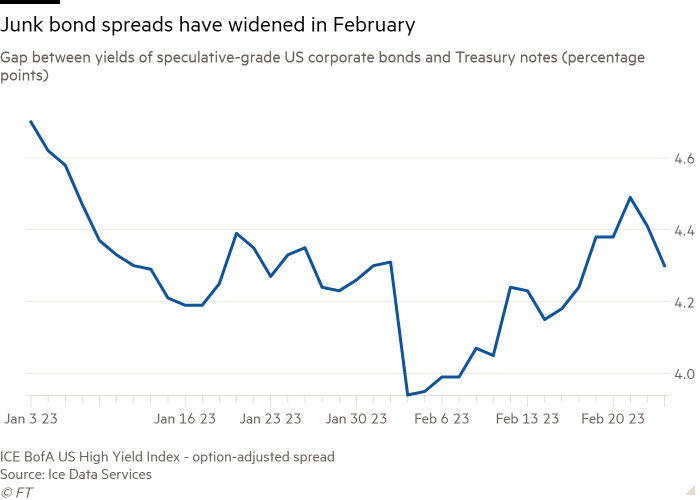
Investors are demanding a higher premium for holding low-rated, high-yield corporate bonds than last month, when market exuberance eased concerns about debt defaults.
The gap between US junk bond yields and Treasury bill yields actually narrowed by 0.87 percentage points since New Year’s Eve to 3.94 percentage points in mid-January. But that spread has since widened to 4.3 percentage points.
John McClain, portfolio manager at Brandywine Global Investment Management, said rates would remain at higher-than-expected levels “for the foreseeable future”.
“We don’t expect rate cuts in 2023 and that will eventually lead to stress in the riskier credit segments,” he said.
The shift in investor expectations is a confirmation of the Fed’s insistence since the beginning of the year that interest rates would remain elevated for an extended period. A December poll of Fed officials showed they expected borrowing costs to end the year at about 5.1 percent.
Now some analysts are wondering whether the central bank’s own forecasts are too conservative.
“There is a real chance we could exceed a 6 percent rate. If the data continues to improve, there’s a real chance the Fed is behind the curve right now and rates will have to rise more than expected,” said Calvin Tse, head of macro strategy for the Americas at BNP Paribas.
Some big investors say the recent sell-off is a sign it’s too early to jump into bonds; That moment will likely come later in the year.
“Of course the Fed will eventually cut rates, but the market has been trying to forestall that. . . and it was so, so premature,” said Sonal Desai, Franklin Templeton’s chief investment officer. “I still think it’s a very good year for fixed income. I just don’t think we haven’t made it yet.”
Comments are closed.