


What is Quad Witching?
Quadruple witching is an event in the financial markets in which four different sets of futures and options expire on the same day.
Futures and options are derivatives linked to underlying stock prices. When derivatives expire, traders must close or adjust positions. This can trigger significant volume and order flow. The four types of derivatives that expire in quadruple sorcery are:
- Stock index futures contracts
- Individual stock options
- Options on stock index futures
- Stock index options
Note: Some lists include single stock futures on the quad witching expiration list. However, these are relatively small products with minimal impact on the market.
When are Quad Witching Days in 2024?
Quadruple Witch Days are the third Fridays in March, June, September and December. In this way they take place towards the end of each quarter of the year. In 2024 they will be there:
- March, 15
- June 21st
- September 20th
- 20th of December
Market Impact of Quadruple Witching
The simultaneous expiration of stock index futures, options on stock index futures, single stock options and index options can result in significant volatility and volume. For example, the Quad Witch Day, December 15, 2023, saw the largest volume in the S&P 500 in the second half of last year. The other Quad Ghost Days also saw above-average activity. (See the table below.)
The popular name “witches” comes from the idea of certain times when dark, supernatural forces are active. This can apply metaphorically in markets when traders are forced to liquidate large derivative positions. Such events can sometimes lead to unexpected moves, although newer rules have reduced much of the previous chaos. Most of the time it causes a lot of noise now.
Stock index futures
These include heavily traded products such as the E-Mini S&P 500 (@ES) and the E-Mini Nasdaq-100 (@NQ). The Dow Jones Industrial Average (@YM) and Russell 2000 (@RTY) also have futures.
Futures traders can take long and short positions 24 hours a day from Sunday evening to Friday afternoon. If they want to hold onto a position until quarterly expiration, they must sell the expiring contract and buy into the newer contract. This so-called “rolling” is a big reason for the high volume of quad witch days.
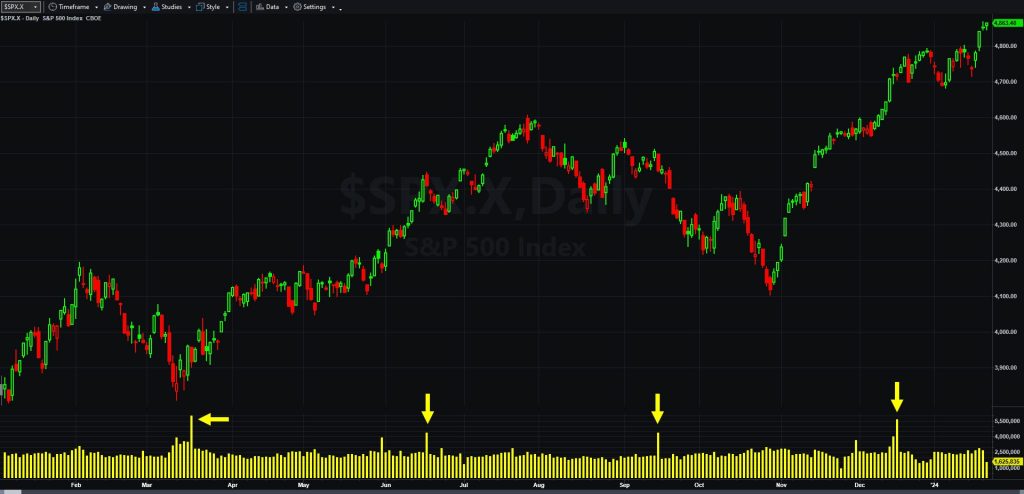 S&P 500, daily chart, from 2023. Note volume spikes on quadruple ghost days.
Individual stock options
Individual stock options track moves in companies like Apple (AAPL) and Tesla (TSLA). Call options give investors the right to buy stocks. Put options authorize you to sell.
Stock options expire on the third Friday of every month and are therefore always active on Quadruple Hex days. It's worth noting that thousands of companies have stock options – unlike the few index futures.
Options on stock index futures
Stock index futures like the E-minis mentioned above have options contracts. Call options allow traders to buy the futures at specific prices, so you benefit when the market rises. Puts allow them to be sold at specific prices, allowing them to profit on the downside.
Options on stock indices
These products have some similarities to options on index futures in that they track major benchmarks such as the S&P 500 and the Russell 2000. However, they have other important differences and are primarily used by institutional investors.
When it comes to stock index options, there are also call options and put options. They expire quarterly on the third Friday, helping to drive activity on Quadruple Witch Days.
Securities futures are not suitable for all investors. To obtain a copy of the Securities Futures Risk Disclosure Statement, visit www.TradeStation.com/DisclosureFutures.
Options trading is not suitable for all investors. Your TradeStation Securities account's application to trade options will be reviewed and approved or rejected based on all relevant factors, including your trading experience. See www.TradeStation.com/DisclosureOptions.
For complete information on the costs and fees associated with options, please visit www.TradeStation.com/Pricing.
Comments are closed.