


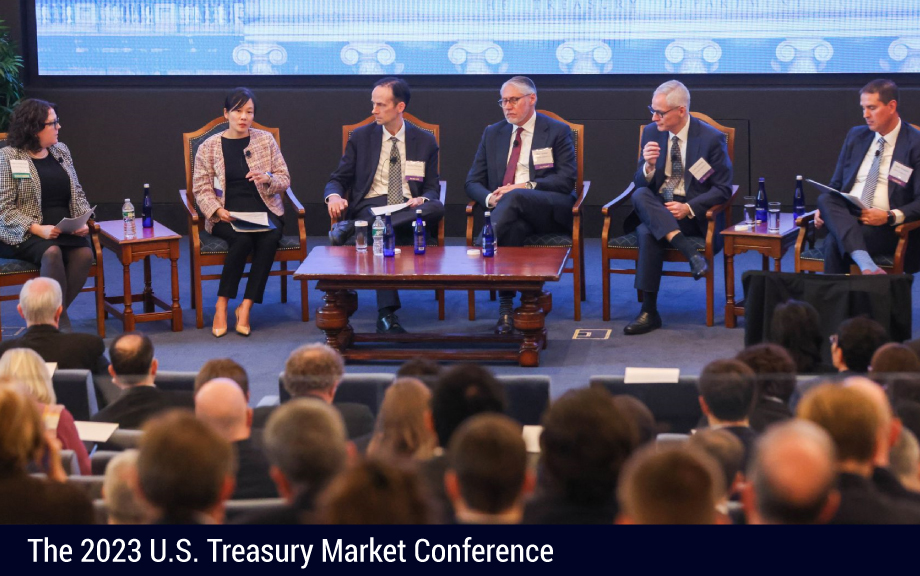
At the ninth annual U.S. Treasury Market Conference, David Bowman of the Federal Reserve Board's Division of Monetary Affairs moderated a panel seeking perspectives on trading practices, motivations, and risk management considerations in the non-centrally cleared bilateral repo (NCCBR). Market. The panel included representatives from three broker-dealer firms, a hedge fund and the Office of Financial Research (OFR). Although visibility into NCCBR activities is relatively limited, it is estimated to be the largest treasury repo market segment and serves as an important source of funding for non-bank financial institutions, particularly hedge funds.
NCCBR Activities and Trade Practices
The OFR representative summarized the results of a recent OFR pilot study on the NCCBR market and highlighted several potential factors driving NCCBR activity. These included potentially lower costs than centralized settlement for some customers and greater flexibility regarding “haircuts,” which refer to the difference between the initial market value of an asset and the discounted value when used as collateral in a repo transaction is pledged. A large proportion of NCCBR trades have no haircuts, and Market Outreach attributed this proliferation to netted trades, where packages of repo and reverse repo trades are netted against each other in bilateral transactions. These transactions provide merchants with capital and accounting benefits that they can pass on to cash borrowers as zero haircuts. Such netting benefits are also available in centrally cleared repo segments as trades are transferred to the Central Clearing Counterparty (CCP), which can be treated as the sole counterparty. The NCCBR segment also appears to be a preferred route for longer-term repo transactions, as a portion of these transactions involve non-treasury collateral that is not eligible for central clearing under current CCP models.
Regarding the NCCBR market, the trader panelists noted that using a CCP can increase trading costs, which can influence the decision for or against centralized settlement. In addition, some clients are interested in a fixed discount over the period of their repo transactions, which may not be as feasible given the possibility of variable margin CCP systems in the discretionary space. Other factors cited as determining whether or not to centrally clear included the terms of netting agreements with clients, the duration of the underlying trade and the concentration risk of the underlying trade at the CCP or between broker-dealers. Some smaller traders may face higher costs to support central clearing or sponsored trades for their customers. The hedge fund panelist, whose firm actively uses both NCCBR and Sponsored Repo, noted that counterparty risk and costs were among his considerations.
On the issue of haircuts, some highlighted that competitive forces can contribute to the absence of haircuts, and even with offsetting there may still be residual risk related to maturity mismatches associated with the collateral. Some panelists also noted that margins are sometimes applied at the portfolio level to address risk, rather than trading-level discounts, and that portfolio-assessed margins may include margins from positions in the futures market. One panelist noted that a general minimum haircut requirement that applies to both centrally cleared and non-cleared trades might be worth considering.
Cash futures basis trading
On the topic of basis trading, Bowman asked the panelists whether the market was in a similar situation and at risk of a recovery like in March 2020. Panelists noted that current activity in basis trading was similar in that hedge funds – participants in the NCCBR market – were providing liquidity by connecting the Treasury's cash and futures markets due to a lack of natural suppliers in the futures market. However, they noted that the market appears to be using less leverage in these trades than in 2019. Some panelists emphasized that hedge funds have been a significant source of demand for Treasury bonds, in part because of their interest in basis trading. which is important in the current environment of growing emissions.
Impact of greater central clearing
Panelists said that if central clearing were rolled out more widely, they would expect higher costs and potentially larger bid-ask spreads as more repo trades would be subject to the CCP's unified margin system, which in turn would increase the CCP's default fund . Similar to today, dealers and other CCP members would have to decide whether they want to bear the increased margin costs – as some dealers are currently doing – or whether they want to pass this burden on to their sponsored customers. One panelist noted that increased centralized settlement could disadvantage smaller traders and increase concentration if there are no changes to clearing rules. Panelists noted that benefits of more centralized clearing in the repo market could include better oversight, data transparency and greater netting efficiency to improve dealers' intermediation capacity when balance sheets are constrained. Such benefits could lead to improved liquidity and lower trading costs over time.
Next, in an accompanying article, we will discuss the panel's key findings assessing the recent resilience and liquidity of the Treasury market.
A replay of this panel is available on the US Treasury Market Conference 2023 event page starting at 22 minutes and 56 seconds in the embedded video.
Leon Barker is a capital markets trading associate in the Markets Group.
Ellen Correia Golay is a capital markets trading advisor in the Markets Group.
Brian Greene is an associate director of capital markets trading in the Markets Group.
Also in this series:
The views expressed in this article are those of the contributing authors and do not necessarily reflect the position of the New York Fed or the Federal Reserve System.
Comments are closed.