


The Federal Reserve (aka “The Fed”) has a parrot problem and is on a crash course with economic reality… maybe.
The Fed sets policies that affect interest rates to keep inflation in check without crippling the economy. After arguably leaving the pro-rate policy intact for too long in 2021, they strove to curb inflation in 2022 with aggressive rate hikes (higher rates leave less money to buy other “stuff”, hopefully lowering the inflation due to falling demand).
For months almost every Fed spokesman parroted a version of the same few thoughts:
- Inflation is too high
- The prices have to be even higher
- Once interest rates are as high as possible, we need to keep them there for as long as possible
- We don’t mind wreaking economic havoc if it means controlling inflation
- We’d rather do damage and beat inflation than protect the economy and risk another surge in inflation
- We don’t want to repeat the mistakes of the early 80’s.
That last bullet point was obviously a guiding principle for the Fed – repeated by almost every member. It refers to a Fed rate cut in 1980 after a sharp drop in inflation. Before that, inflation had risen to unprecedented levels and the Fed hiked rates to unprecedented levels to fight it. In short, it looked like they won. They cut interest rates accordingly, but it proved too early. Monetary scholars believe that the subsequent rate hikes to all-time highs could have been avoided if the Fed had not declared victory so early.
Fast forward to the present, and the Fed is keen to avoid these past mistakes. The market has generally done a good job of believing the Fed’s guidance. In particular, interest rates have risen and stocks have weakened. But we are starting to see divergence and that has been very clear in the reactions to the various economic reports this week.
Thursday and Friday were the two most important days. A trifecta of upbeat jobs reports pushed rates higher and stocks lower on Thursday. Here’s the pattern playing out, as a friendly Fed helps both stocks and bonds by making it cheaper to borrow money. Cheaper borrowing (aka lower interest rates) means more economic growth, which is why we often see rates fall and stocks rise when the market meets the Fed’s expectations.
Thursday’s data led markets to believe the Fed would continue to hike aggressively as promised. That changed abruptly on Friday. The big monthly jobs report showed strong job growth, but more importantly, it also showed slower wage growth. Average hourly earnings were below the median forecast. In addition, last month’s payroll data was revised sharply downwards. Taken together, this gives the impression that wage growth has turned the corner.

The wages component is/was important news as Fed Chair Powell made explicit reference to wage growth concerns in the last press conference in mid-December. If wages don’t rise, that’s one less inflation concern for the Fed. Markets traded accordingly. Then, 90 minutes later, a separate report on the services sector showed massive unexpected weakness. Taken together, the two reports led markets to believe that the Fed would ease its rate hike stance.
In the chart below, Thursday’s data is simply labeled “ADP” because the most relevant market action this morning was the ADP jobs report. Friday’s data is labeled “NFP” for “non-farm payrolls” (the main component of the Big Jobs report).

Despite the labels, Friday’s biggest move actually waited until after the Institute for Supply Management (ISM) service sector data. ISM publishes an index for both the manufacturing and service sectors. The latter has been a key focus for the Fed and generally a bigger market mover when it underperforms significantly. This particular report was as far from expectations as any report in more than a decade, apart from the first few months of Covid lockdowns. The only real counterpoint would be to say that this weakness is some sort of rebound effect after almost 2 years of big annual gains. The chart below shows the main services index in blue and the annual change in green.

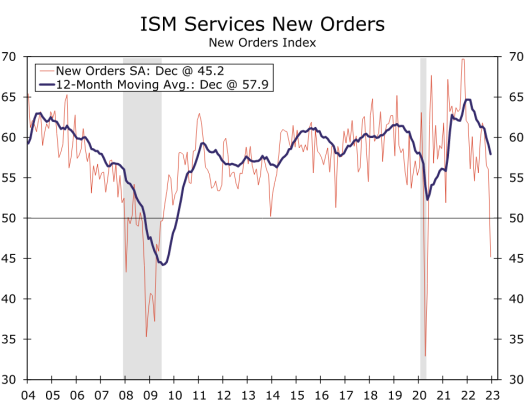
Another “yes, but” can be seen in the New Orders component of the Index. When the red line falls below 50, it was a good indicator of a recession. That could be the case this time as well, but analysts at Wells Fargo pointed out that the moving average remains much higher than during the last two dips. Granted, this could be a process that continues to play out, but the point is that we haven’t seen absolutely conclusive evidence of a recession yet.
It’s that “yes, but” mentality that continues to guide the Fed. Shortly after all of this happened, the Atlanta Fed’s Bostic said the data hadn’t changed his view on the need to keep raising rates and keeping them at peaks well into 2024. Such views are at odds with financial markets’ bets on Fed rate cuts set to take place as early as late 2023.
The chart below shows not only the expectation for September, which is more than 0.10% below June, but also the immediate and obvious reaction to Friday morning’s economic data.

Long story short, the Fed is reading from the same old script where it feels compelled to talk very harshly about how it’s going to deal with inflation. She rightly fears that a change in tone could cause markets to become too exuberant, undoing some of the work already done to fight inflation. Remember, it’s about dampening economic growth and demand for “stuff.” If markets suddenly thought interest rates were about to go steeply down, people might start buying enough stuff to keep inflation higher than it should be.
So the Fed will likely continue to go astray of being a cranky old stick in the mud of interest rate policy, and financial markets will likely continue to nod and smile while continuing to hedge bets with the same sorts of logical responses to data as those who do have seen week.
As for the reaction in mortgage rates, Friday was the best day in a while, but the average 30-year fixed rate is still quite high compared to levels earlier this year. In fact, the average lender didn’t even make it all the way back to the mid-December lows.

Comments are closed.