


Reverse stock splits prevent them from being delisted. But some didn’t even get that far and filed for bankruptcy, like, WOW, that was quick.
By Wolf Richter for WOLF STREET.
Hippo Holdings — one of the “insurance tech” unicorns that went public by merging with a SPAC and whose shares then collapsed — announced in a July 20 proxy statement that it would receive approval for a reverse stock split on July 31 “im Range from 1:20 to 1:30”.
On July 19, Hippo announced that it had received a delisting notice from the New York Stock Exchange because its stock price had been below $1 for 30 consecutive trading days. And to push the stock price above the delisting line, the company announced it would conduct a reverse share offering.
This is Hippo’s stock [HIPO] since announcing the merger with a SPAC in March 2021. The merger at a $5 billion “valuation” was approved by the shareholder on August 2, 2021. Less than a year later, there is the reverse stock split. Shares closed at $0.80 today, down 93%, and the whole thing was one gigantic hype and hoopla horror show at the end of the craziest stock market bubble of all time, as documented in my Imploded Stocks column.
If Hippo executes a 1:20 reverse stock split, the shareholdings of shareholders of record on July 18 will be reduced by 20. If I own 1,000 shares of Hippo before the reverse stock split, I’ll have 50 shares after it. And for a moment, instead of $0.80, the shares are worth 20 times that, which is $16. In dollar terms, I even come out for a moment.
The thing that happens in the market after that, as we learned during the dot-com bust, is that stocks often keep going down because there’s a lot more room underneath them to go down now. But at least it prevents delisting for a while.
If the company can’t figure out how to be cash flow positive, and therefore continues to burn cash, it needs to raise new funds to burn, and that’s very difficult in the current climate. Or maybe another company will buy it for scrap.
If those two options don’t materialize, then one day the company will disappear after all the money has burned up, and everyone had a good time during the party except for the investors, who ended up holding the puke bag.
This $1 delisting threat hangs over many companies that have recently gone public through a merger with a SPAC or through an IPO. And there will be a lot of delisting announcements and a lot of reverse stock split announcements — if the companies make it that far at all. And many won’t do that and will file for bankruptcy instead. And some already have.
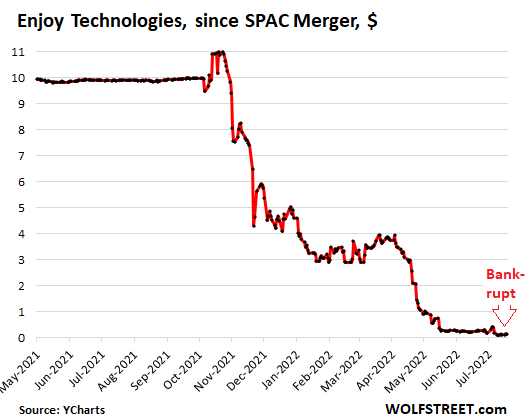
Enjoy technology [ENJY], a delivery startup with a fancy website, is one of the companies that didn’t even make it to a reverse stock split. It went public via a SPAC in October 2021 and then almost went straight to the heck – practically violating the WOLF STREET dictum that “Nothing goes the heck in a straight line”.
On June 17, it announced that it had received a delisting notice. On June 30, it announced that it was filing for bankruptcy. The stock is now gone, has already been delisted, and is trading over the counter at $0.12. It will eventually go to zero and end users will have to ask their brokers to remove the stocks from their account if they get tired of looking at them after a few years.
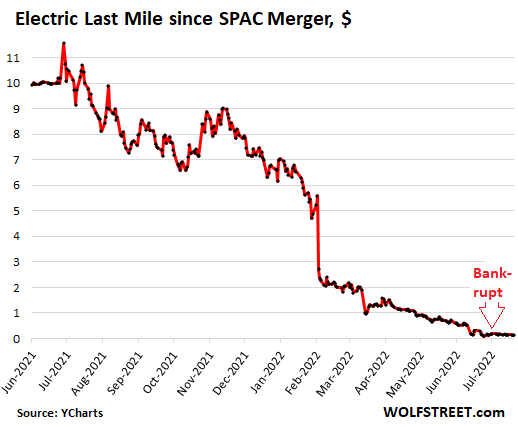
Electric last mile (EV conversions) have also never made it to a reverse stock split; it filed for bankruptcy in June, a year after its SPAC merger, and the stock is gone, now at $0.12 over the counter and set to go to zero.
Voyager Digital (crypto platform), which went public last year with the main listing in Canada, never made it to a reverse stock split either. It filed for bankruptcy in the US on July 6 after freezing customer deposits.
SoFi Technologies [SOFI] already received shareholder approval last week for a possible reverse stock split if the company decides to go that route. The company started out as a student loan provider and stock trading platform, then branched out into crypto trading. In early 2021, it merged with one of Chamath Palihapitiya’s SPACs. The stock had peaked at $28.26 in February 2021, giving it a market cap of around $25 billion. Since then, shares are down 75% to $6.97. And $18 billion in market cap is gone. The company lost $115 million in the first quarter, but shares remain well above the delisting line for now.
To the subway [MILE], another actuarial AI unicorn SPAC that’s lost a lot of money, this auto loan company, is a good candidate for a delisting announcement and reverse stock split. It is currently trading at $1.05 and has traded as low as $0.75. If it trades below $1 for 30 days, get ready:
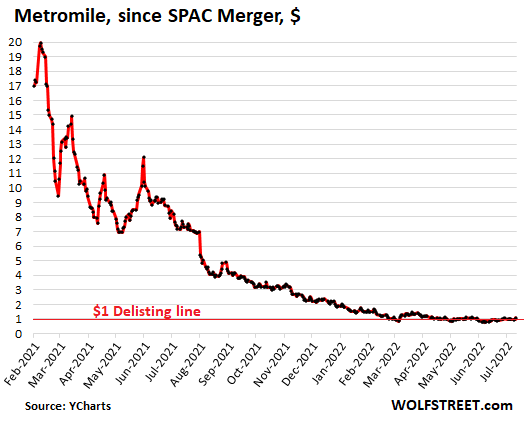
Among our other imploded stocks are the SPAC and IPO heroes, which have fallen near or below $1, at least temporarily:
- Vroom [VRM] (used car dealer)
- Shift Technologies [SFT] (used car dealer)
- Cazoo [CZOO] (U.K. used car dealer). Currently at $0.57 a new low. Losing money, cutting jobs, all that stuff.
- Velodyne lidar [VLDR] (EV technology)
- Centro Electric [CENN] (Australian lingerie brand that went electric)
- desktop metal [DM] (3d printing)
- buzz feed [BZFD] (online publication)
- David Inc. [DAVE] (Mark Cuban endorses Fintech Personal Finance), now at $0.68.
A reverse stock split doesn’t solve the company’s profitability problem. It just solves the delisting threat, at least for a while. If the company can’t pull itself together and generate positive cash flows, it will still disappear and the stock will still go to zero, even after the 1-for-gazillion reverse stock split.
Enjoy reading WOLF STREET and want to support it? Using ad blockers – I totally understand why – but do you want to support the site? You can donate. I appreciate it very much. Click on the Beer & Iced Tea Mug to learn how:
Would you like to be notified by email when WOLF STREET publishes a new article? Sign up here.

Comments are closed.