


“Underlying inflation is there, alive and kicking.”
The President of the European Central Bank, Christine Lagarde, wants to make it clear that the ECB is intent on bringing down inflation.
At his press conference this week, after another half a percentage point hike in interest rates, the President added that the bank “has a lot to do” and “we’re not done yet”.
At the same time, the bank said the risks to inflation and economic growth are now “more balanced”.
For months, risks have been described as “up” for inflation and “down” for growth.
So, in other words, it’s not getting any worse now.
Fine, you say, unless you have a tracker mortgage or an adjustable rate where things are nowhere near getting better.
And many people feel anything but balanced financially in this situation.
The ECB Governing Council hiked interest rates this week
Another way to think about it is that the ECB is still waving red flags but has shut down the sirens.
After all, inflation in the euro area was still 8.5% in January.
This is still a long way from the ECB’s target of 2%.
However, this was lower than expected and we are now well past the peak of inflation.
Growth was also better than expected, although a 0.1% increase in euro area GDP over the last three months of last year is hardly a euro party.
Ireland’s GDP growth of 3.5% over the same period is a different story altogether and is a reminder of the magical mysteries of national accounts, GDP and multinational corporations.
So, despite the ECB’s inflation warnings and the fact that it’s still elevated, it’s probably fair to say we’re at a bit of a tipping point.
And then it can get uncomfortable again.
The shock of this inflationary cycle has taken us months to adjust, and the aspirin of various cost-of-living measures only recently seems to have made us a little less afraid to open our utility bills.
Now comes the tricky task of weaning our electricity bills from €200 credits and accepting the usual excise duties on our fuels.
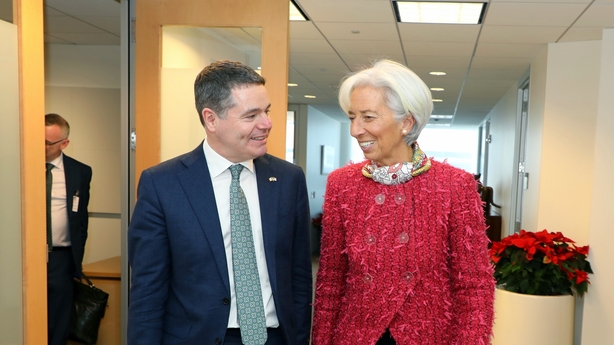 Eurogroup President Paschal Donohoe and ECB President Christine Lagarde
With the government soon to make a decision on various cost-of-living measures that expire at the end of this month, the warning given to Paschal Donohoe during his dinner with the Governing Council must have caused a bit of political indigestion.
“…It is important that these measures are now phased out without delay, in line with the fall in energy prices and in a concerted manner,” the ECB statement said.
It goes on to say that anything below “…is likely to add to inflationary pressures over the medium term, which would require a stronger policy response”.
That’s central bank code for “if you don’t do this, inflation will rise and we’ll be forced to push interest rates even higher.”
Christine Lagarde put this into perspective during the press conference on end-user energy prices.
But with gas prices back to where they were well before the Russian invasion of Ukraine and futures markets showing little sign of a reversal, competition should eventually lead to some downward movement in retail energy prices.
In a response likely to be echoed by his peers across Europe, the finance minister said on Friday that while he understood the “economic logic” of what the ECB president said, he “… will take into account the point of view of the ECB, but equally we respect their independence when it comes to monetary policy decisions, fiscal decisions are made at the national level and we will make the decisions in the interests of the people we represent…”
Ouch.
Relations between central bankers and politicians have been very cordial in recent times, especially at a time when money was being printed for free.
But money is no longer free. Far from it.
This warm relationship could soon be put to the test.
Comments are closed.