


Recent market developments have highlighted the goal of much of today’s monetary policy: funding public spending. If inflation continues to fall, governments will find it more difficult to control public debt.
Federal Reserve Chairman Jerome Powell speaks during a news conference following a meeting of the Federal Reserve Open Market Committee July 26, 2023 in Washington, DC. ©Getty Images×
In short
- Markets defied forecasts of a prolonged decline
- Investors care more about public finances than interest rates
- Falling prices will increase the pressure on central bankers
Financial market pessimists have had a difficult time over the past 15 years. The global financial crisis has certainly caused stock market crashes worldwide; For example, the S&P 500 index fell from about 1,500 points in July 2007 to about 750 in March 2009. However, it only took about four years to recover, hitting 3,200 points in January 2020.
Markets plunged again as Covid-19 caused waves of fear around the world (the S&P fell to 2,300 points in March 2020) but rebounded to 4,600 points in November 2021. A few months later, inflation, rising interest rates and the possibility of a recession started making headlines, but didn’t have much of an impact on the market either. At the beginning of July 2023, the index was around 4,500 points. The balance of the German DAX index was similar despite the weak development of the German economy.
The forecasts were largely wrong. The pessimists were not wrong in their theory that adverse shocks would affect financial markets; to point out that the state of public finances in many countries is fragile and likely to get worse; or to argue that the prospects for economic growth are bleak due to increasingly strict taxation and regulation. Still, the financial markets have been celebrating all along.
Their only accurate prediction was for the price of gold, the quintessential “safe haven,” which rose from around $670 an ounce in the summer of 2007 to $1,500 in March 2020 and $1,900 in July 2023. But of course, those who do. Those who put their money into stocks fared much better than those who bought gold (and much, much better than those who bought silver).
perception and reality
Where have pessimists made mistakes and what can we learn from their mistakes? The answer is: central banks. Before the global financial crisis hit, central bankers claimed they were influencing monetary policy by targeting different variables: interest rates, consumer price inflation, money supply, nominal or real gross domestic product (GDP), employment, etc. The narrative was quite confusing.
Understandably, analysts and the informed public were not overly confident in central bankers’ announcements, and rightly so. Authorities could set a target but in fact consider other targets. Or, while disclosing the variables to be considered, they remain unclear as to the threshold(s) that would trigger policy action.
The prevailing understanding was that monetary policy would consist of fine-tuning exercises when the economy is business as usual – and groping in the dark otherwise. Nobody really knew how central bankers would react if a global shock hit. Accordingly, in normal times, investors would look at fundamentals and compare expected returns across asset classes, or perhaps resort to technical analysis (computerized buy/sell algorithms). And when potential problems arose, they ran to safety.
After the global financial crisis, the perception of monetary policy changed. Investors have learned that the official targets matter less (ie the fight against inflation should not be taken too seriously). Instead, public finances and possibly commercial banking should feature more prominently in analysts’ handbooks.
New model
Markets now doubt that central bankers care about the supposed “modern purpose” of monetary policy (price stability) and have instead reverted to their “original purpose”: financing public spending and public debt. The focus on commercial banking is a side effect, as banks are involved – and sometimes accomplices – in implementing the policies dictated by the state of public finances. Certainly this new focus has implications for interest rates. However, the focus remains on public finances and not on interest rates per se (or inflation).
When a shock hits the economy, two reactions follow. In the short term, unexpected news triggers traditional reactions. A sudden drop in inflation, for example, means less uncertainty and possibly lower interest rates. Equity and bond markets are rising while the local currency exchange rate may weaken.
But in a few days or weeks, market players will examine what this means for public finances. If the fall in inflation means government debt is lower and more manageable, the short-term impact will be amplified. If the changes have not led to a reduction in the national debt burden, the celebrations will prove to be a flash in the pan.
×
facts
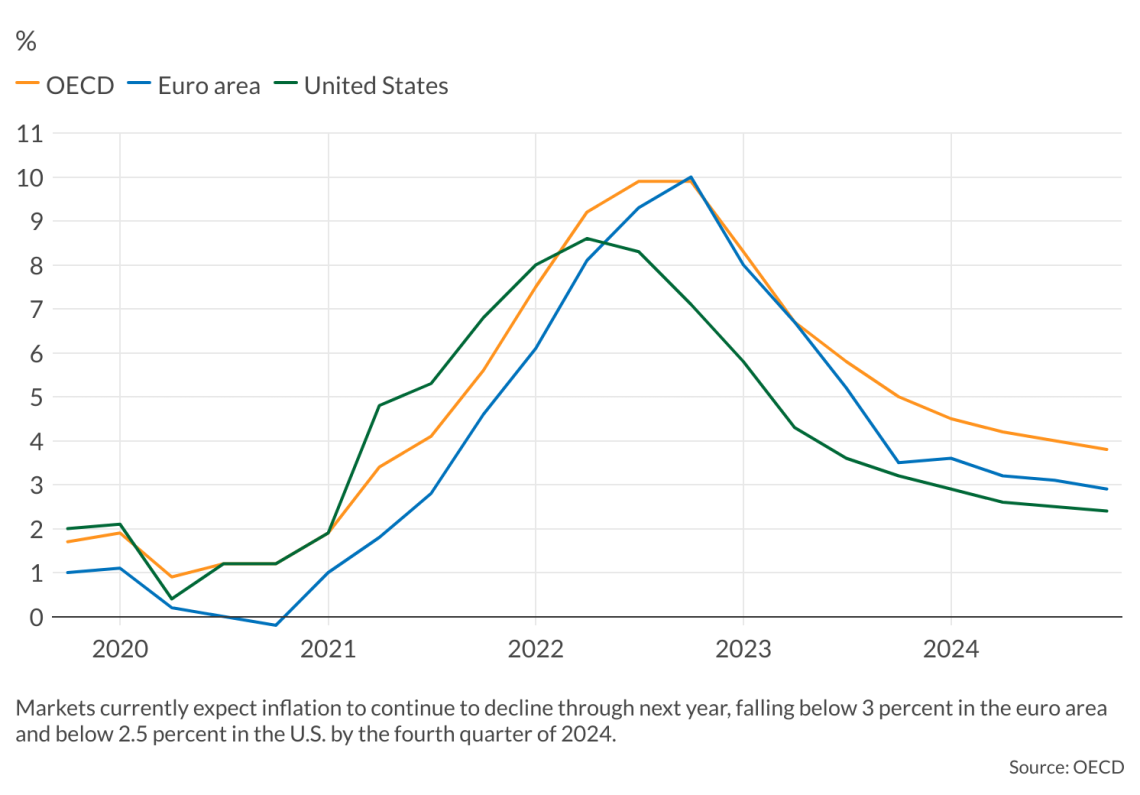
inflation forecast
×
scenarios
With these simple mechanisms, one can now explore where current and upcoming news could take us. Depending on the nature of the possible shocks, different scenarios can occur. Two of them are considered in this report.
Baseline and core inflation were 3 percent and 4.8 percent in the US (June 2023) and 5.3 percent and 5.5 percent in the eurozone (July 2023). In early July, markets expected a slow decline in inflation rates in both zones. But while the Federal Reserve believes inflation is now more or less under control, the European Central Bank (ECB) appears to be maintaining a more aggressive stance. Markets now expect inflation rates in the US and euro area to fall to around 3 to 3.5 percent by the end of this year and to less than 3 percent by the end of 2024. They could reach 2 percent in 2025, possibly later.
If prices fall as expected, governments’ ability to sustain public debt will depend on real growth and fiscal discipline – which in turn will affect financial markets accordingly. On this point in particular, markets are currently anticipating that government spending will remain high in Europe (it reached 50% of GDP in 2022) and likely to increase in the US (from 37% of GDP in 2022).
In 2023 and 2024, therefore, the sovereign debt burden is expected to stabilize in the euro area and continue to rise in the US. If these expectations materialize in this first scenario, financial markets will remain broadly stable. Stock markets can show some volatility but no clear trend.
Of course, investors’ willingness to hold euro-denominated bonds with very low real yields will play a crucial role. Problems could arise as soon as the inflation rate approaches the 2 percent mark. The inflation tax would then be low enough to allow more investors to switch from bonds (and government bonds) to equities or to increase their liquidity. ECB President Christine Lagarde and national governments would then be forced to beg (or “encourage”) commercial banks to convert that liquidity into government bonds, whatever public finance conditions dictated. For Fed Chair Jerome Powell, the outlook could be even more difficult.
In other words, as inflation falls, so does the inflation tax – and the new problem could be tight liquidity and fewer government bond buyers. How will central bankers react? Do they have a plan or will they present this as another “temporary” problem that no one saw coming?
A different scenario could occur if growth picks up significantly. This could be the case if international tensions ease or regulatory pressure to tackle climate change eases. Global growth could benefit from increased trade flows, lower taxation and less repressive regulation. Equity markets would of course rejoice (at least in the short term), but central bankers and sovereign debt managers would also feel relieved – the crucial dynamic for understanding the medium-term implications.
In this scenario, debt-to-GDP ratios could stabilize, even if interest rates are well above those of the last 15 years, and could lead to a pause in rate manipulation, at least for a while. This would be good news for the economy in general and potential bondholders in particular. However, equity markets dependent on negative or low real interest rates would be disappointed and a long overdue cleanup would take place. Good stocks would be rewarded, overleveraged companies would be in deep trouble, and anyone who had bought long-dated bonds in the past would be flogged.

Sign up for our newsletter
Get insights from our experts in your inbox every week.
Comments are closed.