


It’s the time of year when the traditional seasonal upleg for US stocks known as the “Santa Claus rally” usually occurs. But unlike the past holiday season, this season could be overwhelmed by the risks of a recession and a continued rise in interest rates into the new year.
The Santa Claus rally refers to the tendency of the stock market to rally over the last five trading sessions of a calendar year and the first two sessions of the next year. Friday marked the beginning of the period, which this time will last until January 4th. Analysts said investors should not expect stock markets to rise this holiday season, although some market participants are still optimistic.
History underscores how optimistic this final part of the year usually is and how relatively unusual it is for stock markets to fall before and after Christmas. 72 years of data on the S&P 500 SPX and its predecessor, the S&P 90, shows that only 15 to 16 public holidays have failed to produce a rally. According to Dow Jones Market Data, seven of those seasons were followed by losses in the index in the first quarter.
Read: Year-end rally? Bullish stock market pattern will collide with stagflation fears
Any Santa Claus rally to close out the 2022-2023 season “will be very short-lived by its very nature, and we will give back those gains quickly because there simply will not be a sustained rally if the Federal Reserve keeps interest rates high. said Eric Sterner, chief investment officer at Apollon Wealth Management, which manages $3.1 billion of Mount Pleasant, SC
“It’s probably going to take all of 2023 for inflation to come down, and beyond that we need to make big earnings revisions,” Sterner said over the phone. He said earnings per share could fall 15% to 20% on average from currently estimated gains of 4% to 5% for next year and that the S&P 500 hit its October low of around 3,500 in the first half retesting earlier in 2023 could end the year flat.
Stocks have suffered in 2022, with the S&P 500, Nasdaq and Russell 2000 all posting double-digit percentages falls as the Federal Reserve continued to raise interest rates to halt inflation at four-decade highs. Dow Industrials has fared better but is still down 8.6% year-to-date through Friday.
Read: Wall Street stock market predictions for 2022 were the most off since 2008: will next year be any different?
When stock market gains failed to materialize over the holiday season, the S&P 500 averaged a gain of just 0.53% for the first quarter thereafter, according to Dow Jones Market Data. That’s in contrast to most periods of gains around the holiday season, with the index posting an average gain of 2.49% in the first quarter thereafter.
This year “is certainly a good candidate for a Santa Claus rally given how bad the sell-off has been this year, but that doesn’t mean you’re going to have a good year on average,” said Eric Diton, who runs Boca Raton , President and CEO of Florida-based The Wealth Alliance, which has $1.5 billion in assets under management and brokerage. “The greater correlation is the January indicator, where if January is positive, you have a higher probability of having a positive year.”
“If corporate earnings can hold up after this massive Fed tightening and pretty big money supply reduction, the stock market should have a pretty good year,” he said over the phone. “If the revenue is gone, we have another leg in the red. My gut feeling is that we could have a mild recession, but I’m pretty optimistic for the second half of 2023: the Fed should be done raising rates and easing the market by then.”
The Dow Jones Industrial Average DJIA, +0.53%, and the S&P 500 Index have each traded nearly 80% higher during the seven-day holiday season since 1950, gaining an average of 1.38% and 1.32%, respectively, according to Dow Jones Market data . The Nasdaq Composite COMP, +0.21%, has traded higher 78% of the time since 1971 for an average gain of 1.81%, while the Russell 2000 RUT, +0.39%, is up 71% since 1987 has increased over time and is up 1.5% on average.
Source: Dow Jones market data
If Dow Industrials and the S&P 500 finish the 2022-2023 season higher, it would be their seventh consecutive successful Santa Claus rally and their longest winning streak since the eighth series, which occurred between 1969-1970 and 1976-1977.
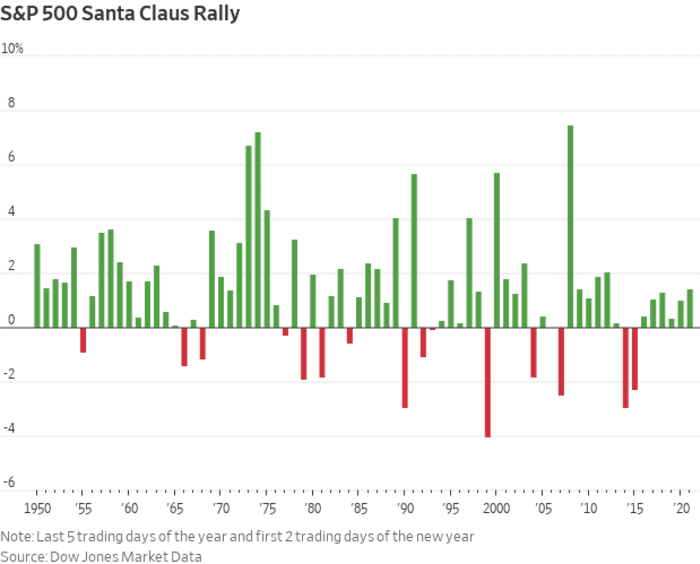
Source: Dow Jones market data
Data from FactSet shows analysts remain relatively bullish on the direction for US stocks in 2023: On Wednesday, their median estimate of where the S&P 500 would be in 6 to 12 months was 4,517.29 – down from Friday’s close 3,845. For the Nasdaq Composite, their median estimate was 13,577.30 versus Friday’s close of 10,497.86.
Read: Wall Street stock market predictions for 2022 were the most off since 2008: will next year be any different?
Given the lack of major market-moving news into the year-end, “conditions are now definitely ripe for a rally that could coincide with what we typically see at this time of year,” said Keith Buchanan, senior portfolio manager at GLOBALT Investments in Atlanta $2.5 billion under management. “With the risks of a recession looming, sentiment is quite down and there is pessimism in the markets. When that’s the case, there can usually be some sort of ricochet.”
GLOBALT remains somewhat conservative in its positions while awaiting opportunities to shift to a more aggressive stance, Buchanan said over the phone. Meanwhile, market participants await what he calls a “blue sky” scenario, in which inflation continues to ease in 2023 and the Fed plans a soft landing by slowing the economy without putting millions of people out of work.
“The absence of a Santa Claus rally would set the tone in early 2023 for a market that needs some, or even optimism, to recover in the face of what many economists see coming: a recession,” he said. Alternatively, a Santa Claus rally that materializes “won’t necessarily mean 2023 will be a year of recovery, but could support the rest of January.”
See also: After the 2022 sell-off, is a stock market recovery imminent in 2023? What history says about consecutive losing years.
The economic calendar is bright in the holiday-shortened week that lies ahead. The stock exchange is closed on the Monday for Christmas which falls on Sunday and is closed again on January 2 to celebrate the New Year holiday.
November goods data is due Tuesday, along with the S&P Case-Shiller US home price index for October and the FHFA US home price index.
Wednesday brings the pending home sales index for November. Weekly initial jobless claims will be released on Thursday, followed the next day by December’s Chicago Purchasing Managers’ Index.
Comments are closed.