


Inflation continued to run hot in May and rising price pressures hit consumers again where it hurts: at the pump and in the grocery store.
While overall inflationary pressures are still likely to cool off in the second half of 2022, rising gas and food prices remain a key reason inflation remains at 40-year highs for now. The latest data suggests that the US Federal Reserve will have to remain on frequent and sharp hikes in the coming months, if not more aggressively than expected.
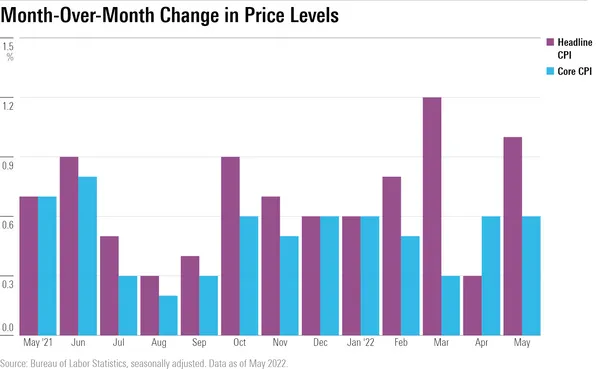
The Bureau of Labor Statistics reported that the consumer price index rose 1.0% in May from April, a sharp acceleration from April’s 0.3% rise and a larger increase than economists had predicted. On an annual basis, the CPI rose 8.6%, the biggest 12-month rise since December 1981. May’s rise was broad-based, the BLS said, with housing, gasoline and food indices the biggest drivers.
Even excluding food and energy prices, which tend to be volatile on a monthly basis, the rest of the index rose more than expected in May. The so-called “core CPI” rose by 0.6% in May, the same increase as in April.
“While inflation continues to be fueled by temporary issues like the Ukraine war, aggressive tightening by the Fed will likely be needed to ensure high inflation does not seep into the economy,” said Preston Caldwell, Morningstar’s chief US economist.
“We still assume that the main causes of the high inflation are since the beginning of the pandemic—energy, food and cars—will eventually reverse in its effect,” he says. For example, Morningstar expects oil prices to fall from their current level of around $120 a barrel to $55 a barrel by 2025 as oil producers adjust to offset the loss in Russian supply. “Supply for vehicles and other goods should also ease and help cool the high prices,” he says.
“The main issue is the timing, which is highly uncertain,” says Caldwell. “If these supply problems take too long to resolve, inflationary dynamics could become entrenched in the economy. At the moment we don’t see any major signs of this; For example, wage growth has slowed in recent months.”
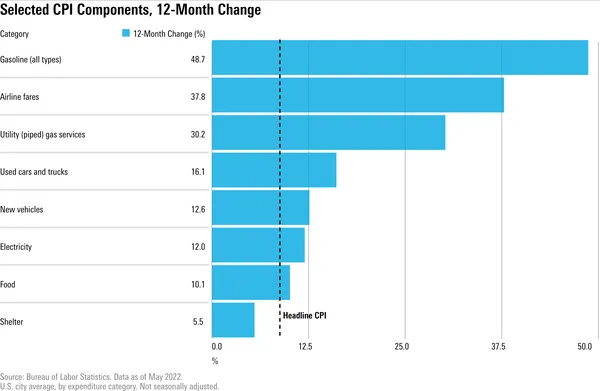
Across the spectrum of consumer energy costs, annual price increases have been significant. Gasoline prices rose 48.7% since May 2021, natural gas posted its largest increase since October 2005, jumping 8.0%, electricity rose 12.0%, its largest increase in August 2006, and heating oil prices have followed suit a 106.7% increase, more than doubling the largest increase since the government began keeping track of it in 1935.
Food prices rose 1.2% in May from April and 11.9% from a year earlier, the largest 12-month rise since the period ended April 1979. All six major food group growth indices rose in the month and the index Eating out saw a 7.4% year-on-year increase, the largest increase since November 1981.
“The biggest factor behind the rapid pace of inflation in May was the ongoing impact of the war in Ukraine, which pushed up food and energy prices,” Caldwell says. “The direct impact on consumer food and energy costs caused the wedge between headline and core inflation. But there has also been an indirect impact on core inflation, where energy is used as an input. Notably, air travel prices rose 13% month-on-month, largely due to higher fuel costs. Prices of all types of goods are affected by higher trucking costs through higher fuel costs.”

Caldwell notes that factors other than volatility from higher gas and food prices played a role in May’s big CPI jump. “We also saw vehicle prices rise by 0.9%, suggesting that solving supply chain issues is not yet bringing relief from high prices,” he says. “Emergency shelter prices rose 0.6%, slightly above the pre-pandemic average of 0.3%.”
Taken together, the May CPI report highlights the difficulties consumers are facing, particularly when looking at income on a “real” basis – adjusted for inflation. “As wage growth has slowed amid persistently high inflation, consumers are now being squeezed by falling real wages,” says Caldwell. “Personal income data shows that consumers have compensated for this in the short term by diving into savings that have been boosted sharply during the pandemic. This momentum cannot last forever and we expect real wages to improve as high energy and food prices ease.”
For the Fed, financial markets are interpreting CPI to suggest that the central bank needs to be even more aggressive in raising interest rates, if at all. In the bond futures markets, expectations are mounting that the Fed will raise the federal funds rate from the current 0.75% to over 3% by the end of the year.

Fed policymakers meet on June 14th and 15th. Markets had expected the Fed to hike interest rates by half a percentage point at both the June and July meetings. “At next week’s FOMC meeting, we could see the Fed take a more aggressive approach, raising the federal funds rate by 0.75% instead of the planned 0.5%,” Caldwell says.
Comments are closed.