


The wise risk their money for innovative products and build market knowledge. The charlatans take advantage of the inevitable unknowns of cryptos. The case of FTX shows it all.
Sam Bankman-Fried (C), founder and CEO of FTX, photographed after the top US derivatives oversight committee, the Senate Committee on Agriculture, Food and Forestry, invited him to testify in February 2022. © Getty Images×
In short
- All true inventions are poorly understood at first, and investors make mistakes
- Cryptocurrencies are at the forefront of financial innovation
- The collapse of FTX is not a judgment on the usefulness and future of crypto
In November 2022, the FTX cryptocurrency derivatives exchange, commonly known as FTX, filed for Chapter 11 bankruptcy. Founded in 2019, the company soon became the third largest cryptocurrency exchange in the world. FTX was also notable for running a cryptocurrency hedge fund and actively seeking a high public profile, such as sponsoring racing car teams and making donations to political candidates in the United States. Typically, exchanges aim for a much lower profile. And they distinguish between transaction facilitation and investment vehicles.
In mid-2022, reports of FTX started leaking into the market. They claimed the exchange may have sponsored many financial research reports about itself. Alameda, the primary market maker for FTX, has been instrumental in the exchange and its products – for example, by being the most significant known depositor of stablecoins on FTX. Additionally, reports claimed that FTX’s data on its performance, transparency and transactions was unreliable.
Unpleasant discoveries
Other irregularities came to light. For example, FTX appears to have systematically used the environmental, social and governance (ESG) framework to prey on inexperienced investors. The company also made false and misleading claims that its deposits were covered by the Federal Deposit Insurance Corporation (FDIC).
What followed is well known. Investors took their capital and dumped FTX, which spread throughout the crypto sector. Sam Bankman-Fried, the founder of FTX, is under house arrest. The valuation of crypto assets fell even if they were not involved in FTX. Predictably, policymakers and other actors in the financial sector began to call for government intervention.
The media presented the collapse of FTX as a case in point for all alleged problems in the crypto sector. For some, the mere idea of generating private money from an algorithm is a scam. For others, the lack of regulation in the crypto sector is the problem. Without regulation, critics suspect, there would be neither transparency nor investor and consumer protection. And yet these criticisms are wrong.
Innovation is new by definition
The value of anything derives from its relative scarcity and how it is traded between interested individuals, and it constitutes no intrinsic mystical quality. Cryptocurrencies can be as valuable as Pokemon Go, a loaf of bread, or a handful of rubies depending on how much people are willing to pay. This also applies to money. Most of today’s currencies are fiat money. They lack intrinsic value, hence the Latin word fiat, meaning believe.
Read more about technology and business
The more important point raised in the media following the collapse of FTX has to do with regulation and transparency. Here’s the clue: many of FTX’s products were already regulated. And most of the irregularities that led to the collapse in late 2022 were widely and transparently known when the company was founded. Research firm Alameda, for example, was co-founded by FTX’s Sam Bankman-Fried. He also personally pushed for regulation by supporting the proposed Digital Commodities Consumer Protection Act (DCCPA) in the US Congress.
What disappeared from public discourse was a completely different phenomenon. Cryptocurrencies are still a new idea and their financial sector and products are driven by innovation. Novelty and emerging sectors attract special groups of people: wise ones who invest, innovate and take risks, and charlatans who see only an opportunity for personal gain.
Learning by doing
In every sector of the economy, innovation is, by definition, poorly understood. Since it is new, market participants have yet to figure out what it is, how to use it, what results to expect, and the risks involved. As these market participants increasingly experiment with the innovation, they find themselves on a learning curve and their results become more public knowledge. Transparency increases the more an innovative product is used on the market.
×
facts
Volatile Cryptos
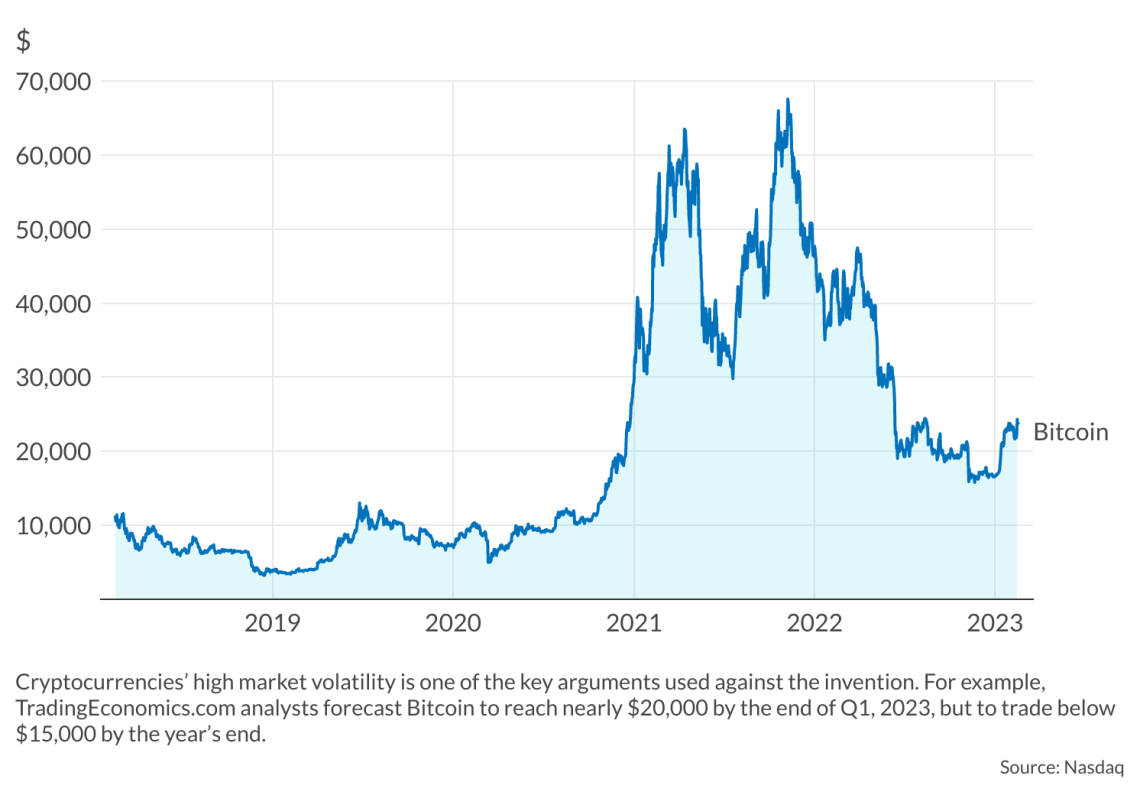
It often takes a long time for the innovation’s value proposition to be sufficiently understood, and it can take even longer for the market to learn to use it. There are bumps on this road. Think of electricity, for example: it took around 100 years for it to be understood as an economic good, and at least as long for it to be used as a value driver.
The same applies to financial innovations. When structured products and hedge funds emerged, few “quants” (qualitative analysts) fully understood them. Market participants learned how to use them step by step. These products also went through phases of spectacular appearances, gigantic slumps, consolidations and repositioning. However, the longer they went through them, the better they became understood. Also, the learning curve was crucial in identifying the scammers trying to exploit the innovation’s initial lack of transparency.
Innovations like crypto are difficult to leverage as their properties are inherently opaque. Equally unpredictable is the process of takeover by market participants. This fuzziness makes innovation interesting for investors and risk-takers. But it also attracts rip-off artists who have figured out how to ride along. On the fringes of innovation, patterns of market behavior are still forming. As a result, many of the usual ripoffs and pointers to weed out the scammers are still missing or don’t work well – a fact well known to the pretenders.
Choose to ignore warnings
Nevertheless, even in the innovative environment, telltale signals can be discerned as to whether a business proposal is part of the creative scope or is just a fake. Interestingly, most of the red flags were for FTX — and regulators, professionals, and casual investors continued to ignore them.
The most notable red flag was the institutional merging of FTX and Alameda Research. It is an established practice in the financial markets to separate proprietary research from market making and product implementation. And proprietary research itself must be conducted independently. The FTX blatantly violated this rule.
Additionally, an exchange that launches its own hedge funds should have sounded some alarms. Another well-established practice in financial markets is that infrastructure providers such as exchanges should not sell financial instruments embedded in their infrastructure.
Mr Bankman-Fried himself should have thrown out some of the usual warnings. An entrepreneur is innovative and spends his money on people who develop products and applications. Spending it on lobbying is suspect at an early stage of company development. Whenever a business owner enters the regulatory business, they aim to redistribute benefits to themselves and not create them – which is contrary to innovation. The FTX founder’s entanglements with politics and drive for regulation should have been enough to call his entrepreneurial spirit into question.
These warnings are not specific to the financial sector. They apply to all investments and economic activities. They relate to governance, the product and the people behind a business model. Also note that all of these aspects were transparent prior to the collapse of FTX and no regulation could have made them more transparent. In this case, people just wanted to follow Mr. Bankman-Fried.
×
scenarios
What scenarios follow for the crypto sector after the fall of FTX? Here are the leading choices.
Organic development and market growth
In the most likely scenario, cryptocurrencies will continue to grow as a market and in scope. However, this is accompanied by a twofold consolidation. First, the infrastructure of the market, the exchanges, will consolidate. Second, the cryptotypes used are reduced. These guys make up the short head while the others end up somewhere in the long tail.
Strong candidates for the short head are cryptos with well-established rules and transparent transactions – like bitcoin – or those that work on or as the enabling technology for other applications like ether. In this scenario, increased regulation, higher operating costs and government co-option (at least of the infrastructure) are likely. On the other hand, the learning curve of the market, increased transparency and product differentiation will allow cryptos to be mainstreamed.
The best-case scenario is similar to the most likely one, but occurs much more quickly and without (major) government intervention. In the most likely case, it will take the market another decade to make its learning curve, and in the best-case scenario it can do so in the next five years. As the crypto sector consolidates, the exponential growth of information is slowing, allowing for more transparency and the establishment of recognizable patterns in crypto markets and products.
Two drivers ensure the speed in this scenario. The first is innovation in the crypto sector itself. Entrepreneurs remain interested in innovation, especially in streamlining their products, which increases their quality. The second is the lack of regulation and state cooptation, which allows innovation, information and risk-adequate behavior to be synchronized with less friction. The probability of this scenario is medium-low.
The Decline of Cryptocurrencies
The worst-case scenario is the complete extinction of the crypto sector. On the one hand, investors and innovators might be disappointed and decide that the potential for cryptocurrency applications is limited. When this is the case, cryptos don’t make up for the higher risk, making them unattractive. On the other hand, governments can either ban cryptos or regulate the sector in a way that drives up costs and drives investors out of the market. In this scenario, the crypto market shrinks, leaving a niche application on the fringes of the markets. The likelihood of this scenario is low as there is strong buy-in sentiment in the crypto sector. While FTX’s decline gripped the market, there was a rebound afterwards. Additionally, the pace of innovation in this sector appears to be independent of FTX.
The meteoric rise and collapse of FTX comes as no surprise. The crypto sector is at the forefront of financial market innovation. It attracts sages and charlatans alike. The wise are the entrepreneurs who invest their money, take risks and try to learn from the market. The charlatans play with the opacity of the new market and channel money into their pockets. As the market evolves, innovation calms down, increasing transparency and allowing market participants to catch up on the learning curve. The more freely they can do this, the faster the invention enters the mainstream and becomes more stable and accessible.
Comments are closed.